
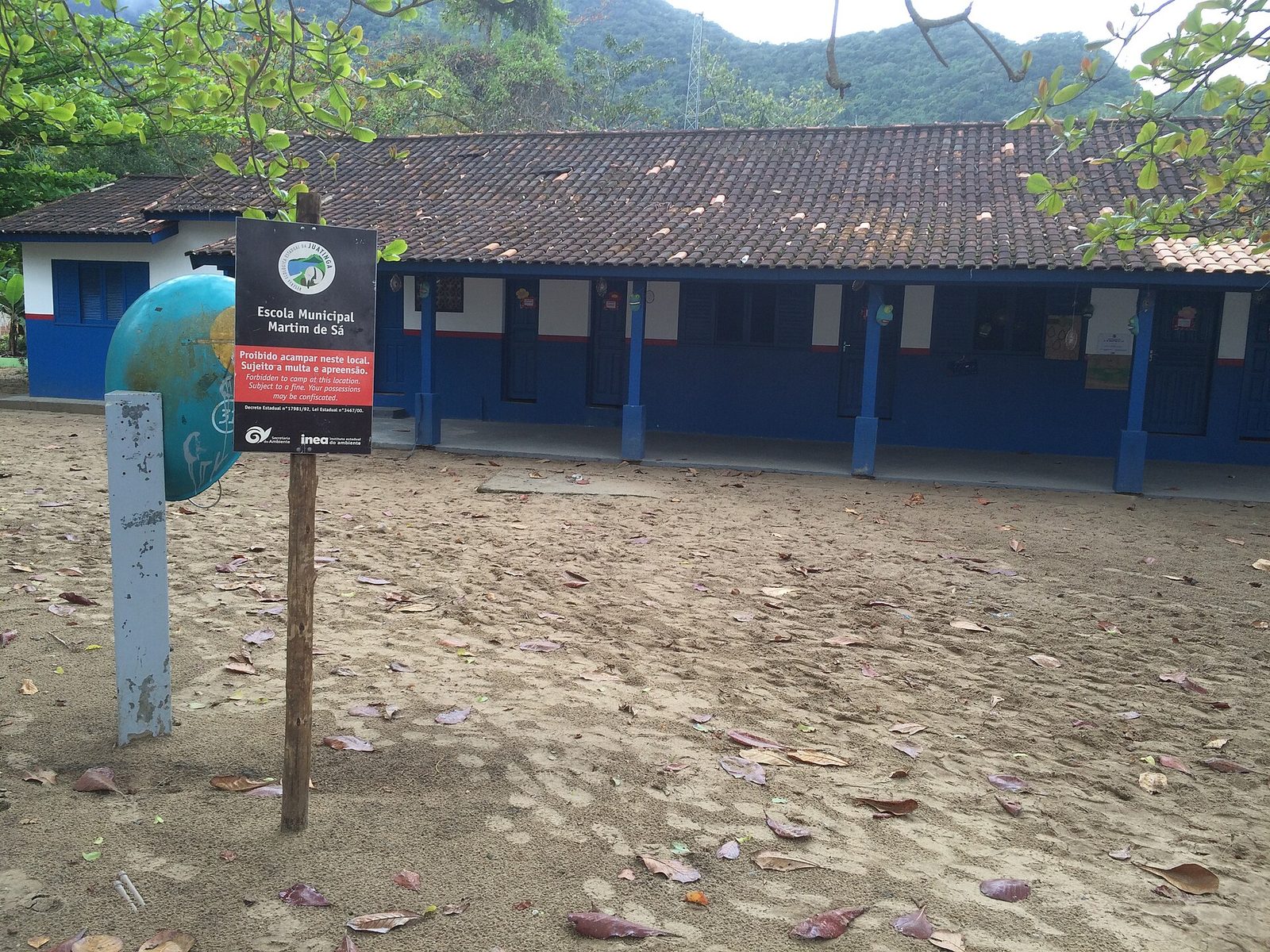
South of Paraty the coast road gives out. The Rio-Santos highway runs on inland, and the little roads that drop from it toward the sea grow shorter and rougher until, past the last of them at Laranjeiras, there is simply no road left at all. Beyond that point the shore belongs to the walkers and the boatmen. The beaches strung along it — Praia do Sono first, then Praia dos Antigos and Praia dos Antiguinhos, and, further out, the fishing hamlet of Ponta Negra — have no cars, no car parks, and no way in but a forest trail over a headland or a small boat across the bay. They are some of the wildest and best-loved beaches on the whole Costa Verde, and you earn every one of them on foot.
The appeal is exactly the difficulty. Because you cannot drive to them, these beaches stayed simple while much of the Brazilian coast filled with traffic and building. There are no resorts here and no beachfront bars pumping music, only a broad crescent of sand, a caiçara village or two, a scatter of campsites and small pousadas, and the forest coming straight down to the tideline. The walk in filters out the day-tripping crowd and the coolers-on-wheels, and what waits on the far side is quieter, plainer, and wilder for it. This is barefoot, self-sufficient, low-key coast, the kind that most of the country paved over long ago.
This guide covers where the trek-in beaches are and why there is no road to them; how to reach the trailhead at Laranjeiras; the walk over the headland to Praia do Sono and what the beach and its village are like; the steeper trails on to Antigos and Antiguinhos; the remote hamlet of Ponta Negra; whether to day-trip from the reserve, camp on the sand, or take a room in a pousada; what to carry into a place with no shops and no cash machine; and how to walk this protected, lived-in coast safely and lightly, with honest words about the heat, the footing, the tides, and the crowds at New Year.
- Where
- wild, car-free beaches on the coast south of Paraty, on the Juatinga peninsula, Rio de Janeiro state
- Protected
- inside the Área de Proteção Ambiental do Cairuçu, on a coast that runs on into the Juatinga reserve
- Getting there
- drive to the Laranjeiras area off the Rio-Santos highway (BR-101), then continue on foot or by a short boat
- The walk to Sono
- a forest trail over a headland, roughly an hour, uneven and steep in places
- The beaches
- Praia do Sono, then wilder Praia dos Antigos and Praia dos Antiguinhos, each quieter than the last
- Deeper still
- Ponta Negra, a remote caiçara fishing hamlet, more often reached by boat
- No services
- no shops, banks, or ATMs, only simple kiosks and pousadas, often cash-only, with little or no phone signal
- Crowds
- swimmable most of the year but packed at New Year, Carnival, and the summer holidays, so come early and off-peak
Where the wild beaches are, and why the road ends
These beaches lie on the southern arm of the Paraty coast, out along the Juatinga peninsula — the long, mountainous spur of land that reaches into the Atlantic below the town, where the Serra do Mar comes down to meet the sea with almost nothing built in between. It is one of the last large stretches of the southeastern Brazilian coast to have stayed roadless and largely wild, a place of steep forested slopes, hidden coves, and small caiçara settlements linked by boat and trail rather than by road. Praia do Sono sits at the near end of it, the first of the walk-in beaches; beyond it the coast grows wilder with every headland, running out toward the tip of the peninsula and the open ocean.
The Juatinga peninsula
The Juatinga peninsula is the wild heart of this coast, and understanding it explains everything about the beaches. It is a broad, mountainous finger of the Serra do Mar, cloaked in Atlantic Forest, with a deeply indented shore of bays, points, and pocket beaches. No road crosses it. The people who have always lived here — caiçara families who fish, grow cassava and banana on forest clearings, and gather from the sea — reach their homes on foot along old trails or by canoe and boat, exactly as they have for generations. For the visitor, that means the peninsula is walking and boating country, not driving country, and the beaches along it keep the character that roadlessness gives them: quiet, simple, and hard-won.
Inside the Cairuçu protected area
All of this coast lies within the Área de Proteção Ambiental do Cairuçu, the federal environmental protection area created in the early 1980s to safeguard this stretch of shore, its forests, and the traditional communities living on it, and parts of it fall within the state's Juatinga reserve as well. That protected status is the reason the peninsula still looks the way it does. Building is tightly limited, the forest is guarded, and the caiçara communities have a recognized place within the protected area. It is the same conservation logic that keeps the mountains above the seven waterfalls intact at the reserve: protect the land and the water first, and the beauty takes care of itself.
Why the lack of a road is the point
It would be easy to read "no road" as a problem waiting to be solved. It is the opposite. The absence of a road is precisely what has kept these beaches wild, and it is why people who know this coast well will happily walk an hour with a pack to reach sand they could never drive to. A road would bring cars, then car parks, then kiosks and crowds and all the rest, and the quiet that is the whole appeal would be gone within a season. Walk in, and you arrive on a beach that works more or less as it has for a long time. The effort is not an obstacle standing in the way of the reward; the effort is what protects the reward.
The only road to these beaches is a footpath, and that single fact is why they are still quiet.
Getting to the trailhead at Laranjeiras
Every trip to these beaches begins the same way: you get yourself to Laranjeiras, the small area at the end of the road south of Paraty that serves as the gateway to the whole peninsula. From there you either walk or take a short boat, but Laranjeiras is where the driving stops and the trek-in coast begins. It is the same jumping-off point used by walkers and boats heading for the Saco do Mamanguá on the other side of the peninsula; our guide to the Saco do Mamanguá fjord covers that side of the same wild country.
The drive south of Paraty
Laranjeiras lies south of Paraty, reached by turning off the Rio-Santos highway, the BR-101, onto a side road that runs down toward the coast. From the town it is a straightforward drive of well under an hour along the coast, and from the reserve up in the mountains it means first coming down to Paraty and then continuing south, so a day on these beaches is a proper outing rather than a quick hop. Give yourself the drive at each end and plan to arrive early, both to make the most of the day and because the small parking areas near the trailhead fill up on busy mornings. Our getting there guide covers the mountain road down from the reserve and how transfers work.
By car, van, or taxi
You can reach Laranjeiras by car, by the local vans that run down from Paraty, or by taxi. If you are driving yourself, be ready to park at one of the modest lots near the trailhead and pay a local fee, then shoulder your bag and walk; you cannot drive any closer to Praia do Sono than this. The vans are the simplest option for many visitors, dropping you near the start of the trail so you need not worry about parking at all. Whichever way you come, treat Laranjeiras as the end of the wheeled part of your journey and the start of the walk, and pack accordingly, with everything you will need for the day carried on your back.
The short boat across
There is a gentler alternative to the walk, and on some days it is the better one: a short boat trip. From the Laranjeiras area, local boatmen run water taxis around the headland to Praia do Sono, and boats also serve the beaches further along the coast that are harder to reach on foot. A boat is worth knowing about for several reasons — it saves the climb over the headland if you are carrying a heavy pack, camping gear, or small children; it is the sensible choice if the trail is very wet and slick; and it opens up the beaches beyond Sono without a long trek. Many people walk in and take a boat back, or the reverse, to get both experiences in a single day. Arrange boats on the spot at Laranjeiras or through wherever you are staying on the beach.
The walk in to Praia do Sono
The walk from Laranjeiras to Praia do Sono is the classic approach, and for most people it is part of the pleasure rather than a chore to be got through. It is a forest trail that climbs over a headland separating the Laranjeiras side from the beach, and it delivers you, after roughly an hour on foot, onto the broad sweep of Praia do Sono with the satisfying sense of having arrived somewhere you had to work for.
Over the forested headland
From the trailhead the path climbs away from Laranjeiras and up over the morro, the forested hill that stands between you and the beach. It is a well-trodden trail, used daily by residents, campers, and day walkers, so it is easy to follow, but it is a real trail and not a promenade: it rises and falls, it is uneven underfoot, and it runs over roots, rock, and packed earth that turns to mud after rain. The climb up and over the headland is the main effort of the day; once you crest it, the path drops down through the trees toward the sea and the sound of surf, and the first sight of the beach opening below you through the forest is the reward for the sweat of the ascent.
How long, and how hard
Reckon on about an hour of walking, give or take, depending on your pace and how heavy your pack is. It is not a long walk, but it is not a flat one either, and in the tropical heat and humidity it can feel like more than the distance suggests, especially carrying camping gear or a cooler. Anyone reasonably fit will manage it comfortably in good shoes, and children used to walking do it happily enough, but it is worth being honest that it is an uphill-then-downhill forest hike rather than a stroll along the sand. Take it steadily, drink as you go, and do not plan to rush it. If the walk sounds like too much with young children or a lot of gear, the boat from Laranjeiras is the easy answer; our guide to visiting with family and kids has more on which of the region's outings suit small legs.
The forest you pass through
The trail is a walk through Atlantic Forest, the same great coastal forest that clothes the mountains at the reserve, and it is worth slowing down for. You pass under a high green canopy, through the calls of birds and, in the early morning, the roar of howler monkeys carrying across the valley; you cross small streams; you feel the shift in the air as you climb and then the first salt tang as you come down toward the sea. It is a short immersion in one of the richest forests on earth, bracketing your beach day with green on the way in and the way out. Keep to the trail, both to protect what grows on either side of it and to keep your own footing, and let the walk be part of the outing rather than merely the price of it.
Praia do Sono itself
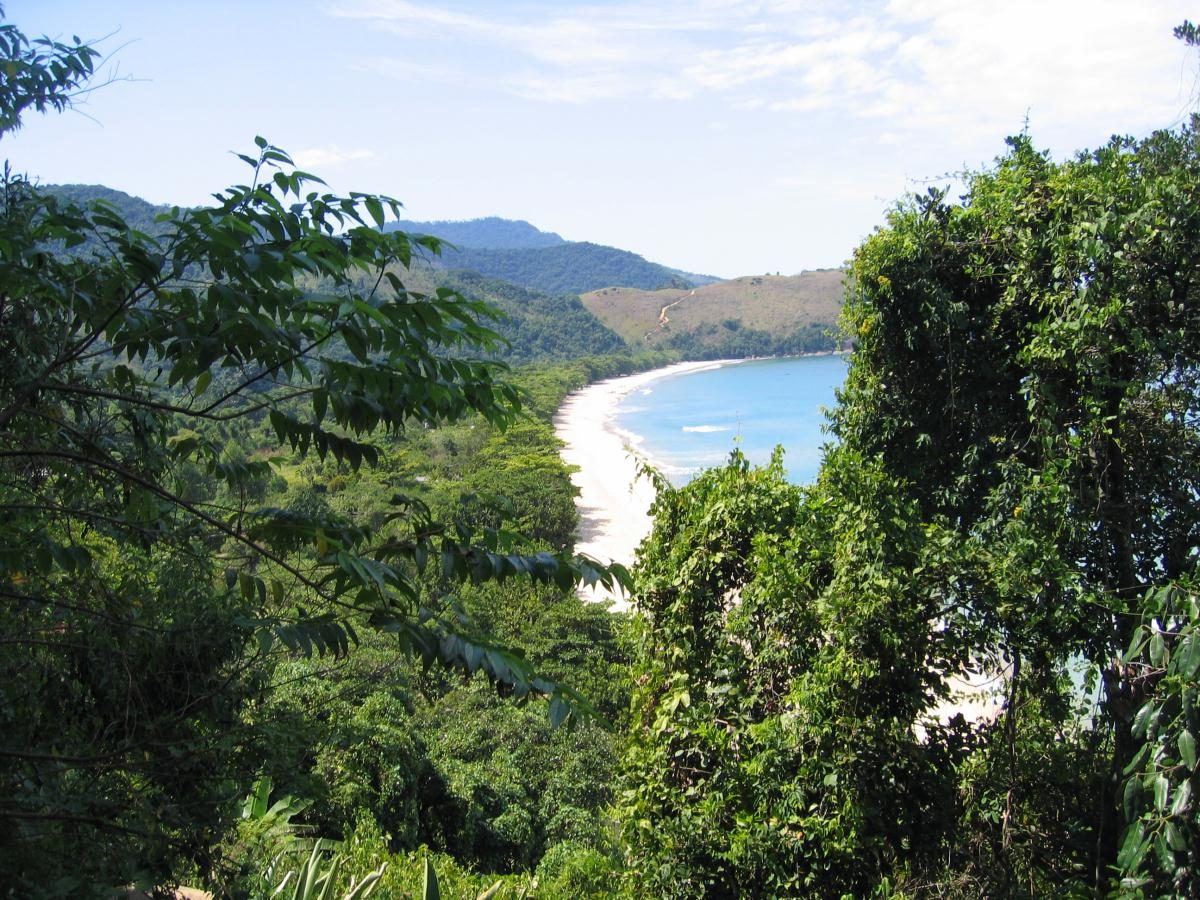
Come down off the headland and Praia do Sono opens in front of you: a long, broad crescent of pale sand, backed by forest and a scatter of low buildings, curving around a sheltered bay with green headlands closing off each end. It is the largest and most developed — a relative word here — of the walk-in beaches, and for good reason it is the one most people come to see. The name means "the beach of sleep," and it has the drowsy, unhurried feel to match.
The beach and the bay
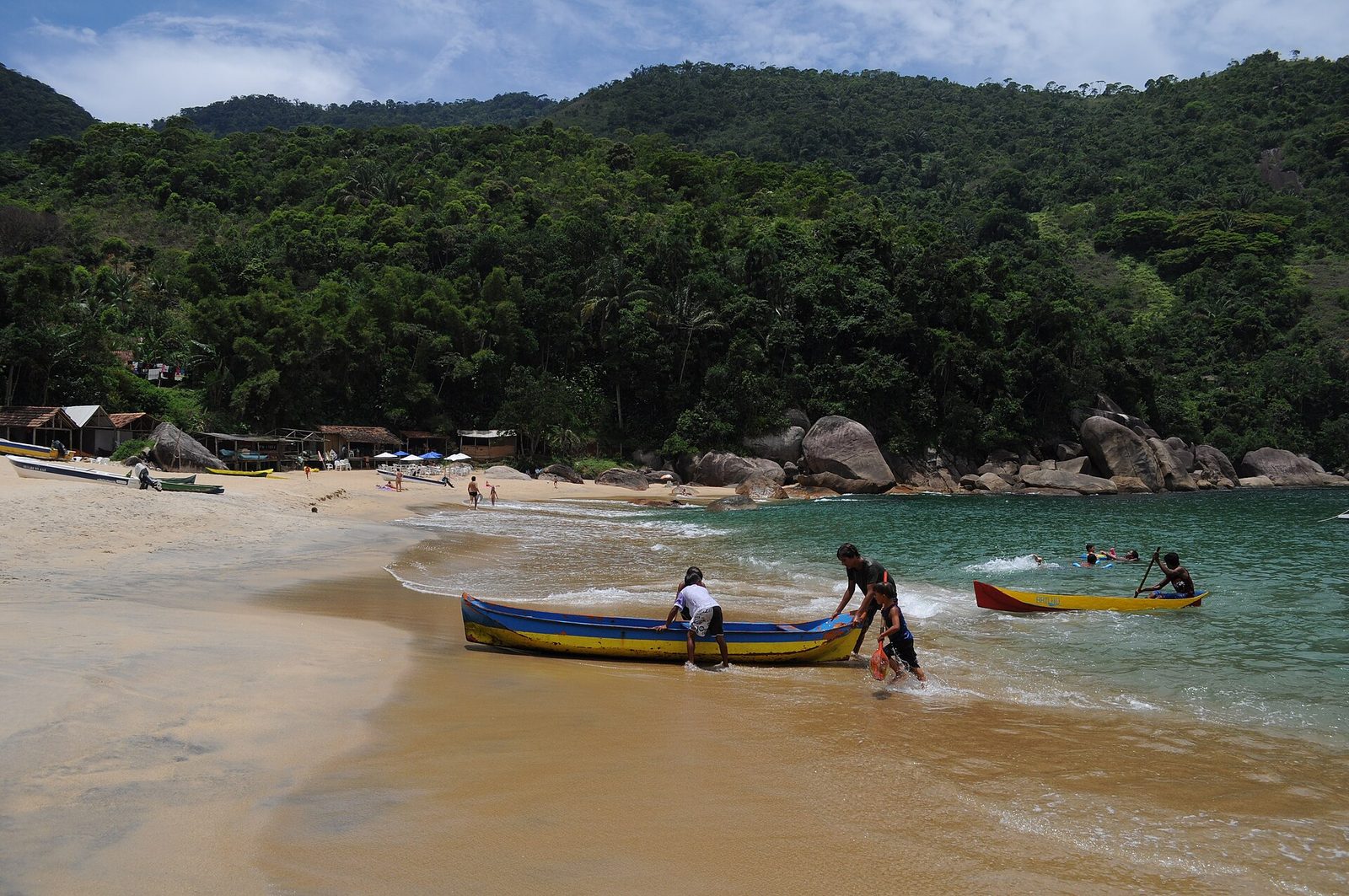
The beach is a generous one, wide enough to absorb a crowd and long enough to walk off along, with sand that runs down to water usually calmer than the open ocean beaches thanks to the sheltering arms of the bay. On a settled day it is fine, gentle swimming, though like all this coast it deserves respect when the sea is up. Fishing boats lie at anchor or drawn up on the sand, streams run down off the forest and across the beach to the sea, and the green wall of the Serra rises straight up behind. It is a classic caiçara beach: working and lived-in at one end, wild and quiet at the other, and beautiful along its whole length.
The caiçara village
Behind the sand at Praia do Sono is a small caiçara community, one of the traditional fishing and farming settlements of this coast, and it is a living village rather than a tourist stage set. Families here fish, run the campsites and kiosks, cook for visitors, and keep small plots back in the forest, much as their families have for generations. It is their presence, and their long stewardship, that has kept the beach as it is. As a visitor you are a guest in their home, and the beach works best when it is treated that way: buy from local people, ask before photographing anyone or their boats and houses, keep your noise down at night, and remember that behind the holiday feel is a community going about its ordinary life.
Kiosks, camping, and pousadas
Praia do Sono has just enough to make a comfortable day or an easy overnight, and no more. Along the back of the beach are simple barracas and kiosks serving cold drinks, fried fish and shrimp, and plates of the day's catch with rice, beans, and farofa; there are several campgrounds where you can pitch a tent under the trees behind the sand; and there are a handful of small, rustic pousadas and rooms for those who would rather sleep under a roof. What there is not is anything resembling a shop, a bank, or a cash machine, and the kiosks generally take cash only. It is enough to eat and sleep well in a simple way, but you arrive self-sufficient, carrying what you need, rather than expecting to buy it on the beach.
Pushing on to Antigos and Antiguinhos
For many visitors Praia do Sono is the destination, and a fine one. But for those with the legs and the time, the coast beyond it holds two more beaches, each wilder and emptier than the last: Praia dos Antigos and, past it, Praia dos Antiguinhos. Reaching them means more walking on steeper, rougher trails, and that extra effort is exactly what keeps them quiet. It helps to picture the walk-in beaches as a sequence, each one further and wilder than the one before:
- Praia do Sono — the largest and nearest, with a village, kiosks, camping, and pousadas, about an hour's walk from Laranjeiras
- Praia dos Antigos — over the next headland from Sono, wilder and far less built-up, with little in the way of services
- Praia dos Antiguinhos — smaller and quieter still, a steeper walk again, and often empty outside the peak weeks
The trail to Praia dos Antigos
From the far end of Praia do Sono a trail climbs away over the next headland toward Praia dos Antigos. It is shorter than the walk in from Laranjeiras but steeper and rougher in places, a genuine forest path over rock and root with some sharp little climbs, and it rewards the same care and footwear as the main trail. Praia dos Antigos, when you reach it, is a beautiful open beach, wilder and far less built-up than Sono, with fewer people and a rawer feel. There are usually only the most basic services, if any, so you carry your own water and food. It faces the sea more openly than the sheltered bay at Sono, which makes it lovely and also means the surf can be stronger, so read the water before you swim.
On to Antiguinhos
Beyond Antigos, a fainter and steeper trail carries on to Praia dos Antiguinhos, the little Antigos, smaller and wilder still. This is the quietest of the three, a pocket of sand and rock where you may well have the beach to yourself outside the peak weeks, and it has the end-of-the-line feeling that comes with being that bit harder to reach. There is essentially nothing here in the way of services; it is a place to swim, to sit, and to be somewhere genuinely remote for an afternoon, then to turn back the way you came. The trails out here are less trodden and less obvious than the main path, so it is easy to lose the way, and it is worth going with someone who knows the coast or asking directions carefully at Sono before you set off.
The trade of effort for solitude
The pattern along this coast is simple and consistent: the further you walk, the fewer people you meet and the wilder it gets. Praia do Sono has a village and kiosks and a summer crowd; Antigos has a beach and a handful of people; Antiguinhos has sand, rock, forest, and often no one at all. Each step out costs you a steeper climb and takes you further from help, water, and a cold drink, and buys you quiet and wildness in exchange. Decide honestly how far you want to go, keep plenty of daylight and water in hand for the walk back, and do not push on to Antiguinhos late in the day or in doubtful weather. The beaches will still be there next time.
Ponta Negra and the deeper peninsula
Further along the coast, deeper into the Juatinga peninsula, lies Ponta Negra, a remote caiçara fishing community that stands a step beyond the day-hiker's world of Sono, Antigos, and Antiguinhos. It is one of the traditional villages of this shore, a cluster of houses and boats in a bay ringed by forested mountain, with a small church, a school, and a way of life still built around fishing and the sea. For anyone drawn to how this coast actually lives, rather than only to its beaches, Ponta Negra is a window onto it.
Getting to Ponta Negra is more of an undertaking than a beach day at Sono. It is most often reached by boat — a water taxi or tour from Paraty or from the Laranjeiras area — which is the simplest and most common way in, and the way most visitors arrive. It can also be reached on foot, but only by longer and more demanding treks over the peninsula's trails, the kind of walking that belongs to a full day's hike or a multi-day trip with a guide rather than to a casual outing. Beyond Ponta Negra the coast runs on toward the tip of the peninsula and beaches such as Martim de Sá and the point at Juatinga itself, wild country that is proper trekking territory and best done with local guides who know the trails, the tides, and the communities.
However you reach it, Ponta Negra asks the same courtesy as the rest of this coast, and perhaps more, because it is smaller, more remote, and less used to crowds. This is a working village and a home, not an attraction laid on for visitors. Buy fish or a meal from local families, engage a local guide or boatman rather than treating the place as a free spectacle, ask before photographing people and their homes, take all your rubbish away with you, and move through quietly. The reward for visiting respectfully is a glimpse of a way of life that has nearly vanished elsewhere on the Brazilian coast, kept alive here in large part because the peninsula stayed roadless and protected.
Camp, pousada, or day-trip from the reserve
One of the first decisions to make is how to fit these beaches into your trip: a long day out and back, a night under canvas on the sand, or a room in one of the simple pousadas. Each works, and the right choice depends on how much wildness, and how little comfort, you are after.
A day trip from the reserve
For guests staying up in the mountains at the reserve, Praia do Sono makes a rewarding day trip. You drive down to Paraty and on south to Laranjeiras, walk in over the headland or take the boat, spend the day on the sand and perhaps push on to Antigos, then walk out and drive back up to the cool of the forest in the evening. It makes a full day, so start early, both to have time on the beach and to walk in the cooler part of the morning. The advantage of basing yourself at the reserve is the contrast it gives you: the wild coast when you want it, and the streams, waterfalls, and quiet of the mountains the rest of the time, with a proper night's rest at the end rather than a night on hard ground.
Camping on the sand
Camping is the classic way to stay at Praia do Sono, and for many the whole point. The campgrounds behind the beach are simple — a patch of shaded ground, cold showers, basic toilets, cash paid to a local family — and staying overnight lets you have the beach in its best hours, early and late, when the day walkers have gone and the sand is quiet. Waking to the sound of the sea and the forest, with the stars bright over the water and no town glow to dim them, is an experience a day trip cannot give you. It asks you to carry a tent and gear over the headland, or send them round by boat, and to be comfortable with rustic conditions, but for anyone who likes to camp it is one of the great nights on this coast.
A night in a simple pousada
If a tent is a step too far, Praia do Sono and its neighbors have a handful of small, rustic pousadas and rooms run by local families. Expect simplicity: a basic room, cold water more often than hot, power that may run only part of the day, home cooking built around the day's fish, and little in the way of luxury. What you get in return is a bed under a roof in a place most people only day-trip to, and the same quiet mornings and evenings the campers enjoy. Book ahead in the busy season, since there are very few rooms and they fill fast, and come in the spirit of the place, which is barefoot and simple rather than serviced and smooth.
What to carry, and the fact there are no shops
The single most important practical truth about these beaches is that there is nothing to buy beyond what a few simple kiosks sell, and no way to get cash once you have left Paraty. There are no shops, no banks, no cash machines, and no pharmacies out here, and the phone signal ranges from patchy to none. Whatever you need for the day or the night, you carry in with you, and you carry your rubbish back out. Get this right and the beaches are easy and generous; get it wrong and a lovely day turns uncomfortable.
Pack as if you are walking into a place with no services, because you are. For a comfortable, self-sufficient day or overnight, carry:
- Plenty of drinking water, more than you think you need for the walk and the heat, and a way to carry it comfortably
- Cash in small notes, for kiosks, camping, boats, and parking, since cards are useless and there is no ATM
- Real shoes with grip for the trail — not flip-flops — plus something for your feet on the hot sand and rocks
- Strong sun protection: reef-safe sunscreen, a hat, sunglasses, and a light long-sleeved layer
- Food and snacks if you are particular or staying over, since the kiosks are simple and may run out
- A dry bag for phone, cash, and valuables, and a bag to carry out every scrap you bring in
- Insect repellent, any personal medicines, and a small first-aid kit, since help is a long way off
- A head torch if you are camping, and a light rain layer, since the coast can turn wet quickly
Carry in, carry out, and go self-sufficient
Treat a trip to these beaches as a walk into the backcountry, because that is what it is. There is no shop, no cash machine, and little or no phone signal, so bring all the water, food, cash, and sun protection you will need, and pack it to survive an hour on a sweaty trail. Wear real shoes with grip for the headland climb, not sandals. Carry a bag for your rubbish and take every scrap back out with you, since there is no one here to clear up after a careless visitor. And tell someone where you are going and when you expect to be back, because you are walking beyond easy reach of help.
Trail and beach safety, honestly
These are wild beaches on a remote coast, and while thousands of people walk in every year without trouble, they are not a managed resort with lifeguards and a clinic around the corner. A little honesty about the hazards, and a little preparation, is what keeps a trek-in beach day the pleasure it should be.
Heat, sun, and water
The commonest thing that spoils a day here is not some dramatic danger but plain heat and sun. The tropical sun on this coast is fierce, doubly so reflected off sand and water, and the humid heat on the forest trail can sap you faster than you expect, especially carrying a pack. Dehydration and sunburn are the real risks. Carry more water than you think you need, drink steadily rather than waiting until you are thirsty, cover up and reapply sunscreen, wear a hat, and take shade in the hottest part of the day. Walking in the cooler morning and late afternoon, rather than the midday heat, makes the whole outing easier and safer.
Footing on the trail
The trails over the headlands are uneven, and the single most likely way to get hurt out here is a slip or a turned ankle on wet rock or a tangle of roots. After rain the packed earth turns to slick mud and the stone gets greasy, and even in the dry the going is rough in places. Wear shoes with real grip and some ankle support, watch your feet on the descents, use your hands on the steep bits, and slow down rather than hurry, particularly with a heavy pack that shifts your balance. A sprained ankle an hour's walk from the road, with no signal to call for help, is a serious problem, and it is almost always avoidable with the right shoes and a bit of care.
The sea and the tides
The water asks the same respect as the trail. Praia do Sono, tucked in its bay, is often gentle, but the more open beaches like Antigos and Antiguinhos face the sea more directly and can have real surf and currents, and there are no lifeguards anywhere out here. Watch the water before you go in, swim only where you can clearly stand and where others are already swimming, keep children within arm's reach, and stay out of heavy surf if you are not a strong ocean swimmer. Mind the tide as well, since a high tide can narrow a beach and cover the rocks you scrambled over at low water, and never swim alone in doubtful conditions.
Start early, and leave a margin
The thread running through all of this is time. Start early and you walk in the cool, get your pick of the sand, have hours of daylight in hand, and leave yourself a margin if anything goes slowly. Start late and you are walking the trail in the heat, racing the light on the way back, and taking risks you did not need to. Give yourself far more daylight than the walk strictly requires, decide your turnaround time before you set off, and stick to it. This coast is safe and lovely for the well-prepared and the early; it punishes the rushed and the casual.
Start early — it is the whole secret
Almost everything that makes a trek-in beach day go well comes back to starting early. An early start means walking the forest trail in the cool rather than the midday heat, arriving before the crowds and the boats, having your choice of a campsite or a patch of sand, and keeping hours of daylight in reserve for the walk out. It is also the single best safety measure there is, since it leaves a margin for a slow trail, a change in the weather, or a tired member of the group. Set your turnaround time before you leave, and be walking out with light to spare.
The caiçara communities and the Cairuçu coast
These beaches are not empty wilderness; they are a lived-in coast, home to caiçara communities whose presence is inseparable from what the place is and from how it has survived. The caiçara are the traditional coastal people of the southern Rio and São Paulo shore, of mixed Indigenous, Portuguese, and African descent, and their way of life — fishing the sea, growing cassava and banana on forest clearings, gathering from the forest, and moving by canoe and trail — shaped this whole stretch of coast. The villages at Praia do Sono, at Ponta Negra, and at the other settlements of the peninsula are their homes, not attractions arranged for visitors.
A life kept by roadlessness and protection
The caiçara presence here is not a picturesque survival by accident. It endures because the peninsula stayed roadless and, since the 1980s, protected. Within living memory these communities have had to defend their right to remain on land their families have worked for generations, against outside speculation that eyed this coast and against rules that did not always account for the people already living inside the protected area. The Área de Proteção Ambiental do Cairuçu, and the state reserve on the Juatinga peninsula, exist in part to safeguard both the environment and these traditional communities together, on the understanding that the two have kept each other whole for a very long time.
Visiting as a guest
What this asks of a visitor is simple courtesy, carried consistently. Buy your fish, your meals, your camping, and your boat rides from local families, since that is what turns your visit into a help rather than a burden. Ask before photographing people, their homes, or their boats. Keep to the trails and the beach, keep your noise down, especially at night, and take every scrap of your rubbish back out with you, because there is no one here to clear up after you and the sea takes whatever is left. Pay the small parking, camping, and access fees without grumbling, since they help the communities manage the crowds and protect the place. You are a guest on someone's home coast, and the warmth you meet here is repaid by treating it that way.
Wildlife and the forest along the way
Part of the pleasure of walking in, rather than driving, is that you pass through one of the richest forests on earth to reach the sand, and the wild coast itself is full of life for anyone who looks. The Atlantic Forest that covers the Juatinga peninsula is the same great biome that clothes the mountains at the reserve, and it brings its birds and animals right down to the shore.
On the trail and in the trees behind the beaches you move through classic Atlantic Forest: a high canopy loud with birdsong, tanagers and toucans and flycatchers among the branches, and, at dawn and dusk, the deep carrying roar of howler monkeys rolling across the valleys. Small marmosets move through the mid-canopy, butterflies work the sunlit gaps, and the streams that cross the path run clear off the forested slopes. It is a short but genuine immersion in the forest, and going quietly and keeping to the trail gives you the best chance of seeing more than you hear.
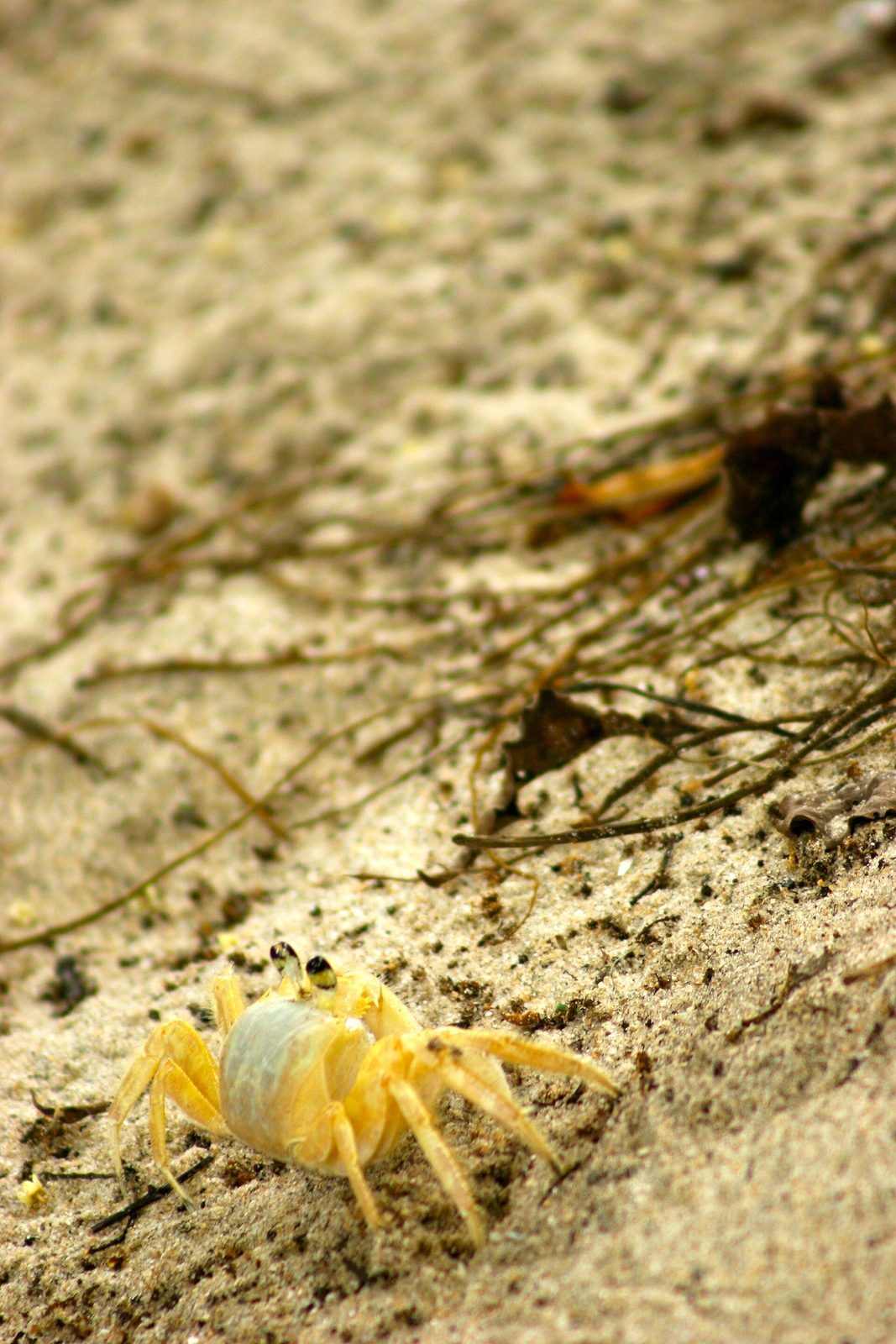
Down on the beach and along the tideline there is a whole other world of life to notice, the small and easily overlooked kind. Crabs work the wet sand and scuttle among the rocks at the ends of the beach; hermit crabs haul their borrowed shells across the flats; seabirds patrol the shallows; and the rock pools at low tide hold urchins, small fish, and whatever the sea has left behind. It is unshowy wildlife watching, but a rewarding one, and it costs nothing but attention. Watch where you put your feet among the rocks, both for your own footing and for the creatures living there, and let the animals set the terms of the encounter rather than chasing them.
All of this is the same living web that the reserve exists to protect up in the mountains, seen here where the forest meets the sea. The birds you learn to pick out along the trail are many of the same ones that fill the valleys above the seven waterfalls; the forest you walk through to reach Praia do Sono is the same forest, running unbroken from the high ridges down to the shore. To walk in to these beaches is to travel through that continuity from mountain to sea in a single morning, and to see, in miniature, why keeping the forest whole matters so much.
Best season, and the crowds
These beaches can be walked to and swum at year-round, but the season shapes what you find, in the weather and even more in the number of people sharing the sand with you. The broad pattern is the coast's usual one: a hot, wet summer and a milder, drier winter, with water warm enough to swim in through most of the year.
Weather through the year
The warm months, roughly from late spring through the Brazilian summer, bring the hottest days, the warmest water, and the greenest forest, along with the heaviest rain. Rain matters here for practical reasons: it turns the headland trails to slick mud and makes the footing harder and slower, and a heavy downpour can swell the streams you cross. The cooler, drier months bring firmer trails, clearer air, and easier walking, at the cost of slightly cooler swimming and shorter days. For many people the shoulder seasons on either side of high summer give the best of it — warm enough water, more settled trails, and far fewer people.
The crowds at New Year and Carnival
The crowds are the thing to plan around, more than the weather. Praia do Sono is well known and much loved, and at the peaks of the Brazilian holiday calendar — New Year, Carnival, and the height of the summer school holidays in January — it fills up dramatically. The campgrounds pack out, the trail runs busy in both directions, the kiosks strain, and the quiet that is the whole appeal is hard to find. The beach is still beautiful, but it is not the empty wild sand of the photographs at those times. If you can possibly avoid the peak weeks, do; and if you cannot, come on a weekday, start very early, and consider pushing on to Antigos or Antiguinhos, which stay far quieter even when Sono is full.
Walk an hour with a pack and you arrive on a beach that works much as it always has — that is the bargain of this coast, and it is a fair one.
The simplest advice holds in any season: come early in the day and, if you have the choice, come outside the peak holiday weeks. An early start on a quiet weekday in the shoulder season gives you the trek-in coast close to its best — cool walking, an empty trail, sand with room to breathe, and the drowsy calm that gave Praia do Sono its name. The same crowds that can overwhelm it at New Year melt away entirely on an ordinary morning out of season, and the beach hands itself back to you.
From the mountain forest to the wild coast
The trek-in beaches south of Paraty are the sea-level echo of what the reserve protects up in the mountains: land kept wild because it was kept hard to reach, and beautiful because it was kept whole. Walk in to Praia do Sono and you cross the same Atlantic Forest that clothes the slopes above the seven waterfalls, following it down to where it meets the sea, and you arrive on a coast that has stayed simple for exactly the reasons the reserve holds dear — no road, light building, a protected forest, and communities who have lived lightly on the land for generations. Mountain and coast are two halves of one conviction here: protect the land and the water first, and the rest follows.
That makes these beaches a natural counterpart to a stay in the mountains. Spend your mornings among the banana terraces, the streams, and the cool green pools of the reserve, and then, on the days you want salt water and an open horizon, drive down to Laranjeiras and walk over the headland to a wild beach you cannot reach any other way. Come back up in the evening to the quiet of the forest, having had the best of both. For the wider run of the region's coast, from the road-accessible beaches to the other wild ones, our guide to Paraty's beaches sets Praia do Sono in context, and if the full trek sounds like more than you want, the similarly wild but road-reachable village of Trindade offers a gentler way to the same kind of coast.
A day on the trek-in beaches is not a polished, serviced excursion, and that is the point of it. It asks you to walk, to carry your own water and cash, to respect the sun, the sea, and the people who live here, and to leave no trace of your passing. In return it gives you some of the last genuinely wild sand on this coast, earned on foot through the forest. When you are ready to plan how the coast fits around time in the mountains — how many beach days, which walks, and how to weave the sea into a trip built around the forest — start with our stays and booking page, and browse the rest of our local guides to see how these beaches sit alongside the waterfalls, the town, and the wider Costa Verde. Walk in slowly, tread lightly, and let the drowsy calm of Praia do Sono be your reward.