
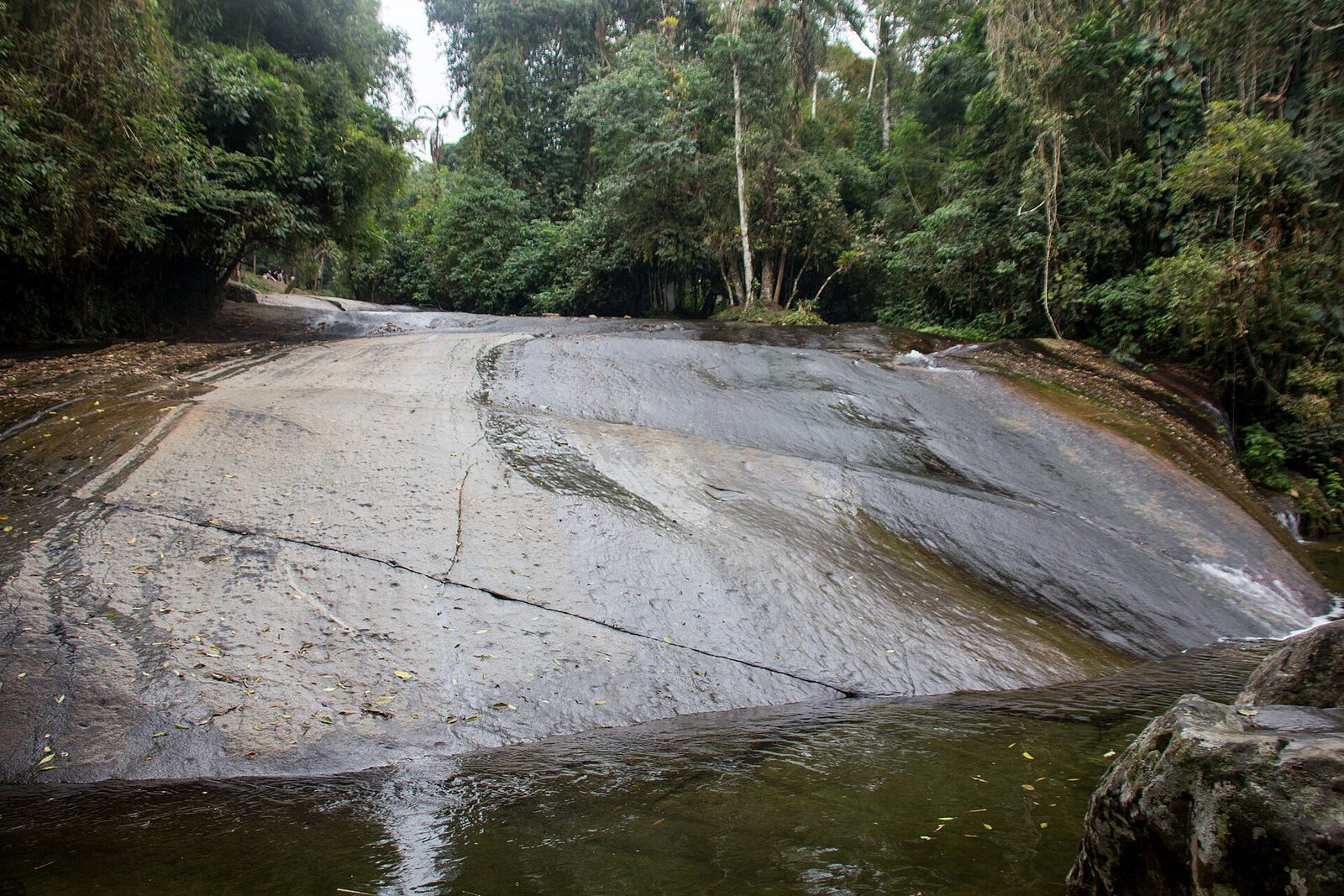
A short way outside Paraty, where the road leaves the flat coast and starts to climb toward the mountains, a clear forest stream runs down a long, tilted slab of bare rock. Over an immense stretch of time the water has worn that rock smooth, and somewhere along the way people worked out that you could sit down in the current, let go, and slide. That is the Cachoeira do Tobogã: not a tall, dramatic drop but a natural waterslide, a ramp of polished stone with a pool at the bottom, set into a rural valley that most visitors reach in a matter of minutes from the town center.
It is one of the best-loved swimming spots around Paraty, and it is worth being clear from the start about what it is and is not. The Tobogã is a public fall on a public stream, shared by locals and travelers alike, and it sits in a small rural community — the Penha area, sometimes called Pantanal do Ouro — with a white church on the hill above it and a scatter of family cachaça distilleries along the same road. It is a separate place from the reserve's own seven waterfalls, which lie higher in the forest and are private to guests. Think of the Tobogã as the region's communal playground in the water, and this page as a guide to enjoying it the way it deserves.
And it does deserve some care, which is the other thing to say plainly at the outset. The Tobogã is genuine, uncomplicated fun, and it is also slippery, moving water on hard rock, which is a combination that rewards respect. Downstream, a place called the Pedra que Engole — the rock that swallows — has pulled people under and drowned them, and the whole stream turns dangerous after heavy rain. None of that should keep you away. It should simply shape how you go: unhurried, sober about the water, and glad to follow the lead of people who know the rock.
- Where
- the rural Penha (Pantanal do Ouro) area, on the road from Paraty toward Cunha
- What it is
- a natural rock waterslide on a public forest stream, not one of the reserve's private falls
- Getting there
- a short drive, taxi, or local bus from the Paraty center
- Best time
- the cooler, drier months for safer footing; midday for warmth and light
- Difficulty
- easy to reach; the slide itself takes care and steady feet on wet rock
- Who it suits
- mixed groups and families who supervise closely; confident swimmers for the deep pool
- Serious hazard
- the Pedra que Engole downstream has drowned people, so keep well clear
- Also here
- the Penha church on its hill and several cachaça alambiques on the same road
What the Tobogã actually is
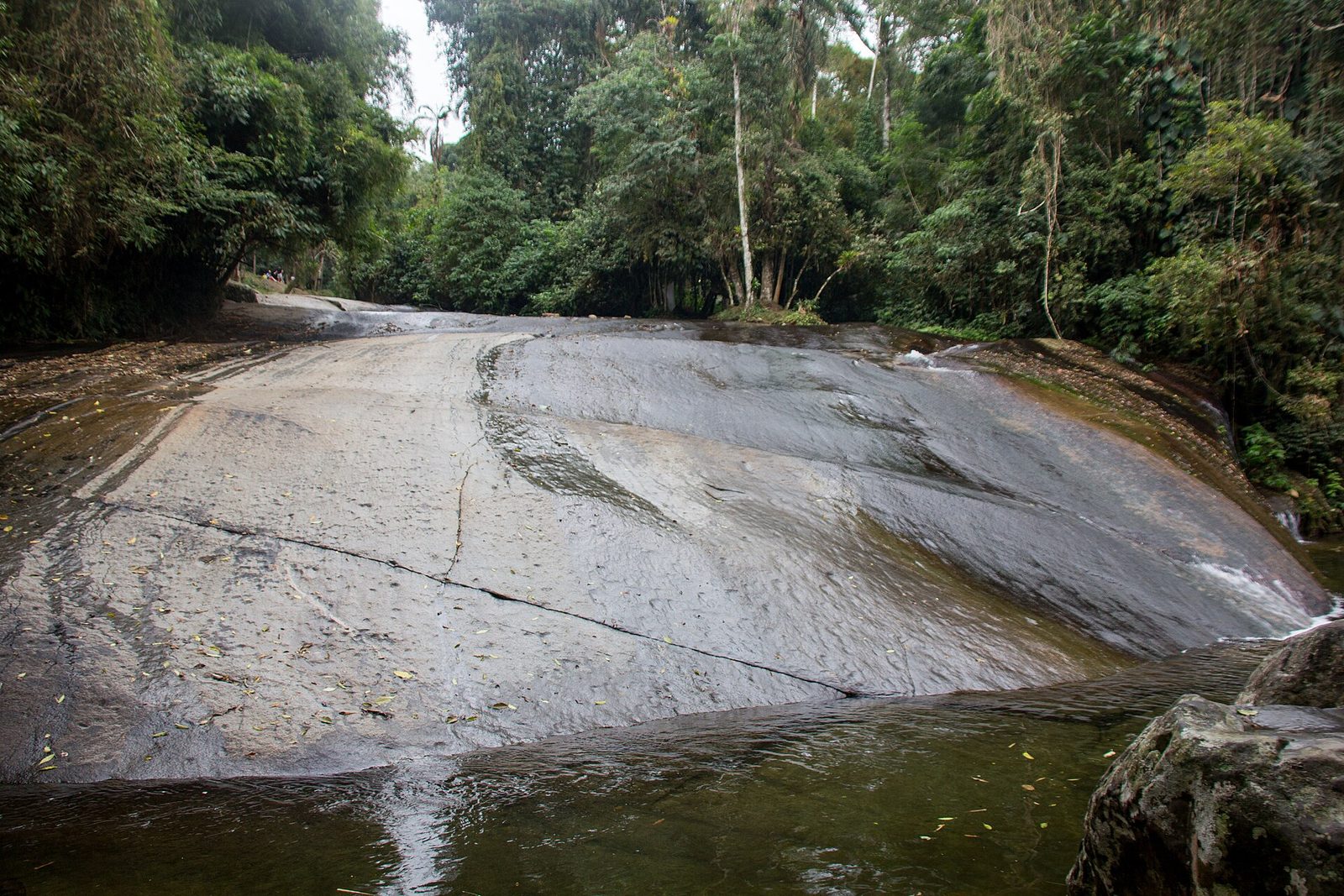
The word tobogã is simply Portuguese for a slide or a chute, and that is the most honest description of the place. This is not a waterfall you stand beneath and photograph from a distance. It is a wide, gently pitched ramp of rock, long enough to build up real speed, down which a shallow sheet of clear water runs all year. The surface is worn to the smoothness of a river stone, and where the water thins over it the rock takes on a slick, glassy quality. People climb to the top, settle into the flow, and ride the current down into a deep green pool at the base. It looks, and largely is, like something the forest built for play.
How a stream makes a slide
The mechanics are worth understanding, because they explain both the fun and the danger. The Serra do Mar, the coastal mountain range that rises behind Paraty, is built of hard crystalline rock — granite and gneiss — and here the stream happens to run across a single broad tongue of it rather than tumbling over broken boulders. Moving water carries fine grit, and over a very long time that grit acts like sandpaper, grinding away every rough edge until the rock is polished nearly flat. Add a constant film of water and a thin coat of algae in the wetter patches, and you get a surface with almost no grip. On a slope that gentle, a person in the current keeps sliding rather than tumbling. Steeper, and it would be a fall; rougher, and you would simply scrape to a halt. The Tobogã sits in the narrow band between those two, which is exactly why it works, and exactly why the same smoothness that carries you also means you cannot walk on it without slipping.
The chute and the pool below
At the top, the water spreads thin and quick over the stone. As the ramp steepens slightly it gathers into a defined channel, the fastest line down, and this is the groove that riders follow. At the bottom the rock releases you into a pool deep enough to swim in, ringed by more stone and by the leaning green wall of the forest. The water is cool, clear, and stained faintly amber by the leaves and roots it has passed through upstream, which is a sign of a healthy forested catchment rather than anything wrong. Around the pool, flatter rocks make natural benches and sunning spots, and the whole place has the easy, sociable feel of a swimming hole that a community has used for generations. On a warm afternoon you will hear it before you see it: running water, and over the top of it, laughter.
Where it is and how to get there
The Tobogã lies in the rural country just outside Paraty, in the district around the little settlement of Penha, an area some locals still call Pantanal do Ouro after the old gold-road history of these valleys. It is on the inland side of town, along the road that eventually climbs the mountains toward Cunha, the same broad landscape the colonial pack roads once crossed. You do not go far to reach it — this is a short trip from the historic center, a matter of minutes by car and a little longer by bus — but you do leave the tourist town behind and pass into a working countryside of small farms, roadside chapels, and family distilleries.
By car, taxi, or bus
By car it is the simplest of outings: follow the signs out of Paraty toward Penha and the Cunha road, and the turn for the Tobogã is well marked, with a cluster of small bars and parking areas where the stream comes down beside the road. A taxi or rideshare from the center is quick and easy, and drivers know the spot well. If you would rather go as locals do, a rural bus line runs from the Paraty bus terminal out through these districts; ask for the bus heading toward Penha or Ponte Branca and tell the driver you are going to the Tobogã, and you will be let off close by. The bus is cheap, unhurried, and part of the experience, though it runs on a country timetable, so check the return times before you commit to it for the trip home.
When you arrive
The Tobogã is not a ticketed attraction with a gate and a car park; it is a place beside a road, with a small, informal community grown up around it. You will usually find a bar or two serving cold drinks, grilled snacks, and the local cachaça, sometimes a stall of crafts or fruit, and a few people who make their living here and know the water better than anyone. Parking is roadside and can fill up on hot weekends and holidays. There are no lifeguards, no railings, and no official supervision of the water, which is precisely why the local knowledge around you is worth so much. Arrive expecting a rural swimming hole rather than a managed park, treat the people who live and work here as hosts rather than staff, and the day goes well.
How people ride the slide
Watching before you climb is the whole trick. Sit on the rocks by the pool for a few minutes when you arrive and you will see how it is done, usually by local kids and young men who have been riding it since they could walk. There is a preferred line — the groove where the water runs fastest and deepest — and a preferred posture, and copying what the regulars do is far smarter than working it out on your own.
The usual way down
Most people ride sitting up or lying back, feet first, arms crossed or hands kept in close, letting the current do the work. Feet first is the sensible default: if you are going to hit anything at the bottom, you want it to be your feet, not your head. You climb to the starting point at the side, where the rock is easier to grip, ease into the flow, and go. The ride is short and quick, ending with a splash into the pool, where you swim clear to make room for the next person. It is the kind of thing that looks alarming the first time and becomes irresistible by the third. Go once gently to learn the line before you go faster, and let anyone waiting above know you are clear of the landing.
Standing riders, and knowing your limit
You will almost certainly see someone ride the Tobogã standing up, surfing down the rock on their bare feet with their arms out for balance. It is a genuine local skill, built on years of knowing exactly where every ripple and rough patch sits, and it is a real pleasure to watch. It is also not something to try because you saw it done. A standing fall on this rock means landing on the hardest part of you, and the people who make it look easy are the first to tell a visitor to sit down and slide. There is no shame in the beginner's version — feet first, low, and unhurried — and no prize for the standing one. Ride within what your own balance and nerve can honestly handle, let the children and the show-offs have their moment, and enjoy the slide at the pace that keeps you whole.
Wet rock and moving water
Almost every injury at a place like the Tobogã comes from the least dramatic cause imaginable: a simple slip on wet stone. Not the slide itself, not some freak event, but a foot that shoots out from under someone walking across the rock beside the pool. The polished stone that makes the ride possible is treacherous underfoot everywhere here, and the wet, shaded, green-tinged patches are as slick as ice. This is the single most useful thing to hold in your head all day.
So move deliberately whenever you are on the rock. Assume any surface with water or algae on it will not hold your foot until you have tested it. Keep your weight low and your hands ready on the steeper sections, and do not stride around the way you would on a dry trail. Bare feet often grip the wet rock better than a smooth-soled sandal, which can be genuinely dangerous here; if you wear anything on your feet, it should be a proper water shoe or a sandal with real tread and a heel strap. Keep a special eye on the flat rock right at the edge of the pool, where people relax their guard exactly where a fall would put them into the water head first.
The water itself deserves the same respect. Even at a normal level, moving water carries more force than it looks like it does, and the current at the base of the chute can push and pull in ways that surprise people. Do not dive or jump head first into the pool or into any water here — you cannot see the bottom through the tannin color, submerged rock is common at the foot of a slide, and the depth shifts with the seasons and after big rains rearrange the streambed. Get in feet first, wade where you can, and only swim where you have felt the bottom yourself that day. Treat every part of the pool as unknown until you have personally checked it.
The same smooth water that makes the slide a joy is what makes the rock unforgiving. Both facts live on the same stone.
The Pedra que Engole: the rock that swallows
Downstream of the friendly pool, where the stream narrows and drops away through a jumble of large boulders, is the place the locals call the Pedra que Engole — the rock that swallows. It is not a legend or a nickname invented to thrill tourists. It is a real and genuinely deadly feature, and it has taken lives. Anyone spending the day at the Tobogã should know it is there, know roughly where it is, and know to stay well away from it.
Why it is so dangerous
The danger comes from the way the water moves through the rocks rather than over them. Where the stream forces itself between and beneath big boulders, it creates powerful channels and undertows — places where the current runs down into gaps a person can be pushed into and held, unable to fight back up against the flow. Water that looks merely lively on the surface can be doing something violent underneath. People have been drawn in, pinned by the force of the water, and drowned, and a rescue in that kind of terrain is desperately difficult. This is not a stronger version of the swimming pool. It is a different order of hazard, and the line between the safe pool and the deadly stretch is shorter than a first-time visitor would ever guess.
How to treat it
The rule is simple: do not swim, wade, scramble, or play anywhere near the Pedra que Engole, and do not let anyone in your group drift downstream toward it to explore. Keep to the known swimming pool at the base of the slide, and if you are not certain where the dangerous stretch begins, ask one of the local people at the Tobogã to point it out so you can be sure to avoid it. The hazard grows enormously after rain, when the extra water turns the whole streambed into something far stronger and faster. Watch children constantly and never assume a quiet-looking side channel is safe. This is the one place in the whole valley where casual curiosity has killed people, and the only sane response is plain, unglamorous caution.
The Pedra que Engole is not a place to explore
Downstream of the Tobogã's swimming pool, the stream funnels through boulders into channels and undertows that have drowned people. Stay at the known pool below the slide. Do not wade, scramble, or swim toward the narrower rocks downstream, keep children close, and never go near this stretch after rain, when the water is far stronger. If you are unsure where the danger begins, ask a local to show you so that you can keep clear of it.
The Igreja de Nossa Senhora da Penha
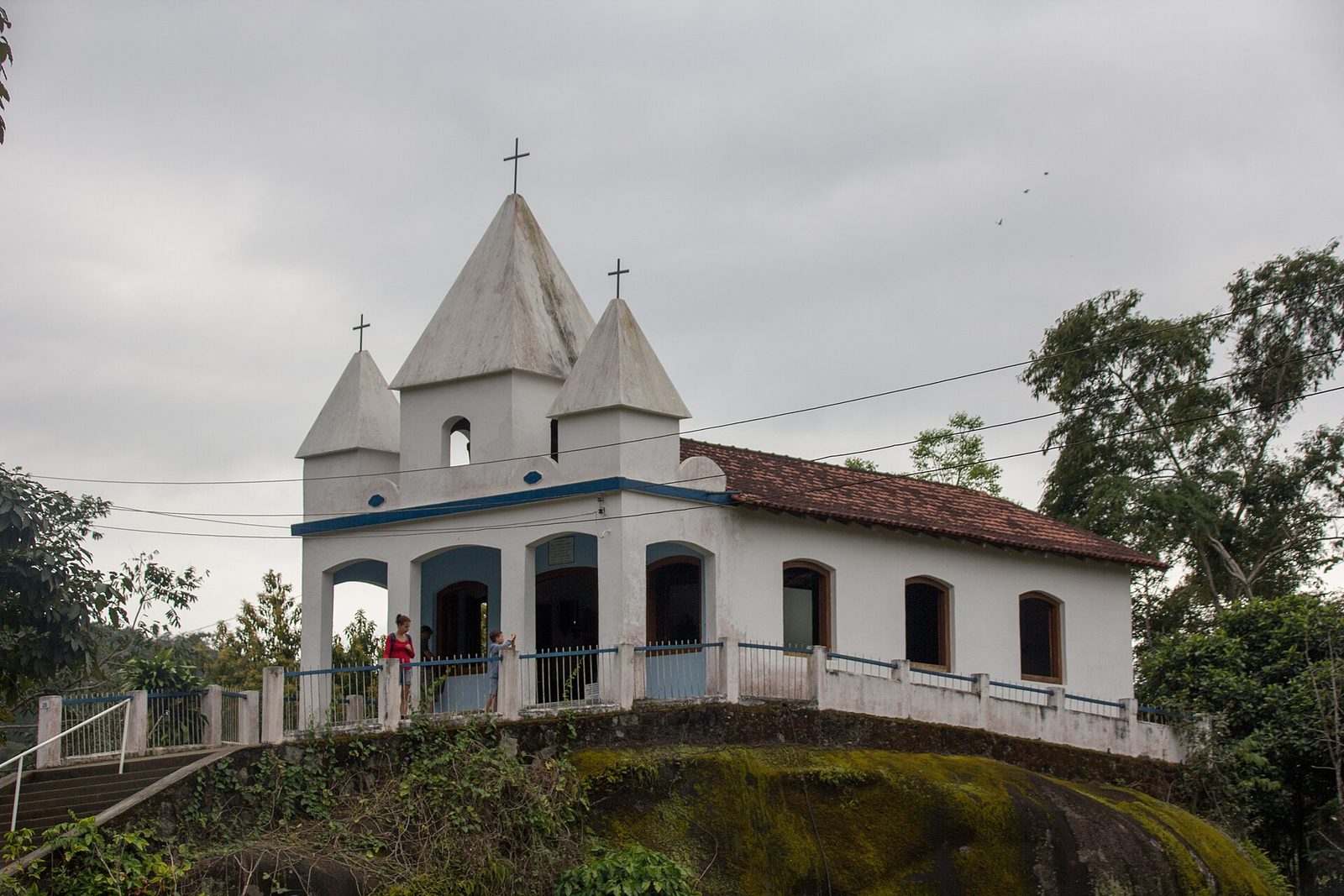
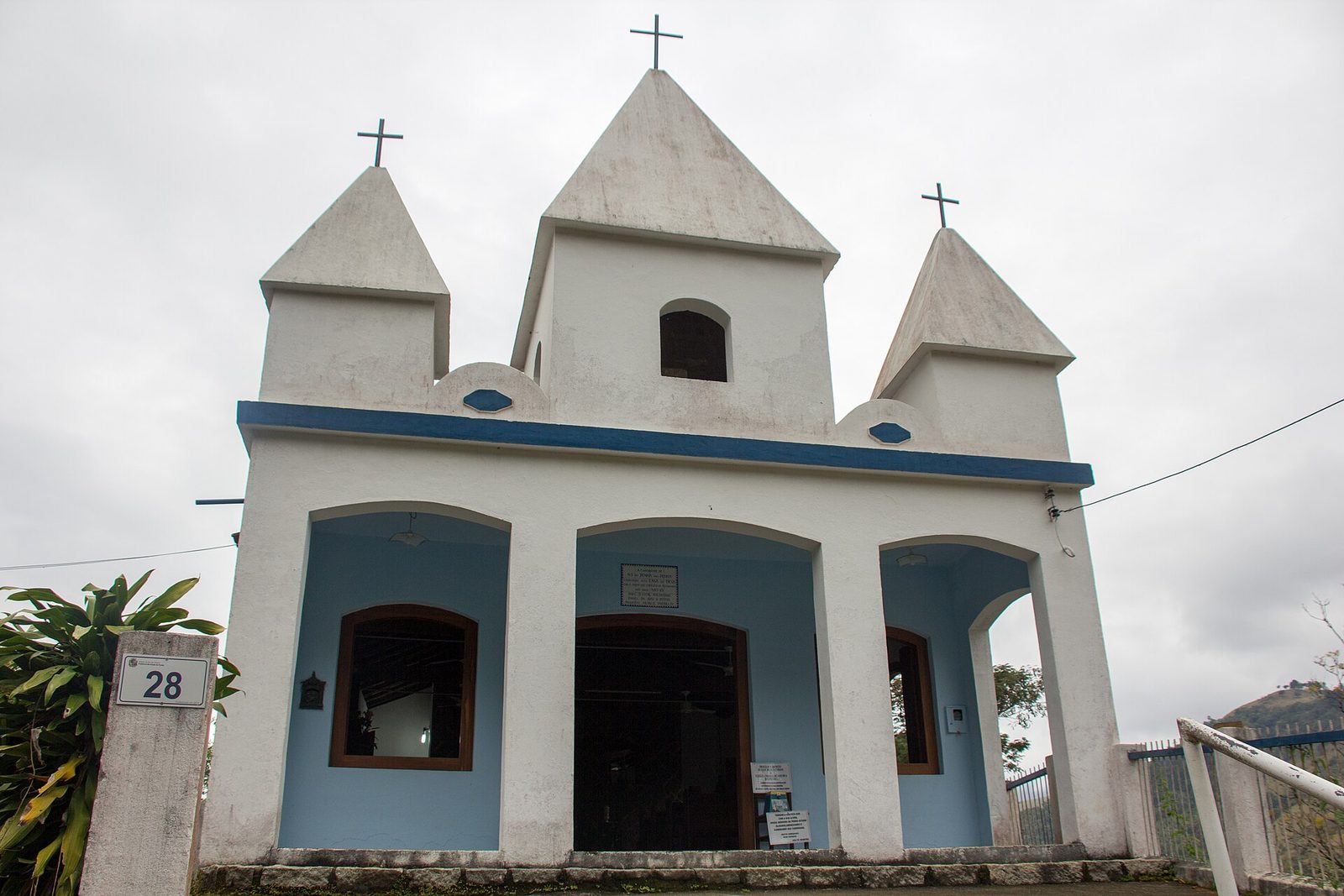
Rising over the same stretch of road, on a green rise above the valley, stands a small whitewashed church: the Igreja de Nossa Senhora da Penha, which gives the whole district its name. It is a modest colonial-country church rather than a grand cathedral — a simple rectangular nave, thick white walls, a bell, and a plain front looking out over the fields and forest. But its placement on the hill, bright against the deep green of the mountains, makes it one of the most recognizable landmarks on this road, and a natural companion to a day at the Tobogã.
The church on its hill
Country churches like this one were the heart of rural life across the Paraty region, built by the farming and mule-driving families who worked these valleys in colonial and imperial times. Nossa Senhora da Penha — Our Lady of the Rock, or of the Cliff — is a devotion carried to Brazil from Portugal, and versions of her church stand on high, rocky ground in many parts of the Portuguese world, which is why so many of them share this hilltop placement. The one here has watched over the Penha valley for generations. Its feast day still draws the community together each year, and even when the doors are closed the walk up to it, and the view back down over the road and the stream, is worth the few minutes it takes.
Visiting respectfully
This is a living place of worship, not a museum, so visit it as you would any working church. Dress with a little modesty if you go inside, keep your voice down, and be mindful of services or private prayer; if there is a mass or a gathering, admire it from a respectful distance rather than wandering through. The building's plain beauty is exactly the point — the whitewash, the simple lines, the way it sits so squarely on its hill — and it belongs to the same colonial architectural tradition as the more famous churches down in town. If that tradition interests you, the story of Paraty's churches and its whitewashed, tide-washed streets is worth reading on its own; there is a full guide to the town's churches and colonial architecture. Here at Penha, the pleasure is quieter: a small country church, a wide view, and the sound of the stream carrying up from below.
Cachaça on the same road: the alambiques
The road that carries you to the Tobogã and the Penha church is also cachaça country. Paraty has been known for its sugarcane spirit for centuries — so well known that Brazilians once called the drink itself parati, after the town — and the hills around here hold a number of alambiques, the small distilleries where cane juice is fermented and run through copper stills into cachaça. Several sit within easy reach of the Tobogã, which makes it natural to combine a morning in the water with an afternoon tasting, or the other way around.
Engenho d'Ouro and its neighbors
One of the better known on this road is the Engenho d'Ouro, a working distillery that welcomes visitors to see how cachaça is made and to taste what it produces, including the aged and infused versions that surprise people who only know cachaça as the raw base of a caipirinha. It is not the only one; the Paraty countryside holds a spread of family alambiques, some of them generations old, each with its own character and its own labels. Many offer a walk through the mill and the stills, past the copper and the barrels, and a tasting at the end, and most are proud, personal operations where the people pouring are the people who made it.
Turning cane into spirit
The process is worth seeing at least once. Sugarcane is crushed to extract its sweet juice, the juice is fermented, and the fermented wash is distilled in copper stills, with the distiller keeping only the clean middle of the run and setting aside the rougher first and last fractions. From there, cachaça may be bottled young and clear, or rested in wooden casks — often native Brazilian woods that lend their own color and flavor — to become the amber, mellower stuff that is meant to be sipped rather than mixed. A good tour walks you through all of it and lets you taste the difference. A fuller account of the town's distilleries, the labels to look for, and the August festival that celebrates them lives on the guide to Paraty cachaça and its alambiques. One sensible caution ties back to everything else on this page: if you plan to ride the slide, taste the cachaça afterward, not before. Alcohol and slick rock over moving water make a bad pairing, and the water deserves a clear head.
Smaller pools and short walks nearby
The Tobogã is the main event, but it is not the only water in the valley, and part of a good day here is drifting a little beyond the busiest rock. Upstream and downstream of the main slide the stream steps through other, quieter spots — smaller chutes, shallow basins where the water slows and warms a touch, and calm corners where you can sit with your feet in the current away from the crowd at the main pool. These gentler places are often the best of the day for young children and for anyone who would rather wade than ride, provided you have made sure you are nowhere near the dangerous downstream stretch.
Short paths run along the stream and up through the surrounding forest and farmland, and even a brief walk changes the feel of the visit. The country here is the edge of the Atlantic Forest — the Mata Atlântica of the Serra do Mar — and stepping a little way into the trees brings you into shade, birdsong, and the green tangle of ferns and vines that make this one of the richest forests on Earth. You do not need to hike far to feel it. A slow loop up toward the church and back along the water, with a stop to look at an alambique and a cold drink at one of the bars, easily fills a half day without ever feeling rushed.
The Tobogã is also just one entry on a long list of falls in this part of the coast. The Serra da Bocaina behind Paraty is full of moving water, from easy roadside spots like this one to remote pools that take a real hike or a boat to reach, and each has its own character and its own rules. If the slide gives you a taste for it, the wider circuit is worth planning properly; there is a dedicated guide to the waterfalls of Paraty that lays out the options, the seasons, and the safety that each one asks for. The Tobogã is a fine place to start, precisely because it is so easy to reach and so sociable, but it is a door into a much larger watery landscape.
What to bring, and how to prepare
Part of what makes the Tobogã easy is that you do not need much to enjoy it. It is a swimming hole, not an expedition, and the shortlist of useful things is short. But a few of them matter more here than they would at a calm beach, because of the rock and the remoteness, and a little preparation is the difference between a loose, happy afternoon and a scramble.
The things worth carrying:
- Footwear with real grip, such as a water shoe or a sport sandal with tread and a heel strap. Smooth-soled flip-flops are worse than useless on this rock, and many locals simply go barefoot, which grips better than bad shoes.
- Swimwear you can move in, plus a towel and a dry set of clothes for afterward. The valley runs cooler than the coast, especially in the shade and once you are wet.
- Drinking water and a snack, though there are usually bars selling cold drinks and food. Carry cash in small notes for the bars, the parking, and the alambique, since card machines are not a given out here.
- Sun protection for the open rock and insect repellent for the forest edge, both applied well away from the water and rinsed off before you swim, so that you do not foul the pool.
- A dry bag or a simple plastic bag for a phone and valuables. Things get wet here, and there is nowhere secure to leave them.
- A relaxed sense of time. The Tobogã rewards an unhurried visit — watch, swim, dry off in the sun, have a drink, wander up to the church — far more than a quick tick-the-box stop.
Beyond the gear, the best preparation is mental: arrive planning to watch before you leap, to follow the locals' lead on the slide, to keep well clear of the downstream danger, and to check the sky and the water before committing children or yourself to anything. None of that costs a thing, and all of it makes the day both better and safer.
Is it right for families?
For a lot of families, the Tobogã is one of the highlights of a Paraty trip, and children tend to love it — the novelty of a natural slide, the warm rock, the shallow edges to splash in, the whole sociable scene of it. It can absolutely be a family place. But it is an unsupervised natural water feature with a genuinely dangerous stretch nearby, so it asks more active attention from parents than a pool or a gentle beach would, and it is worth going in clear-eyed about that.
The sensible approach is to treat the calm pool and the smaller upstream basins as the children's territory and the slide itself as something older kids and adults do with care and one adult watching from the water below. Keep young children within arm's reach around any moving water, never let anyone drift downstream toward the Pedra que Engole, and choose your day well — a calm, dry-weather afternoon, not the aftermath of a storm. Plenty of local families spend whole weekends here happily and safely; they simply do it with a constant, low-key awareness of where their children are and what the water is doing.
Reading the water is a skill worth modeling for your kids as part of the day: showing them why you test a rock before trusting it, why you enter feet first, why some places are off limits. It turns a swim into a small lesson in how wild water works. If you are traveling with children more broadly and want to know which of the region's outings suit which ages, the reserve keeps a fuller guide to visiting with family and kids, including the gentler water closer to home. The short version for the Tobogã: yes, it can be wonderful for families, as long as the adults stay switched on and the youngest stay close.
Best time of day and year
When you go changes the Tobogã more than you might expect. The water level, the light, the temperature, and the crowd all shift with the hour and the season, and a little timing makes a real difference to the day.
The seasons
The Costa Verde has a wetter, warmer half of the year and a cooler, drier half, and the drier months generally make for the better and safer visit. With less rain, the stream runs at a friendlier level, the rock is more predictable, and the water is clearer. The wetter season brings heat, lushness, and a fuller, more powerful stream, which sounds appealing but is exactly when the hazards sharpen: the slide runs faster, the pool churns harder, and the downstream danger becomes far worse. The firmest rule of all cuts across the calendar — avoid the Tobogã during and immediately after heavy rain, in any season, because the water can rise fast and turn a playground into a genuine threat. A clear spell of settled weather is worth waiting for.
The hour and the crowd
Within the day, the middle hours are the warmest and the brightest, when the sun climbs high enough to reach down into the valley and light the pool, and the water — which is cool mountain runoff — feels its most inviting. That is also, unsurprisingly, the busiest window. If you want the place quieter, go early, when the light is soft and the rock is yours for a while, or later in the afternoon as the day-trippers thin out, accepting that the water will be cooler in the shade. Weekdays are calmer than weekends, and ordinary weekends are far calmer than Brazilian holidays and the Carnival and New Year periods, when the Tobogã can be genuinely crowded. If your schedule allows a weekday in a dry, settled stretch, you will see the place close to its best.
Guides, etiquette, and the rural community
The Tobogã is free and open, but it is not a no-man's-land; it is the front yard of a working rural community, shared with the people who live, farm, and make their living along this road. How visitors behave here shapes whether the place stays welcoming, and a little courtesy and care go a long way.
Going with a guide
You do not strictly need a guide to visit the Tobogã, but a knowledgeable local presence is genuinely valuable, especially on a first visit. A guide, or simply a friendly local at the water, knows where the safe swimming ends and the dangerous stretch begins, reads the day's water level for you, and can steer children and nervous first-timers to the right spots. If you are combining the Tobogã with the church, an alambique, and perhaps other falls, a guided outing knits it together and takes the navigation and the safety judgment off your plate. The reserve is glad to help guests arrange a trustworthy local guide for a day out here; it is one of the many things a stay makes easy, and it sits among the wider local guides to the region.
Etiquette and leaving no trace
The rest is common sense, stated plainly. Keep the water clean: no soap or shampoo in the stream, and rinse sunscreen and repellent off before you get in, because the frogs and insects that live in this water are sensitive to it. Pack out everything you bring, including food scraps and fruit peel, and leave the rock cleaner than you found it. Keep the noise down — loud music empties a valley of the very peace and birdsong that make it worth the trip, and it is discourteous to the residents and to everyone else at the water. Buy a drink or a snack from the local bars rather than treating the place as free infrastructure; that small spending is part of how the community makes visitors welcome. Park considerately, respect the church and any private land, and take nothing home but photographs and a good memory. Treated this way, the Tobogã stays what it has long been: a shared, unspoiled swimming hole that belongs to everyone who respects it.
A morning here is two things at once — a village at prayer on its hill, and a river at play on its rock.
Where the Tobogã fits in a stay above the falls
The Tobogã is the region's shared waterslide, easy and sociable and open to all, and it is the natural public counterpart to the quieter, private water higher up the mountain. A day here — the slide, the pool, the walk up to the white church, a tasting at an alambique, a cold drink in the shade — is one of the simplest good days the Paraty countryside offers, and it slots neatly into a longer, slower visit to the coast.
That is really the argument for basing yourself in the forest rather than rushing the region in a day. From a chalet at Reserva Sete Quedas you can spend a morning on the reserve's own seven waterfalls — private, protected, and uncrowded — and an afternoon down the road at the public Tobogã, and understand them as two faces of the same mountain water: one to be kept wild and quiet, one to be shared and enjoyed out loud. The reserve can help you arrange the local guide, point you to the safest day for the slide, and send you off with everything you need. When you are ready to build a trip around all of it, you can plan a stay and let the mountain, and its water, set the pace.