
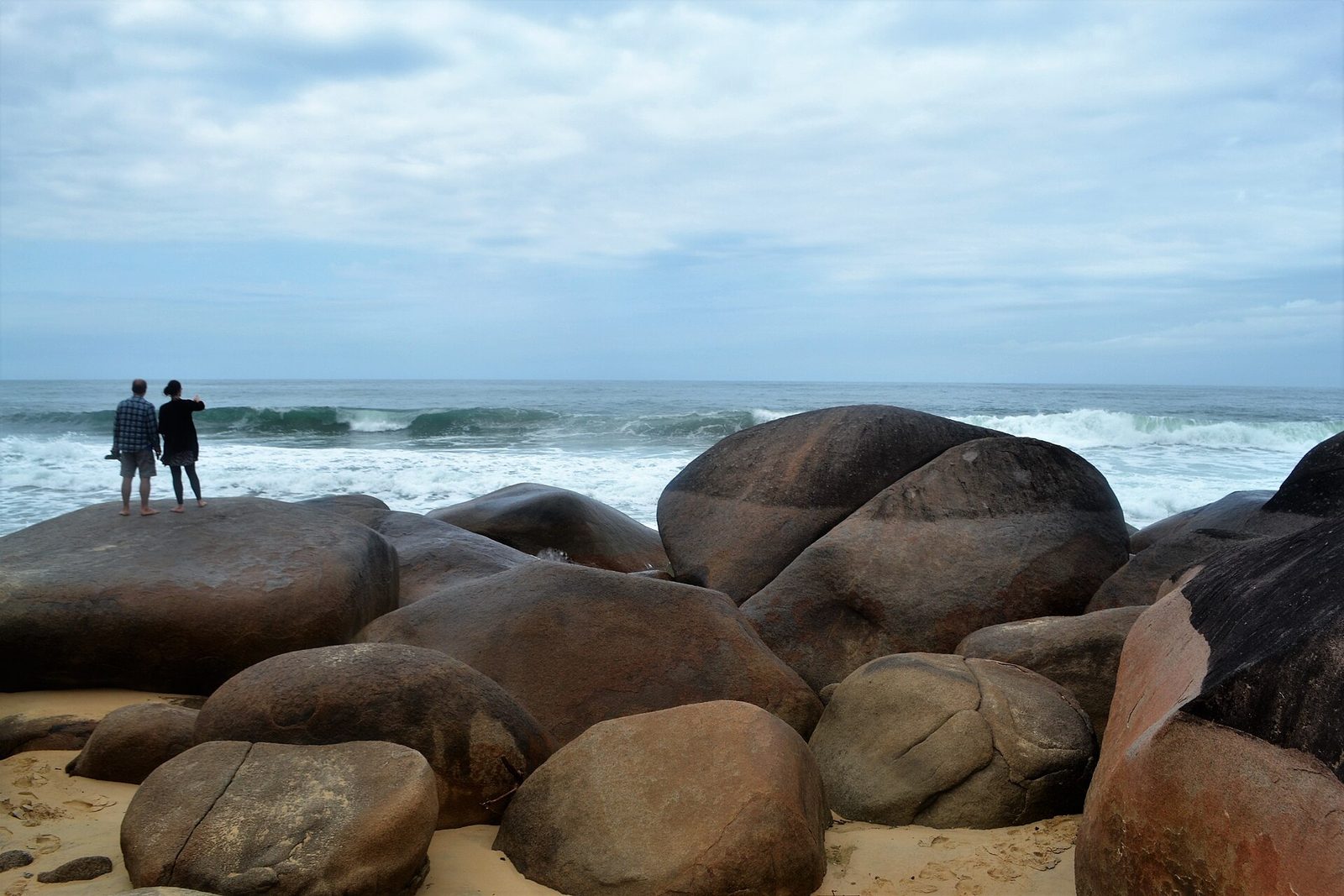
Trindade lies at the southern end of Paraty's coast, a former fishing village that turned, over the last fifty years, into one of the best-loved beach destinations on the Costa Verde. It sits where the Serra do Mar drops almost into the sea, so the village is a small, green place hemmed in by forested hills on one side and open ocean on the other, with a single sandy main street running down toward the water. There are no high-rise hotels here and no seafront resorts, and that is not an accident: the whole stretch is inside a protected area, and the rules that come with it have kept Trindade low and loose while much of the Brazilian coast built upward.
People come for two things above all. The first is the string of beaches that runs along the coast on either side of the village, from calm swimming sand to open surf. The second is the Piscina Natural do Cachadaco, a natural tidal pool sheltered behind a wall of rock, reached by a short walk through the forest, where on a calm day you can snorkel in clear, protected water while the ocean breaks a few steps away. Around both of those is the thing that made Trindade's name in the first place: a barefoot, unhurried mood that survived the crowds, the paved road, and the summer traffic.
It is worth being honest from the start. Trindade is popular now, and in the height of the Brazilian summer it can be very busy, with the beaches full and the parking lots overflowing. But out of peak, and even on an ordinary weekday in season, it is still one of the finest days you can have on this coast, and from the reserve up in the mountains above the seven waterfalls it makes a natural down-the-hill counterpart to a morning in the forest. This guide covers where Trindade is and how to reach it, what each beach is like, the natural pool and the walks, where to eat, whether to stay or day-trip, and how to visit a crowded, protected place without adding to the wear.
- Where
- south of Paraty on the Costa Verde, inside the Cairucu protected area (APA do Cairucu)
- Getting there
- a steep access road down from the Rio-Santos highway (BR-101); by car, van, or bus from Paraty
- The beaches
- Praia do Cepilho, Praia dos Ranchos, Praia do Meio, Praia Brava, Praia do Cachadaco
- The star
- Piscina Natural do Cachadaco, a rock-sheltered tidal pool reached by a short forest trail
- Best time
- warm water roughly December to March; quieter and calmer in the shoulder months and on weekdays
- Crowds
- packed over the Brazilian summer holidays, Carnival, and New Year, and parking fills early
- Bring
- cash, water shoes, and sun protection, since there is little in the way of banks
- Character
- low by design, no big resorts, a single main street of pousadas and simple restaurants
Where Trindade sits, and the road down to it
Trindade belongs to the municipality of Paraty, but it sits well south of the colonial town, out toward the border with Sao Paulo state, on the last Rio-side stretch of the Costa Verde before the coast climbs into the Serra da Bocaina. The whole area falls inside the Area de Protecao Ambiental do Cairucu, the Cairucu Environmental Protection Area, a federal conservation zone created in the early 1980s to guard this coast and the traditional communities on it. That protected status is the single most important fact about the place, because it explains almost everything else: why the village is small, why there are no resorts, and why the beaches are backed by forest rather than by concrete.
The turn off the Rio-Santos highway
You reach Trindade from the Rio-Santos highway, the BR-101, which runs along the coast between Paraty and the state line. South of town a signed turnoff leaves the highway and drops toward the sea on a steep, winding access road that descends through the forest to the village at the bottom. The descent is short but sharp, with tight bends and long views out over the coast as you come down, and in a low car or a heavy rain you take it slowly. At the bottom the road flattens into the village, where cars, vans, and buses all funnel into a small grid of sandy streets and parking areas near the beach.
Getting there by van, bus, or car
From Paraty, the simplest way in is by the local vans and buses that run down to Trindade through the day; they leave from town and take under an hour, dropping you at the entrance to the village. In high summer they run often, filling and leaving as they load; off-season they are less frequent, so check the last one back before you commit to a late afternoon on the sand. If you are driving yourself, the road is straightforward but the parking is the catch: the lots at the village entrance fill early on busy days, and you may end up parking up the hill and walking down. Our getting there guide covers the mountain road from the reserve and how transfers work. From the reserve you drive down to Paraty and then south along the coast, so a Trindade day is a proper outing rather than a quick hop; plan on the drive at each end.
Why there are no big resorts
The absence of large hotels is the thing visitors notice and love, and it is a direct result of the protected status. Building is limited inside the Cairucu area, and the shape of the land, a narrow shelf of flat ground between steep forest and the sea, leaves little room for anything big in any case. What grew instead is a village of pousadas, guesthouses, campgrounds, and simple restaurants, most of them low and small, strung along the main street and the lanes off it. It means Trindade will never be slick, and that is the point. You come here for sand, forest, and salt water, not for a pool deck. It also means services are modest, so you arrive prepared rather than expecting a resort to provide.
A fishing village that went its own way
Long before it was a beach destination, Trindade was a caicara fishing settlement, one of many small communities that lived along this coast by working the sea and farming little plots of cassava and banana in clearings cut from the forest. The caicara are the traditional coastal people of the southern Rio and Sao Paulo shore, of mixed Indigenous, Portuguese, and African descent, and their culture shaped this whole stretch of coast, from the canoes and the fishing to the saints' festivals and the round dances. You can read more about them in our guide to caicara culture. Trindade grew from that root, and the fishing boats still pulled up on the village beach are a living reminder of it.
Caicara roots
For most of its history Trindade was remote and poor, cut off from Paraty by the mountains and reached mainly by boat. Families fished, grew what they could, and lived lightly on a coast that gave them everything and very little cash. That isolation, hard as it was, is exactly what kept the forest standing and the beaches wild into the second half of the twentieth century, when roads finally reached down the coast. When the outside world arrived, it found a place that most of Brazil had already paved over elsewhere, and that contrast is what made Trindade famous.
The crowd that found it
From the 1970s, Trindade became a magnet for a different kind of visitor: surfers chasing the open waves at Cepilho, and young travelers, artists, and back-to-the-land types looking for somewhere cheap, beautiful, and far from the cities. It earned a reputation as an alternative, counterculture haven, with tents on the sand, cheap fish, and long unhurried days, and something of that spirit still hangs about the place. There were harder chapters too, including disputes over land as speculators eyed the coast, and it was partly to settle that pressure and protect both the environment and the caicara communities that the area was made a protected zone.
Trindade grew up, but it never grew tall.
What it feels like now
Today Trindade is firmly on the map, and in January and at Carnival it can feel a long way from a secret. But it has kept its shape and much of its temper. The main street is still sand and small shops, the pousadas are still low, the beaches are still backed by forest, and the boats still work the water. Come outside the peak weeks, or simply walk twenty minutes down a trail, and the old, quiet Trindade is right there. It is a place that has been loved a bit too hard and has held up better than most, which is its own kind of recommendation.
The village beach: Praia dos Ranchos
The beach in front of the village is Praia dos Ranchos, sometimes just called the village beach, and it is the heart of Trindade. The name comes from the ranchos, the boat sheds and shelters where fishermen kept their canoes, and it is here that the wooden fishing boats are still pulled up on the sand between trips. It is a broad, sheltered beach with generally calm water, backed directly by the village, so it is the easiest of all the beaches to reach; you simply walk out of the main street onto the sand. Because everything is right there, it is where a lot of visitors settle in for the day, with kiosks and restaurants a few steps behind them and the boats coming and going in front.
This is also the working waterfront, such as it is: the point from which local boats run short trips out along the coast to the beaches and pool you cannot easily walk to, and where a boatman will take you around to Cachadaco or Praia Brava if you would rather ride than hike. It is not the wildest or the most beautiful of Trindade's beaches, but it is the most sociable and the most convenient, and it has the mood of the village concentrated on one strip of sand: children in the shallows, boats on the water, the smell of fish frying behind you. For a first hour in Trindade, while you get your bearings, it is the natural place to land.
Because it is so central, Ranchos fills up fast on busy days, and it is not where you go to be alone. If you want space and quiet, it is the departure point rather than the destination, a place to leave your bag at a kiosk, hire a boat, or start a walk to somewhere emptier. But do not overlook it either. On a calm morning before the day-trippers arrive, with the boats mirrored in the flat water and the forest green behind the roofs, the village beach is a fine place to stand and take the measure of Trindade before the crowds come down the hill.
Praia do Meio and Praia Brava
Beyond the village beach, the coast strings out into a series of beaches, some an easy stroll away and some a proper walk through the forest. Two of them mark the range: Praia do Meio, close in and easygoing, and Praia Brava, out on the wild edge.
Praia do Meio
Praia do Meio, the middle beach, sits just along from the village and is reached on foot in a few minutes. It is a broad, open stretch of sand with water that is usually calmer than the surf beaches but livelier than the enclosed pool, which makes it a good all-round choice for a day of swimming and lying in the sun. There is room to spread out and simple kiosks nearby for a cold drink and a plate of fish, so families and groups often make it their base. From the far end of Praia do Meio the trail toward the Costao and the Cachadaco pool begins, so it doubles as the gateway to the best of Trindade's walking.
Praia Brava
Praia Brava is the wild one, and the name says it, since brava means rough, fierce. It is reached not by road but by a forest trail over the hills, a walk of the better part of an hour through Atlantic Forest, and that effort keeps it far quieter than the beaches you can drive to. The reward is a beautiful, open, ocean-facing beach with strong surf and a rugged, empty feel, backed by forest with almost nothing built on it. The trade is the same as the reward: the waves and currents here can be powerful, there are no services and no lifeguards, and it is a beach for confident swimmers, surfers, and walkers rather than for small children paddling. Wear real shoes for the trail, carry your own water and food, go with plenty of daylight in hand, and check that the weather is settled before you set out. If Praia Brava whets your appetite for the wilder coast, the beaches around Praia do Sono, reached on foot further south, take that same trade a step further; see our Praia do Sono trek guide.
Praia do Cepilho, the surf beach
At the northern edge of Trindade, near where the access road meets the coast, is Praia do Cepilho, the beach most associated with surfing. It is an open, ocean-facing strand that catches the swell head-on, and on a good day it draws surfers to some of the more reliable waves on this part of the coast. Even if you do not surf, Cepilho is worth seeing for the drama of it, a long beach with the waves rolling in and forested headlands closing off each end, and for the contrast with the sheltered water elsewhere in the village.
Because it faces the open sea, Cepilho is not the place for a casual swim. The same waves that make it good for surfing make it hazardous for anyone not confident in ocean water: the shore break can be heavy, and rip currents can pull, so this is a beach to respect. Watch the water before you go in, stay where you can clearly stand, keep children out of the heavier surf, and if the sea is big, treat it as a beach to walk and watch rather than to swim. Surfers should know their own limits and the beach's moods, and nobody should surf or swim alone here in strong conditions.
Cepilho tends to be a little less crammed than the central village beach, partly because it is at the entrance rather than in the middle of things and partly because the surf keeps casual bathers away, so it can be a good place to breathe on a crowded day, as long as you are there for the setting and the waves rather than a gentle dip. There are usually a few kiosks along the back of the beach for a drink and a snack, and the surf schools and board rentals, when they are running, cluster here. It is the loud, open, elemental face of Trindade, the counterweight to the calm of the pool.
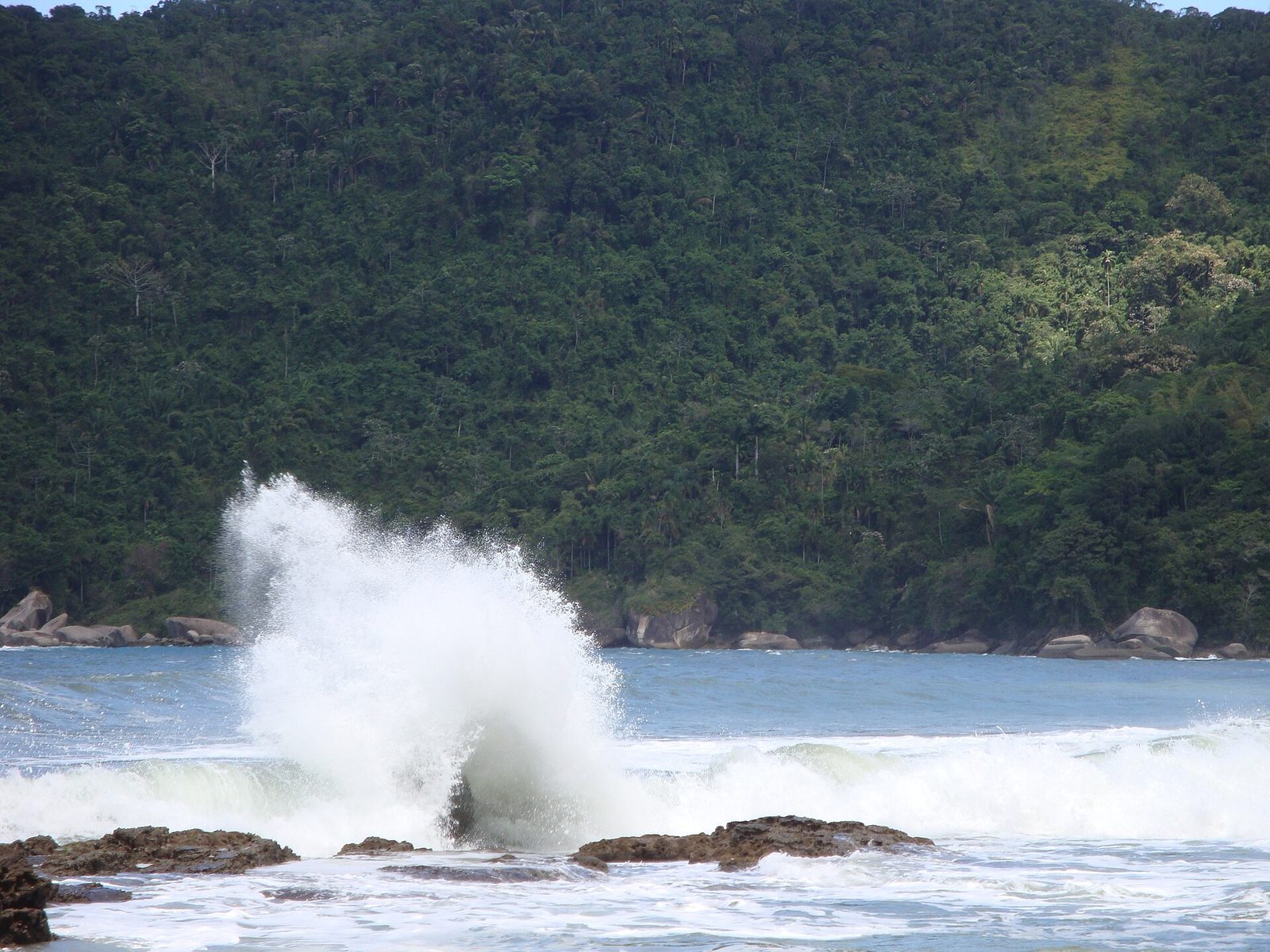
The Piscina Natural do Cachadaco
If Trindade has one thing that everyone wants to see, it is the Piscina Natural do Cachadaco, the natural pool at Cachadaco. It is a pocket of sea water held behind a natural wall of granite boulders, so that even when the ocean is moving outside, the water inside stays calm, clear, and shallow, a rock-ringed swimming pool made by the coast itself, full of small fish, and reached by a short walk through the forest from the beach. On a calm, sunny day it is one of the finest places to snorkel on the entire Costa Verde, and it is the image most people carry away from Trindade.
The trail out to the pool
You reach the pool on foot, by the Costao trail that runs from the Cachadaco end of the village out over the rocky point. It is not a long walk, well under an hour, but it is a real trail, through forest and over roots and stone, with some uneven and slippery sections, especially after rain. Wear shoes you can grip and climb in, not flip-flops, and take your time on the rocks near the water, which are slick. The walk is part of the pleasure, shaded and green with glimpses of the sea, and it filters out anyone unwilling to make the effort, though in high season plenty are willing and the trail runs busy in both directions.
Snorkeling when the sea is calm
The pool is at its best when the sea is calm and the water clear, which tends to mean settled weather and not too much recent swell or rain. On a good day the water inside the rocks is glassy and clear enough to watch fish moving over the bottom, and because it is enclosed and shallow it is far safer and gentler than the open beaches, good for careful snorkeling and for confident children with an adult close by. Bring your own mask if you have one, since there is nothing to rent out there, and wear something on your feet for the rocks. It is a small, living place, so look and float rather than stand on or grab the rock, and let the fish come to you.
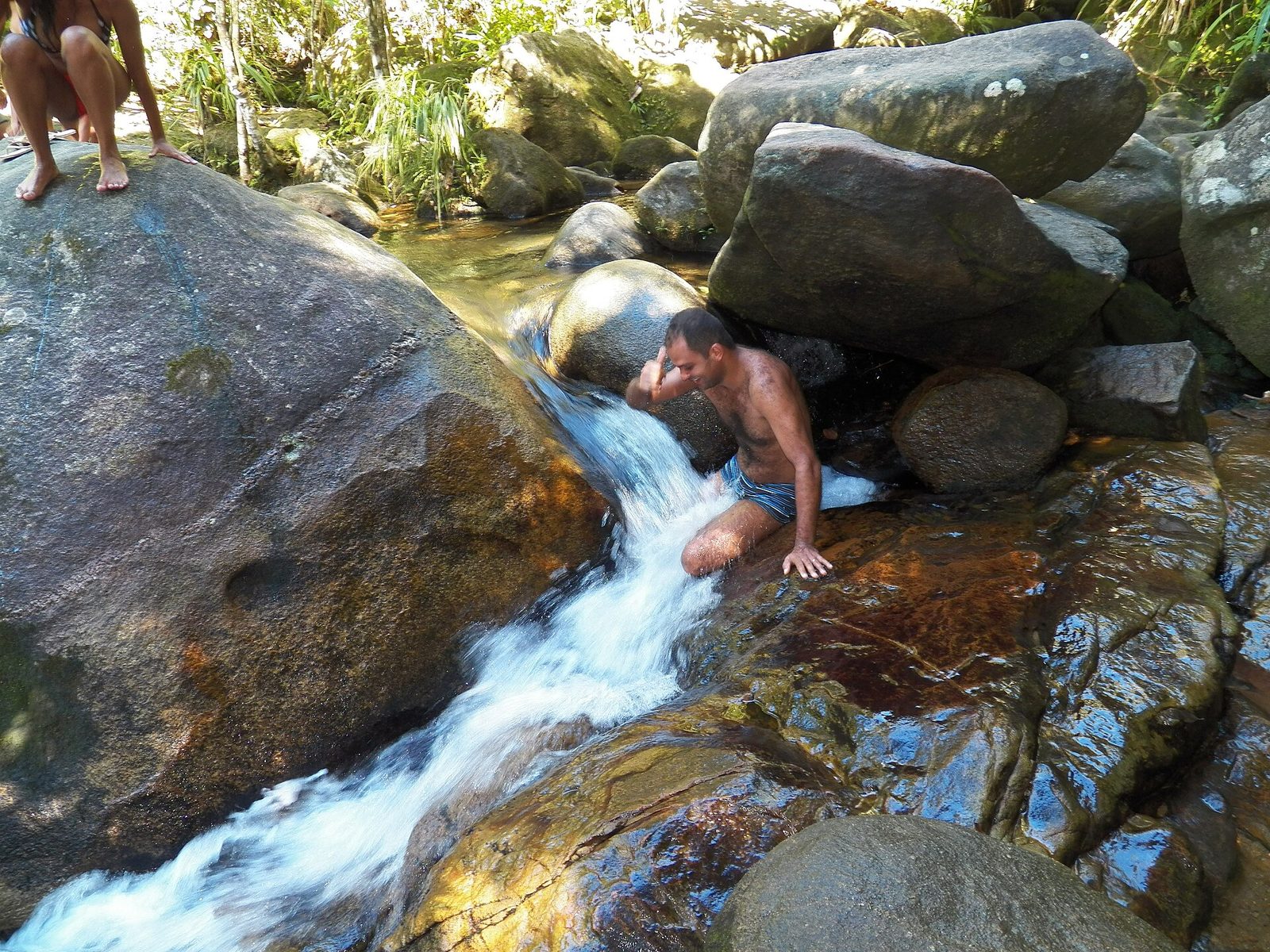
When the sea is calm the Cachadaco pool holds water so clear the fish seem to hang in the air, even as the surf breaks on the rocks a few steps away.
When the pool is crowded, and when it isn't
The flip side of being the star attraction is the crowd. In the summer holidays, on weekends, and at Carnival and New Year, the pool can be genuinely packed, with a steady file of people on the trail and the water busy with snorkelers. It is still beautiful, but it is not the quiet cove the photographs suggest, and the sheer number of feet and hands takes a toll on a small, living place. The way to see it closer to its best is simple: come early in the day, come on a weekday, and come outside the peak weeks if you possibly can. On a calm morning off-season you may have something close to the pool the pictures promise; at midday on a holiday Saturday you will share it with a great many others. If the sea is rough, the pool loses both its clarity and its safety, so save it for a calm day.
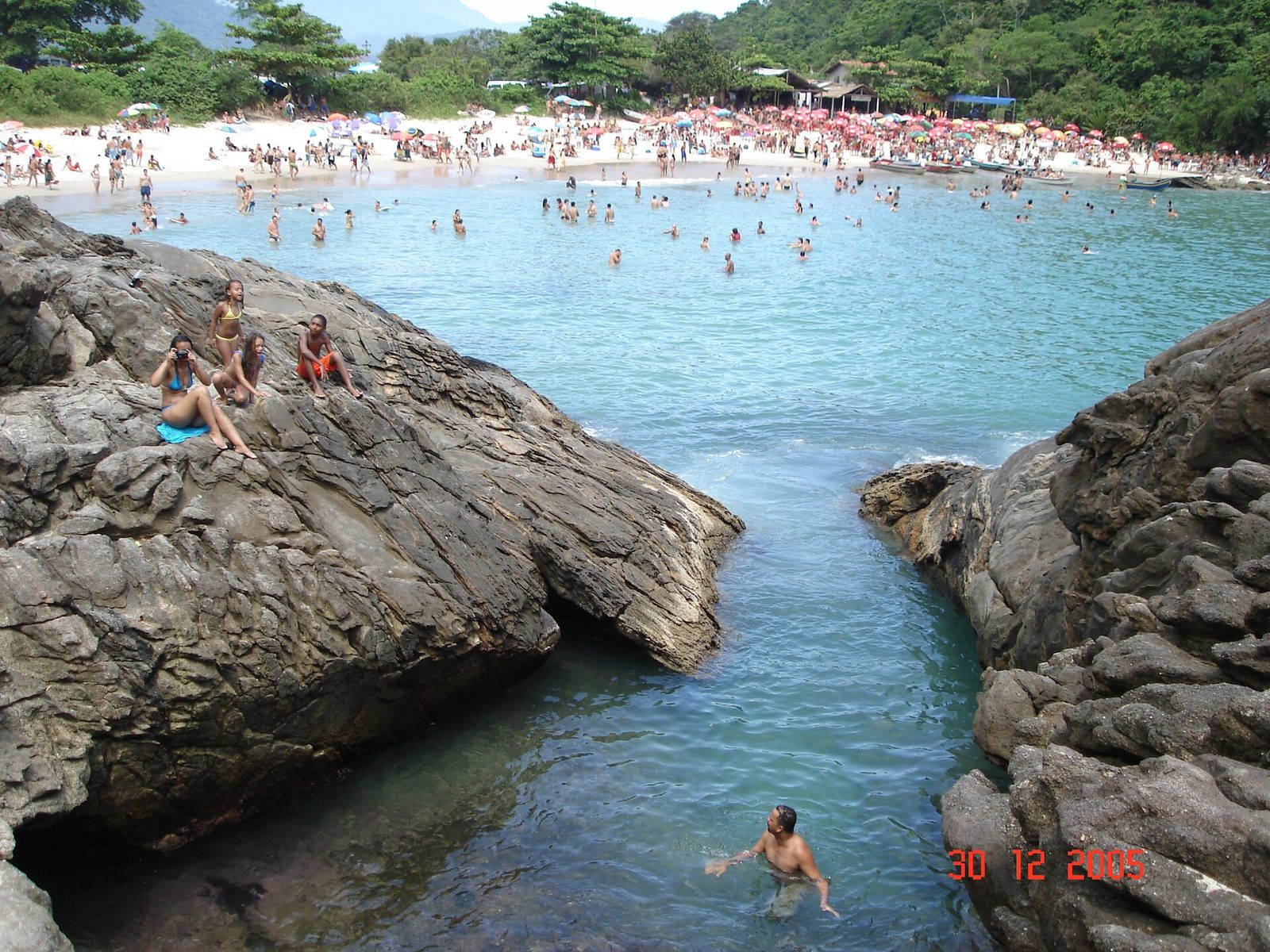
Praia do Cachadaco and the Costao walk
Just before the natural pool, at the far southern end of the village's beaches, is Praia do Cachadaco itself, a small, calm, sheltered beach that many people rate the prettiest in Trindade. It is reached either by the same Costao trail from Praia do Meio or, when the boats are running, by a short ride around from the village beach. Because it takes a little effort to get to, Cachadaco beach is usually calmer and less crowded than the central sands, with clear, gentle water good for swimming, backed by forest and rock. For a lot of visitors it is the destination in its own right, with the natural pool as the reward just beyond.
The Costao trail that links these beaches, the walk over the rocky headland from Praia do Meio to Cachadaco and on to the pool, is the classic short hike of Trindade, and it is worth doing slowly for its own sake. It runs through a strip of well-kept Atlantic Forest, with the sound of the sea on one side, and it gives you the shifting views of the coast that you never get from the sand. It is not difficult, but it is uneven, with roots, steps, and stone, and it can be slippery, so proper footwear and a little care make all the difference. Allow more time than the distance suggests, both because you will want to stop and because in high season you will be walking with plenty of company.
Beyond these gentle walks, Trindade sits at the edge of much bigger country. The forested hills behind the village climb toward the Serra da Bocaina, and the protected coast runs south toward wild bays reached only on foot. You do not need to go far to feel it; a short way up any trail and the crowd falls away and the forest closes in. That is the quiet secret of Trindade: the beaches are the draw, but the green wall behind them is never more than a few minutes' walk away, and it is the same Atlantic Forest that clothes the mountains around the reserve. For the full run of beaches up and down this coast, our Paraty beaches guide sets Trindade in context.
Eating in Trindade
Eating in Trindade is a simple, seafood-first pleasure, and it is one of the real reasons to linger past your swim. This is a fishing village, and the best of its food is the plainest: fresh fish and shrimp, grilled or fried or cooked into a moqueca, the coastal stew of fish, coconut milk, palm oil, and coriander that is the signature dish of this shore. Along the main street and behind the beaches you will find small family restaurants and kiosks doing exactly that, without ceremony, and a plate of the day's catch with rice, beans, and farofa eaten a few steps from the sand is hard to beat.
The beach kiosks, the barracas, are an institution in their own right, and much of a Trindade day happens at them. You settle at a plastic table more or less on the sand, and they bring cold drinks, fried fish or shrimp, pasteis, chips of fried cassava, and whatever else is going, all afternoon long. It is casual and unhurried, and it is how most people eat here: not a booked dinner but a slow grazing through the day between swims. Prices are reasonable by beach standards, though as everywhere the sand adds a little to the bill, and many kiosks take cash only, so come with notes.
What ties it together is caicara cooking, the traditional food of this coast, built on fish, cassava, banana, and whatever the forest and sea provide. It is not fancy, and it is not trying to be; it is the honest cooking of a place that has always lived off the water. If you want to understand where it comes from and what else to look for around Paraty, our Paraty food and cuisine guide goes into the region's kitchen in more depth. In Trindade the advice is short: eat the fish, eat it simply, eat it near the water, and do not be in a hurry.
Staying in Trindade, or day-tripping from the reserve
One of the questions every visitor faces is whether to make Trindade a base or a day out. Both work, and the right answer depends on the kind of trip you want.
A day trip from the reserve
From the reserve, Trindade is a day trip: you drive down the mountain to Paraty and then south along the coast, spend the day on the beaches and the trails, and drive back up in the evening to the cool and the quiet of the forest. It makes a full day rather than a quick one, so it pays to start early. Early also beats the worst of the parking and the crowds, and it pays to keep the plan loose around the weather, since the pool and the surf both depend on a settled sea. The advantage of basing yourself at the reserve is exactly the contrast: you get the beach when you want it and the forest, the streams, and the waterfalls the rest of the time, and you sleep somewhere calm and uncrowded rather than in the thick of the summer crush.
A night or two in the village
Staying in Trindade itself is a different experience, and for some trips it is the right one. The pousadas and campgrounds are simple and mostly small, and a night or two lets you see the village at its best, in the early morning on the beaches before the day-trippers arrive, and in the evening after they have gone, when the streets empty and the place settles back into itself. If your whole aim is beach days and a barefoot pace, and you do not mind modest lodging and a busy village in peak season, staying puts you right on the sand. Just go in knowing that Trindade in high summer is popular and lively, not a retreat, and that the quiet comes at the edges of the day.
For most guests of the reserve, the natural pattern is to stay up the mountain and come down to Trindade for a day on the coast, treating the beaches as one bright chapter in a trip built around the forest. Whichever way you split it, the reserve makes a calm base and the coast a fine day out from it.
Visiting a protected place responsibly
Everything that makes Trindade worth the trip, the clear pool, the forest trails, the fish, the caicara village, exists because this is a protected coast, and it will only stay that way if visitors tread lightly. Trindade sits inside the Cairucu protected area, and the crowds it now draws are the main pressure on it, so how you visit matters.
Crowds in high summer
The heart of the problem is timing. In the Brazilian summer holidays, over New Year, and at Carnival, Trindade receives far more people than a small, fragile coast can comfortably hold, and the pool, the trails, and the beaches all show the strain. The single most responsible thing you can do is come at a quieter time, a weekday, the shoulder months, or simply early in the morning, both for your own sake and for the coast's. If you must come in peak season, come early, be patient, and accept that you are one of many; do not add to the problem by trampling off the trails or crowding onto the rocks of the pool.
Come early, or come off-peak
Trindade's beauty and its crowds are the same story. In January, over New Year, and at Carnival the village fills, the access road backs up, and the parking lots at the entrance are full by mid-morning. The fix is timing: come on a weekday, come in the shoulder or cooler months, and start early whenever you come. An arrival soon after the day begins buys you a parking space, an emptier trail to the pool, and an hour of the coast closer to how it looks in the photographs, before the day-trippers come down the hill.
Leave no trace
The basics matter more here than almost anywhere, because so many feet pass through. Take out everything you bring in, including food scraps and cigarette ends; there are few bins and the sea takes the rest. Do not stand on or break the rocks and living things in the natural pool, do not feed the fish, and use reef-safe sunscreen if you can, since the pool is a small enclosed habitat and whatever you wear into it stays in it. Keep to the marked trails so the forest on either side is left alone. None of it is difficult; it is simply the price of a place this good staying good.
The people who live here
Trindade is not a theme park; it is a working village where caicara families still live, fish, and run the pousadas, kiosks, and boats. Treat it as their home, because it is. Buy from local people, pay the small parking and access fees where they are charged without grumbling, since they help manage and protect the place, and be courteous in the village and on the water. The relationship between the crowds and the community is not always easy, and a little respect from each visitor goes a long way toward keeping it healthy. You are a guest on a lived-in coast, not a customer at a resort, and the difference shows in how the place is treated.
Practicalities: cash, shoes, sun, and parking
Trindade is simple, but it is not slick, and a good day here rewards a little preparation. A few practical notes save a lot of bother.
Bring cash, and more than you think. Trindade has little in the way of banks or reliable cash machines, and many kiosks, small restaurants, boatmen, and the parking and access points take cash only. Arriving with enough notes for the whole day, for food, drinks, parking, a boat, and any pool access, spares you hunting for a machine that may not be there or may be empty. Parking is the other recurring headache. The lots are at the village entrance, and cars are kept largely out of the narrow inner lanes, so you park and walk in. On busy days those lots fill early, which is one more reason to come in the morning; late arrivals may park well up the hill and face a hot walk down. The lots are run locally and charge a fee, part of how the village manages the crush.
For a comfortable day, pack for a simple, self-sufficient beach outing:
- Cash in small notes, for kiosks, boats, parking, and any access fees
- Water shoes or trail shoes you can grip and climb in, for the Costao trail and the rocks around the pool
- Strong sun protection: reef-safe sunscreen, a hat, and a light shirt or rash top
- Your own mask and snorkel, since there is little to rent
- Plenty of drinking water, especially if you are walking to Brava or Cachadaco
- A dry bag for phone and valuables, and a towel and a change of clothes for the drive home
None of this is heavy, and Trindade is forgiving of a relaxed plan, but the combination of open sun, rocky trails, cash-only kiosks, and full parking lots catches out plenty of day-trippers. Come prepared for a simple, self-sufficient beach day and the village gives you an easy one.
Safety at the beaches and on the trails
Trindade is a gentle place in calm weather, but it is a real coast with real hazards, and the honest advice is to respect the water and the rock. The open beaches, Cepilho and Praia Brava above all, face the ocean directly, with surf that can be heavy and currents that can pull. There are no lifeguards to speak of, so you are your own judge: watch the water before you go in, swim only where you can clearly stand and where others are swimming, keep children within arm's reach, and stay out of the heavy surf if you are not a strong, confident ocean swimmer. If the sea is big, make it a day to walk and watch rather than to swim.
The natural pool is far safer than the open beaches when the sea is calm, which is exactly why it is the family favorite, but it is only safe when the sea is calm. On a big swell the pool churns, the water clouds, and the sheltered feel disappears, so read the conditions and do not go in if the ocean is throwing water over the rocks. The rocks themselves, at the pool and along the Costao trail, are slippery, and a fall on wet granite is the most common injury here. Wear shoes with grip, use your hands on the steep bits, and slow down.
Read the sea before you swim
The single rule that keeps a Trindade day safe is to let the ocean decide. On the open beaches, strong surf and rip currents mean you should swim only where you can stand and where others already are, and never alone in big conditions. At the natural pool, the water is calm and clear only when the sea outside is calm; on a heavy swell it churns and turns dangerous, so save the pool for a settled day. And treat every wet rock, at the pool and on the trail, as slippery, because it is.
Two more things catch people out. The tropical sun here is fierce, doubly so reflected off sand and water, and sunburn and heat are the commonest things that spoil a beach day; cover up, reapply sunscreen, drink steadily, and take shade in the middle of the day. And the trails, easy as they are, are unpaved and uneven, so wear real shoes, carry water, and give yourself daylight, because you do not want to be finishing the walk back from Brava or the pool in the dark. Handle the sea, the rocks, the sun, and the trail with a little respect and Trindade is as safe as it is lovely.
Forest above, sea below
The real gift of this corner of the coast is not Trindade alone but the pairing of it with the mountains behind, salt water below and cool forest above, a short drive apart. From the reserve you wake among the streams, the banana grove, and the canopy, spend a morning on the trails or at the seven waterfalls, and then, on the days you want the ocean, drive down to Trindade and choose your kind of coast: the calm of the village beach, the surf at Cepilho, the quiet sand at Cachadaco, or the clear water of the natural pool. In the evening you climb back up the mountain to the cool and the quiet, leaving the crowds on the sand behind you.
That combination is the whole idea of being here. Trindade is one of the bright, busy pleasures of the region, best taken early and off-peak and always with respect for a small, protected coast; the reserve is the calm, uncrowded base that lets you dip into it and then retreat. Come down for the beaches and the pool, eat the fish by the water, walk the Costao trail while it is quiet, and then go home to the forest.
When you are ready to shape the trip, how many beach days, which walks, and how to weave the coast around time in the forest, have a look at our guide to planning a stay to see the chalets and how booking works. For the rest of the region, from the town to the waterfalls to the other beaches, the full set of orientation pages lives in our local guides. Forest above, sea below, and a laid-back fishing village in between: that is a good week on the Costa Verde, and Trindade is one of its best days.