
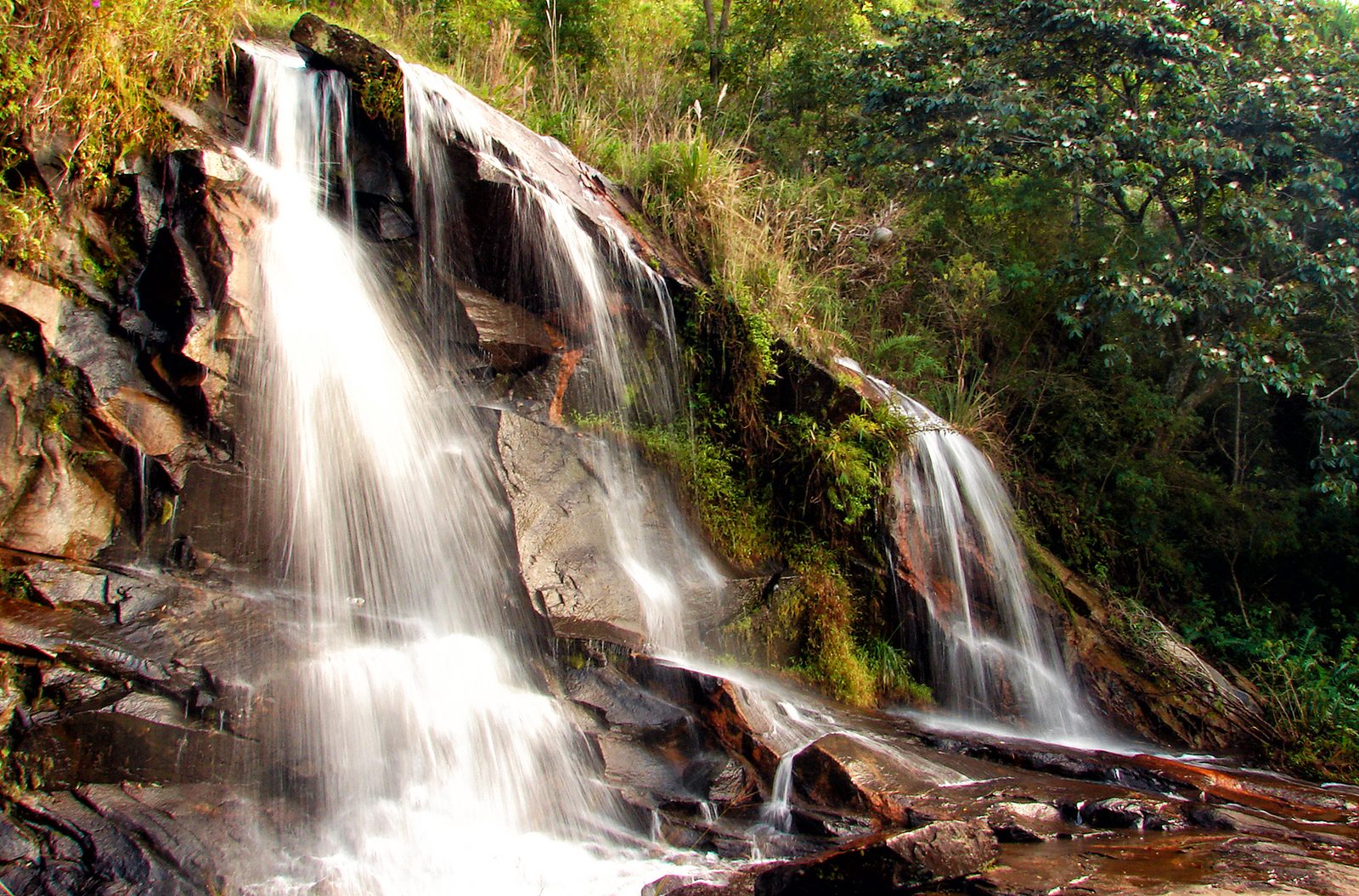
The country behind Paraty is built to shed water. Stand anywhere on the Costa Verde in the wet months and you can hear it working: streams running down through the forest, gathering in the folds of the mountains, and dropping wherever the granite gives them an edge. Some of that water slides over rock polished smooth enough to ride like a chute. Some of it falls into deep green pools ringed by fig roots and bamboo. A little of it runs straight off the forest and into the sea. Add it all up across the ridges and river valleys around town and you have one of the densest gatherings of waterfalls anywhere on the Brazilian coast.
This guide is about that wider circuit, the public and semi-public falls scattered through the Paraty region, from a rock waterslide a short drive from the old town to a remote cascade reached by boat and a multi-day trek deep in a national park. It is not about the seven falls on our own reserve, which are private and walked only from the trails above the chalets. Think of it instead as an orientation to the whole watershed: how these falls come to be here, where they cluster, how to match one to the day and the party you have, and how to enjoy them without getting hurt or leaving a mark. It is part of our Local Guides, written for people who want to understand the place rather than just tick it off.
A good waterfall day in Paraty is planned around three things: water, effort, and weather. The falls change character with the season and even with the last few days of rain, and the difference between a fine afternoon and a frightening one is often just timing. What follows works through the main areas one by one, then steps back to the practical questions, choosing by effort, swimming safely, going with a guide, and reading the sky, so you can build a plan that fits a family with small children or a party ready for a long climb.
- Where
- The mountains and coast around Paraty, on the Costa Verde of Rio de Janeiro state
- Getting there
- By car, on foot with a local guide, or by boat, depending on the fall
- Best season
- Year-round; fuller flow after the summer rains, clearer and calmer water in the drier winter
- Difficulty
- Everything from a roadside pull-off to a multi-day mountain trek
- Time needed
- An afternoon for the easy falls, full days or overnights for the remote ones
- Water
- Cool mountain streams, some clear, some stained tea-brown by the forest
- Guides
- Helpful everywhere, essential on the long backcountry routes
- Safety note
- Rivers can surge without warning after upstream rain; leave slick rock and unknown pools alone
Why this coast collects waterfalls
Two ingredients explain the sheer number of falls around Paraty: a wall of mountains standing right at the sea, and hard old rock underneath it. A short way inland the land tilts up sharply into the Serra do Mar and its high inner reach, the Serra da Bocaina. Rivers here are short and steep as a result. Rain that falls near the crest has only a few miles to travel before it reaches the ocean, and it loses all its height along the way. Water in that much of a hurry does not meander; it falls.
The result is variety as much as number. Within an hour or two of the same small town you can find a slick rock slide, a curtain of water dropping into a black pool, a broad shallow cascade a child can paddle in, and a fall that lands almost on a beach. That range is a gift for a traveler, because it means you can pick a fall to suit the mood and the company on any given day rather than settling for whatever happens to be nearest. It also means that no two outings on this circuit feel quite the same, even in a single week.
The mountains that make rain
Moist air drifts in off the warm Atlantic and runs into the mountain wall, where it is forced up and cooled until it drops much of its water as rain. This is some of the heaviest, most reliable rainfall in Brazil, and it feeds hundreds of small streams across the range. The forest that clothes the slopes, the Mata Atlantica, holds that water in its soils and roots and lets it out slowly, so the streams keep running even through a dry spell. That slow release is why the region stays green and wet when other parts of the country brown off, and why even in winter most of the falls still flow.
Granite, ledges, and plunge pools
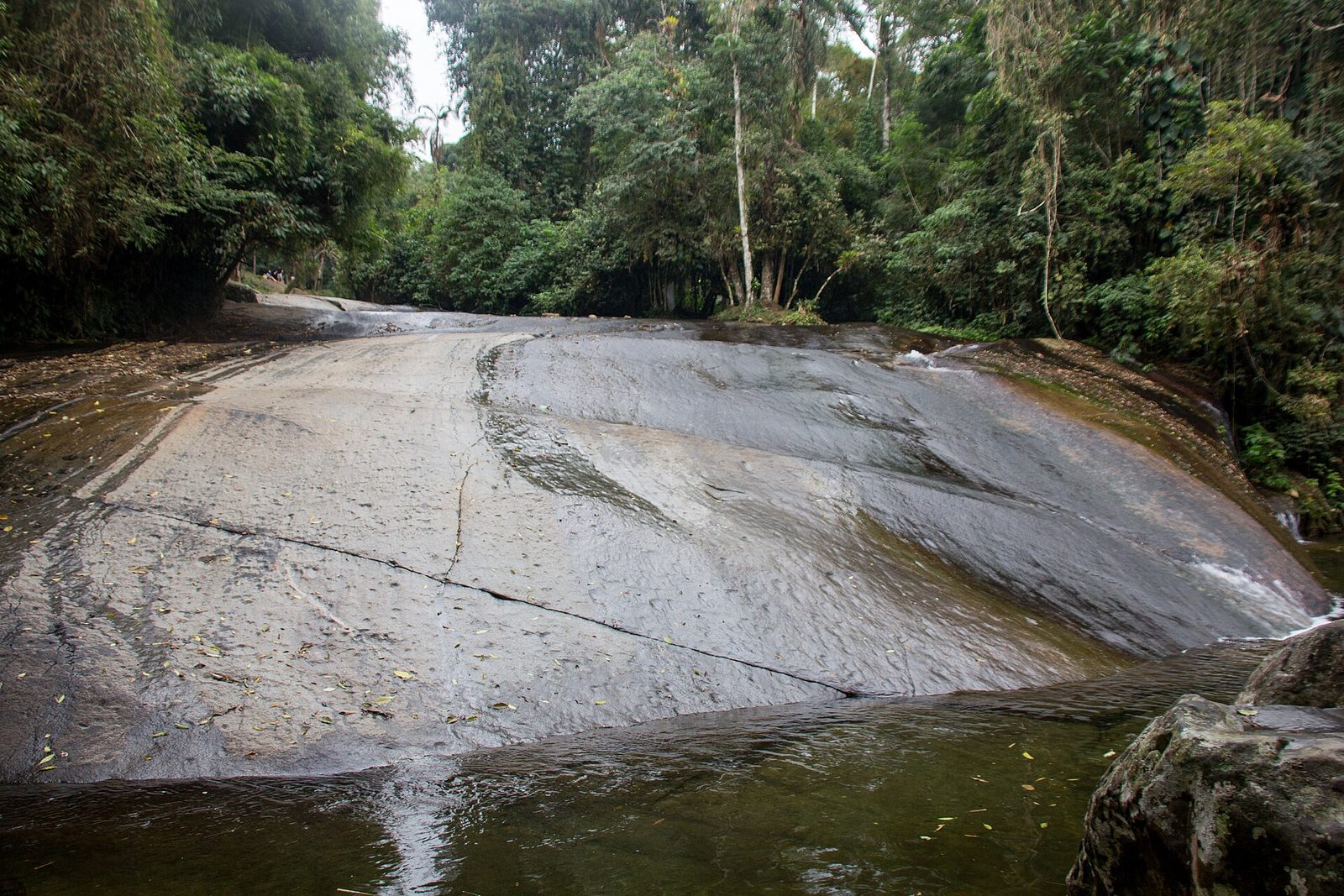
The mountains themselves are ancient crystalline rock, granite and gneiss. Where a stream crosses a band of harder, unbroken stone, it cannot cut down easily and spills over the lip; where the rock is jointed or softer, the falling water drills out a pool below. Repeat that down a mountainside and you get a staircase of falls and pools, the pattern you meet again and again in this region. And where the current runs across a long sheet of unbroken granite, it polishes the stone smooth over centuries into the natural slides the area is known for. The rock does the shaping; the rain just keeps it fed.
The whole coast is tilted for water: the mountains catch the rain, and the granite hands it down step by step.
The reserve's seven falls, and why they stay private
One point before the tour, because it is easy to confuse. The seven falls that give this reserve its name are not part of the public circuit described below. They lie inside the 800 acres we protect, reached on foot from the trails above the chalets, and they are kept for guests and for the forest rather than opened to day visitors or tour vans. That is a deliberate choice, not an oversight.
Conservation is the whole reason the reserve exists, and waterfalls are among the most fragile places to bring crowds. Foot traffic wears down banks, muddies pools, frightens the animals that come to drink, and leaves litter in water that should be clean enough to cup in your hand. By keeping our own falls quiet and lightly walked, we keep them healthy, and the same restraint protects the animals, the water quality, and the soil that holds the whole slope together. So we do not sell tickets to them, and we ask guests to visit them only with the reserve's own guidance and on the trails we maintain. If you are staying with us, you will find them described on the seven waterfalls page. If you are building a broader itinerary, everything else in this guide is open to the public in one form or another. Keep the two straight in your mind: our seven are private and cared for as part of the preserve; the falls that follow are the shared inheritance of the wider region, and worth every mile.
It is worth adding that private ownership is the rule rather than the exception across the whole area, not just on the reserve. A great many of the public falls described below sit on land that belongs to a family, a rural community, or the national park, and are shared with visitors under conditions the owners set. Understanding that changes how you move through the region: you are almost always a guest on someone's ground, and the falls stay clean and unspoiled in large part because the people who live beside them look after them, generation after generation.
How the falls are grouped: a rough map
You can hold the region's waterfalls in your head as a handful of loose clusters, which makes planning far easier than treating them as one long list. Nearest town, along the old road that climbs toward Cunha, is the Penha and Pantanal cluster, the easiest to reach and the busiest, and home to the famous waterslide. Higher on that same road and its side valleys is a scatter of roadside falls you can string together in an afternoon.
Off the coast to the south, reachable mainly by boat, are the sea-meeting falls, of which Saco Bravo is the best known. Behind and above all of it rises the Serra da Bocaina, a national park whose highlands hold the biggest and most remote cascades along with the historic gold road. And over the top of the mountains, on the cooler Cunha side around Pedra Branca, is another set of falls in higher, thinner forest. Distances feel longer than they look on a map, because the roads wind and the trails climb, so it pays to give each cluster its own outing rather than trying to chain them across a single day.
If you have several days, a natural rhythm is to work outward from town. Start with the easy Penha cluster to get your bearings, add a boat day to a sea fall when the forecast is calm, save the long mountain trails for a morning when everyone is rested, and keep a roadside fall or two in reserve for the in-between afternoons. Spreading the effort out this way also spreads the risk sensibly, since you are never far from help on the gentle days and can be fully prepared on the hard ones. It leaves room, too, for the days you decide to stay put and let the forest come to you.
The Penha and Pantanal cluster: Toboga and its neighbors
Closest to town, and the first falls most visitors meet, is the group around the village of Penha and the neighboring locality of Pantanal. A short drive up the road toward Cunha brings you to a clear river that steps down through a series of pools and chutes, easy to reach and easy to spend a half-day around. The full rundown lives on the Cachoeira do Tobogá and Penha page; here is the shape of it.
The waterslide at Toboga
The star is Cachoeira do Tobogá, a long tongue of granite that the river has polished so smooth it becomes a natural slide. People sit down and let the current carry them into the pool at the bottom, and the boldest local guides run it standing upright, but that takes years of practice and a great deal of nerve, and it is not something to attempt on your own. The rock is slick with water and a film of algae, so even walking beside it demands care and a good sole underfoot.
The village, the chapel, and the pools
Around the slide is an easygoing scene: a small chapel on the rise, a couple of riverside bars where you can eat a plate of fish and drink something cold, and quieter pools upstream and down for anyone who would rather wade than ride. It is the one fall in the region that works well as a half-day out for a mixed group, with shade and a place to sit for those not going in the water. Because it is close to town and well known, it draws a crowd on warm weekends; a weekday morning is calmer, and the light is better for it too.
Pedra que Engole, the spot to respect
A little downstream is a place that demands real respect: Pedra que Engole, the swallowing rock, where the river pours into a narrow slot in the granite and disappears under the stone for a stretch. It is exactly as dangerous as it sounds, and people have been pulled in and drowned there. Look at it from dry ground, keep children close by the hand, and never climb into the channel or the fast water just above it. It is a thing to witness, not to test.
Respect the swallowing rock
At Pedra que Engole the river funnels into a slot in the granite and runs beneath the rock. Admire it from dry ground, keep well back from the lip, and never enter the channel or the pool that feeds it.
Easy roadside falls along the mountain road
Beyond Penha the road toward Cunha keeps climbing, and side valleys open with more falls, several of them close enough to the pavement for a quick stop. Falls like Cachoeira do Iriri and its neighbors are the kind you reach on a short walk from a pull-off, ideal for cooling down between other stops on a hot day. Some sit on private land where a family keeps the path clear and asks a small fee at the gate; some have a simple snack stand; a few are just a gap in the trees and a scramble down to the water on a rope and root.
Because they are easy, these falls suit travelers with less time or energy, and they make a gentle introduction for children who are not ready for a long trail. The trade-off is that easy access brings more visitors, and at the popular ones that shows as worn banks and the occasional stray can. Go early, tread lightly, and carry out everything you carry in. Cell coverage thins quickly as you climb into the hills, so tell someone your plan before you set off and do not count on a map loading at the trailhead. Half the pleasure of these stops is their looseness; you can pull over on impulse and be in the water ten minutes later.
What you will not usually find at the smaller falls is much in the way of facilities, so plan to be self-sufficient. A flat rock to change behind and a rope handrail down the bank is about as developed as many of them get. That plainness is part of the appeal; it keeps them quiet and unpolished, closer to the way the whole coast felt a generation ago. Take the roadside falls for what they are, a quick and honest dip on a hot afternoon, rather than expecting the shade, snacks, and easy footing of the busier spots.
Saco Bravo: the waterfall that meets the sea
South of Paraty the coast breaks into a run of coves and forested points, and in one of them fresh water comes off the mountain and falls almost straight into the ocean. Saco Bravo is the region's classic sea-meeting fall, and one of the more memorable outings on the whole circuit. Most people arrive by boat, on a schooner tour or a hired launch, because the land route is a long and rough trail through the forest and along the shore. Boats anchor in the cove and swimmers go ashore to stand under the freshwater fall and rinse the salt away, with the open Atlantic at their backs.
The water is cold coming off the mountain and the setting is genuinely wild; there are no bars, no railings, and often no one else once the day boats move on. Because the cove faces open water, conditions depend on the sea as much as the sky. A calm day makes the landing simple; a swell makes it a poor idea. Go with a boatman who knows the spot, watch the surge working on the rocks, and do not swim out past the shelter of the point. It is the kind of place that rewards patience and a good forecast.
Half the pleasure of Saco Bravo is the trip out to reach it. A day on the water south of Paraty threads past forested islands and quiet beaches, and most tours pair the fall with a swim stop or two and time in clear water. If anyone in the party is prone to seasickness, take something for it before you leave the dock, and bring more sun protection than you think you need, because there is little shade on an open boat. Confirm with the operator that the fall is actually on the day's route as well, since not every schooner trip includes it.
At Saco Bravo the water runs straight off the forest into the ocean, and for a moment you can stand in both at once.
Into the Serra da Bocaina: the gold road and Santo Isidro
Behind the coastal falls rises the Serra da Bocaina, a national park that protects a great sweep of Atlantic Forest from the shoreline up to the highlands. Its rivers make the biggest and most remote cascades in the region, and threading through it is one of Brazil's most storied paths. The park itself, its scale and its rules of access, is covered on the Serra da Bocaina park page; what matters here is that this is where the falls turn serious.
The old stone road
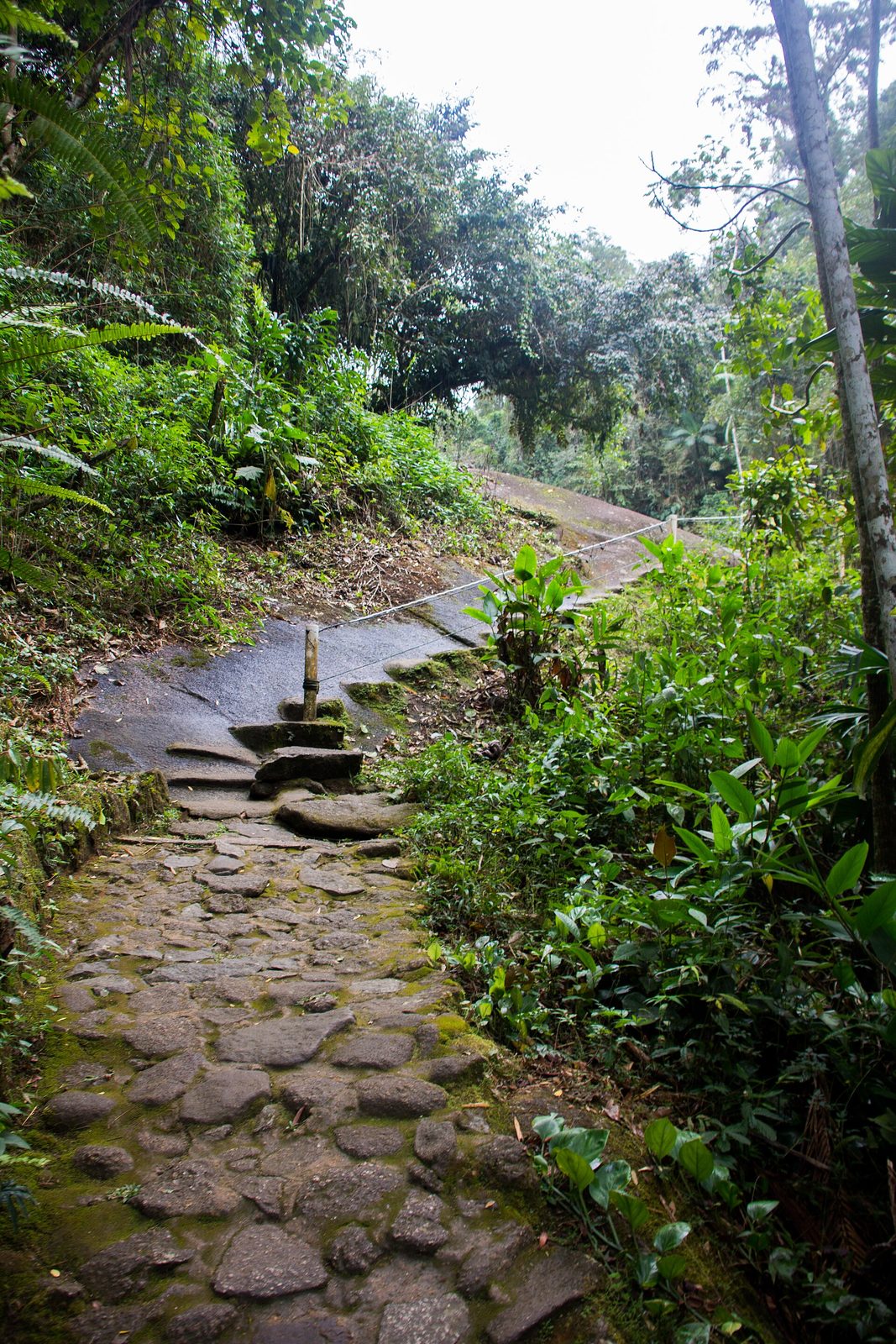
In colonial times, gold from the interior came down to the port at Paraty along a paved mule road cut straight up the mountain. Long stretches of that stone paving survive, restored and walkable, and a day hike on the old road is one of the best short forest walks near town. Our forest hikes on the gold trail page lays it out in detail. The path climbs in worn stone steps under tall trees, past small falls and pools where you can cool your feet, with three centuries of history underfoot the whole way.
The long Trilha do Ouro and Cachoeira Santo Isidro
For those with the time and the legs, the same historic route runs far beyond the day-hike section as the Trilha do Ouro, a multi-day crossing that descends from the Bocaina highlands toward the coast through deep, untouched forest. Along it stands Cachoeira Santo Isidro, one of the tallest and most impressive falls in the region, a long white drop into a forest pool that is well worth the effort to reach. This is real backcountry. The route calls for a licensed guide, park registration, and an overnight or two, and the weather up in the highlands can turn fast and cold. It is not a walk-up fall, and that is precisely why it stays so unspoiled.
Over the mountains: the Cunha side and Pedra Branca
Follow the road all the way over the top of the Serra and you cross into cooler, higher country around Cunha, where the forest thins and the air carries a mountain chill even in the summer. This side of the divide has its own falls, gathered around districts such as Pedra Branca on the long climb up from the coast. The water here tends to run clear and very cold, tumbling through rock in higher, more open valleys than the ones near the sea.
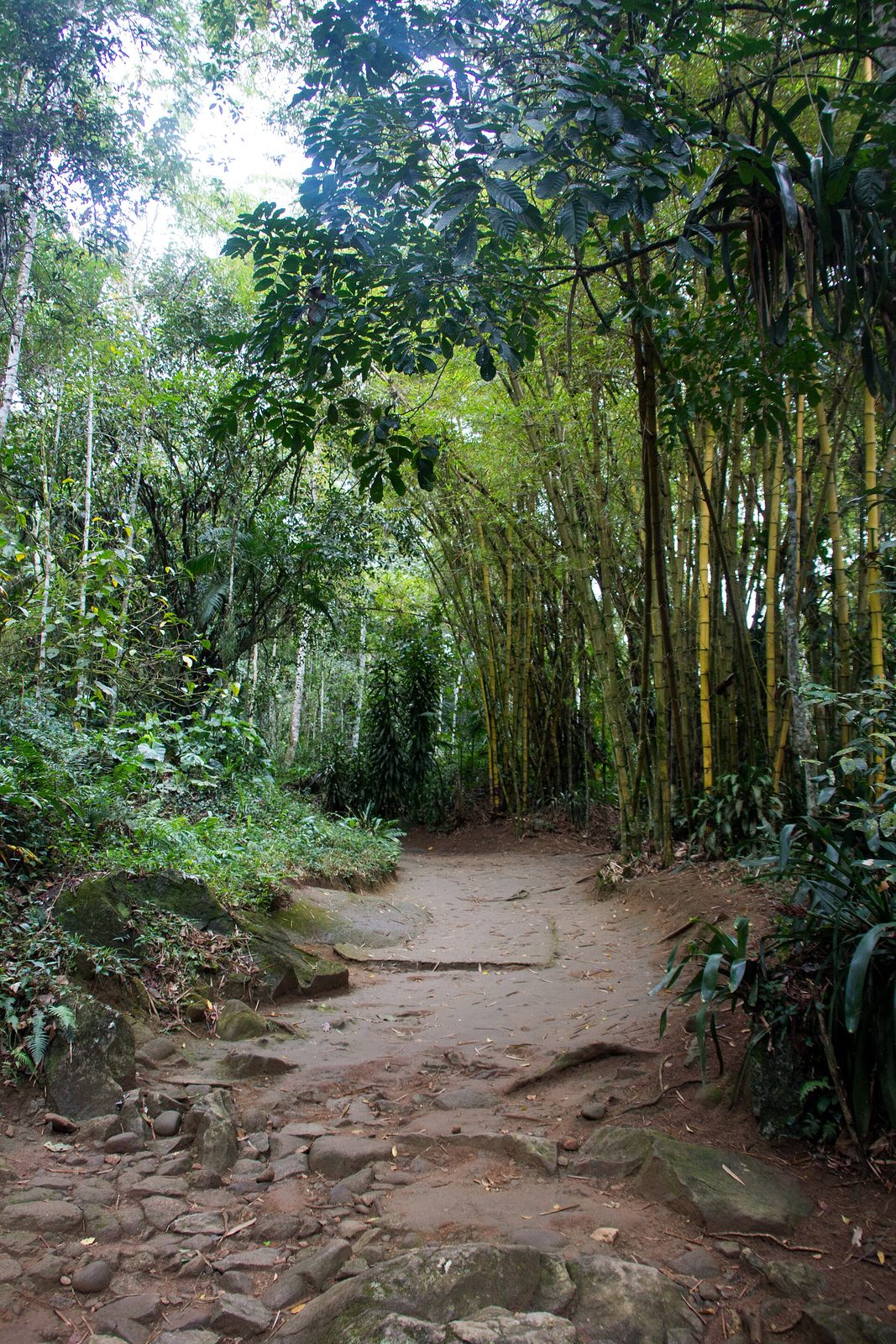
Because it takes real driving to get up and over the range, the Cunha-side falls see fewer beach-town crowds and reward anyone willing to make a full day of the mountain road, which is a fine drive in its own right, with long views back toward the coast on a clear morning. Some of the falls sit on farms and smallholdings where the family minds the trail and may ask a modest fee; the approach is often a walk of an hour or so through forest, sometimes under arching stands of bamboo, before the sound of falling water reaches you. Bring a layer, because the temperature drops noticeably with the altitude, and start early, since the mountain clouds tend to build through the afternoon and can close in quickly.
Cunha itself, just over the line into Sao Paulo state, is a small mountain town known for its wood-fired pottery studios, and it makes a natural pairing with a fall on this side of the range. The contrast is the appeal: within a single drive you go from the humid, palm-lined coast to a cool upland of pines, pastures, and workshops, with the temperature dropping the whole way up. It is a longer day than the near falls demand, so it suits travelers who enjoy the drive itself and want to see how quickly the country changes once you climb above the coastal forest.
Choosing falls by effort
The single most useful question to ask before you set out is how far you actually want to walk. The region's falls sort roughly into three tiers of effort, and matching the tier to your group saves a great deal of grief at the trailhead. A moderate fall might mean an hour on a forest path, some of it climbing, with rougher footing than the roadside stops but a quieter pool as the payoff.
- Roadside and easy: falls a short, flat walk from a car or a boat, such as the Penha cluster, the pull-offs along the mountain road, and the landing at a sea fall. Good for young children, older travelers, and short days.
- Half-day walk: falls an hour or two in on a forest trail, with some climbing and uneven ground, such as the day-hike stretch of the old gold road and many of the Cunha-side pools. Good for anyone comfortable on their feet in the heat.
- Expedition: remote falls that need a full day, a boat, or an overnight with a guide, such as Saco Bravo on a rough day or the deep Trilha do Ouro to Santo Isidro. For fit, well-prepared parties only.
Whichever tier you choose, add time for the heat and the stops, because nobody hurries past a good pool. And be honest about the weakest walker in the group; a fall is only as enjoyable as the trail back out at the end of a long, hot day.
Swimming and pool safety
The falls are made for swimming, and for most of the year the water is a welcome cold after the coastal heat. But moving water and slick rock cause real injuries here every season, and nearly all of them are avoidable with a little care. The most serious danger is the one you cannot see coming: a sudden surge of water down a river after heavy rain higher up the mountain, even while the sun is shining where you stand. Locals call it a cabeça d'água, a head of water, and it can turn a gentle pool into a torrent within minutes. If the water starts to rise or cloud, or you hear a growing roar from upstream, get out and up the bank at once and do not go back for anything.
- Never dive or jump into a pool you have not checked; rocks and depth hide under moving water, and the tea-colored pools give nothing away from the surface.
- Treat wet granite as if it were ice, especially near the lip of a fall, since most accidents happen on the walk rather than in the water.
- Keep back from the top of any drop and out of the fast water feeding a chute or a slot, because the current is always stronger than it looks.
Cold water deserves respect of its own. The mountain pools can be sharp enough to knock the breath out of you on the first plunge, so ease in rather than leaping, and climb out before you start to shiver hard. If someone does get into trouble in the water, resist the instinct to jump straight in after them; reach out with a branch or a pack strap, or throw them something that floats, so that one person in difficulty does not become two. Know where the nearest road and the nearest help are before you settle in for the afternoon, because on the remote falls you are your own rescue.
Watch children constantly, do not swim alone at the remote falls, and skip the water altogether after a big rain when the rivers run high and brown. Alcohol and cliff edges do not mix. The boldest local stunts, running a slide upright or leaping from a height, are done by people who know each rock by heart and have learned the water over a lifetime. Admire them; do not copy them.
Going with a guide, and etiquette on private land
A word on guides and manners, because both matter more here than at a typical tourist site. Many of the best falls sit on private or community land, on smallholdings, old farms, and caiçara communities whose families have lived along these rivers for generations. The custom is simple and worth honoring: ask before you enter, respect a closed gate, and pay the small fee if one is asked, because it maintains the trail and supports the family who keeps it open. Treat the visit as time on someone's home ground, which is exactly what it is.
For anything beyond the roadside falls, a local guide is worth far more than the fee. A good one knows which pools are safe to swim, how a particular river behaves after rain, where the trail washes out, and the stories that turn a walk into something more than exercise. On the long backcountry routes into the Bocaina a licensed guide is not a nicety but a requirement, and going without one is both unsafe and unwelcome. Hiring locally also keeps tourism money in the rural communities that keep these forests standing, which is the whole point of low-impact travel in a place like this. The reserve is glad to help arrange trustworthy guides for guests who want to explore beyond our own trails.
Finding a good guide is not hard if you ask the right people. The reserve's team, a reputable local agency, or the association that manages a particular trail can each point you to someone licensed and experienced, and a short conversation beforehand tells you a great deal. Ask how well they know the specific fall you have in mind, what they carry for a minor injury, and how they read a river after rain. A guide who answers those questions plainly, and who is willing to call off a plan when the conditions turn, is exactly the one you want at your side on a long day in the forest.
When to go: flow versus clarity
The same fall can be two entirely different places depending on when you come to it. The Brazilian summer, roughly December through March, is the rainy season on this coast, and the falls run at their fullest and loudest then. They are powerful to look at, but the water is higher, faster, and muddier, and the risk of a flash flood is real. The drier winter months bring lower, clearer, calmer water that is safer to swim in and easier to reach, though some of the smaller falls slow to a thin trickle by the end of a long dry spell.
So the choice comes down, roughly, to power against safety and clarity. For most visitors, and certainly for anyone swimming with a family, the drier and cooler stretch of the year is the easier call. Whenever you come, though, the single best rule is to watch the last few days of weather rather than the calendar: after heavy rain, give the rivers a day to drop before you get in. The best time to visit page has a fuller month-by-month picture for planning a trip around water and weather together.
The time of day matters nearly as much as the season. Mornings are cooler for the walk in, the light is kinder on the water, and you tend to beat both the crowds and the afternoon clouds that build over the mountains. Weekends and Brazilian holidays fill the easy falls quickly, so if you can only visit a popular one, go early or save it for a weekday. The remote falls stay quiet almost regardless of the calendar, which is one more reason the longer walk so often repays the effort you put into it.
When to go
Falls run hardest in the summer rains from December through March and settle to clearer, safer water in the drier winter. After heavy rain, wait a day and let the rivers drop before you swim.
What to bring, and leaving no trace
You do not need much for the easy falls, and you need the right things for the hard ones, so it helps to pack for the tier you have chosen. A basic kit covers most outings and weighs almost nothing in a small pack.
- Footwear with grip that you do not mind soaking; sandals with a heel strap or old sneakers beat flip-flops on wet rock every time.
- Water, snacks, sun protection, and a dry bag or two for phones and keys, with extra drinking water on the longer trails where there is nowhere to refill.
- A light layer for the higher and cooler falls, a small first-aid kit for the long routes, and a charged phone in the dry bag even though coverage is patchy in the hills.
Beyond the kit, the most useful thing to carry is a flexible plan. Weather on this coast can change an outing at short notice, so it helps to keep a wet-weather alternative in mind, a shorter or lower fall you can switch to if the mountain rivers come up overnight. Leave the day loose enough to wait out a passing storm or turn back early without feeling cheated. The falls are not going anywhere, and the region rewards travelers who move at its pace rather than forcing their own onto it.
The forest that makes these falls is fragile, and how you visit decides what is left for the next person to find. Carry out every scrap you bring in, down to fruit peels and cigarette ends. Use sunscreen sparingly and let it soak in before you swim, since it films the surface of a still pool. Do not move rocks, build cairns, or wash with soap or shampoo in the streams, which carry everything downhill to someone else's drinking water. Keep to the trail so the banks do not erode, give wildlife plenty of room, and keep your voice down, because half the reward of a remote fall is the quiet you find there. These waters have been running far longer than the town beside them, and they will outlast all of us if we let them.
Planning your falls from the reserve
For guests, the reserve makes a calm base for all of this. We sit in the mountains above the seven falls of Paraty, a working bio-preserve of some 800 acres and a banana farm that has been tended organically for close to three centuries, with a small cluster of chalets set lightly into the forest. From here the Penha cluster and the roadside falls are an easy drive, the sea falls a short run down the coast, and the long trails into the Bocaina begin more or less at the ridgeline behind us. Many guests spend a morning on our own private streams and an afternoon out on the public circuit, then come back to the quiet at the end of the day. We are happy to help you match a fall to the weather, arrange a guide, or simply point you toward the pool that suits your party. When you are ready to plan a stay, our stays and booking page has the details, and the waterfalls will be running when you arrive.