
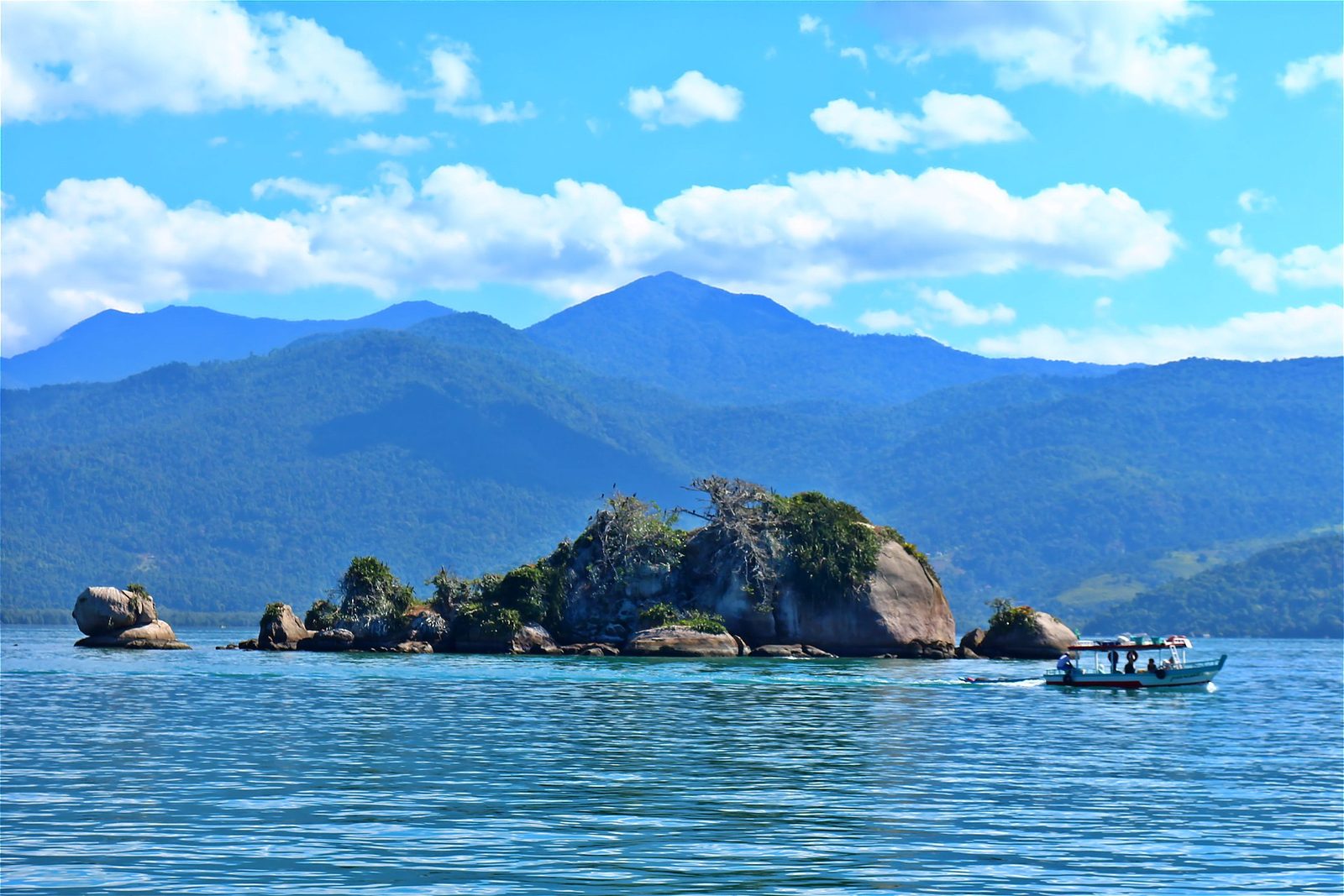
The sea at Paraty is not a single open beach but a sheltered, island-strewn bay, and that changes everything about how you visit it. Behind a scatter of small forested islands, the water lies calm and warm for much of the year, protected from the ocean swell by the shape of the coast and the islands themselves. Coves and quiet beaches ring the shore, many of them with no road to them at all. From the waterfront in town you look out on a maze of green humps and channels rather than a clean horizon, and the obvious question is not which patch of sand to walk to but how to get out among the islands. The answer, nearly always, is by boat.
There is more than one kind of boat day, and choosing the right one is most of the art of it. The classic outing is a slow wooden schooner — an escuna — that carries a deckful of people around the bay for the day, anchoring at islands and beaches to swim and snorkel. Faster and more flexible is a private lancha, a small motorboat you hire with a skipper and take where you like. Quieter still is a kayak or a stand-up paddleboard for the near shoreline, under your own power. Each shows you a different bay, and most visitors who stay a while end up doing more than one.
This is a practical guide to exploring Paraty Bay by water: how the schooner day works and where it takes you, when a private boat is worth the extra money, the paddling close to shore, the stops people always ask about — the Blue Lagoon, Ilha Comprida, Praia Vermelha, the snorkeling islands — where and how to book, the marine life you may see, how a bay day compares with the fjord at Mamanguá and a longer trip out to Ilha Grande, and the honest business of weather, seasickness, and boating the coast without harming it. For guests based up in the forest above the seven waterfalls, a day on the bay is the salt-water half of a stay here, and it repays a little planning.
- Where
- Paraty Bay, on the Costa Verde in southern Rio de Janeiro state
- The bay
- sheltered, warm water dotted with many small forested islands
- Main departure point
- the waterfront pier at the edge of Paraty's historic center
- The classic trip
- a wooden schooner, or escuna, on a day tour with several swim and snorkel stops
- Faster option
- a private lancha, a small motorboat hired with a skipper for a flexible day
- Favorite stops
- the Lagoa Azul (Blue Lagoon), Ilha Comprida, Praia Vermelha, and the snorkeling islands
- Calmest water
- usually the early morning, before the afternoon wind gets up
- Also within reach
- the Mamanguá fjord and, farther north, Ilha Grande
The bay at a glance
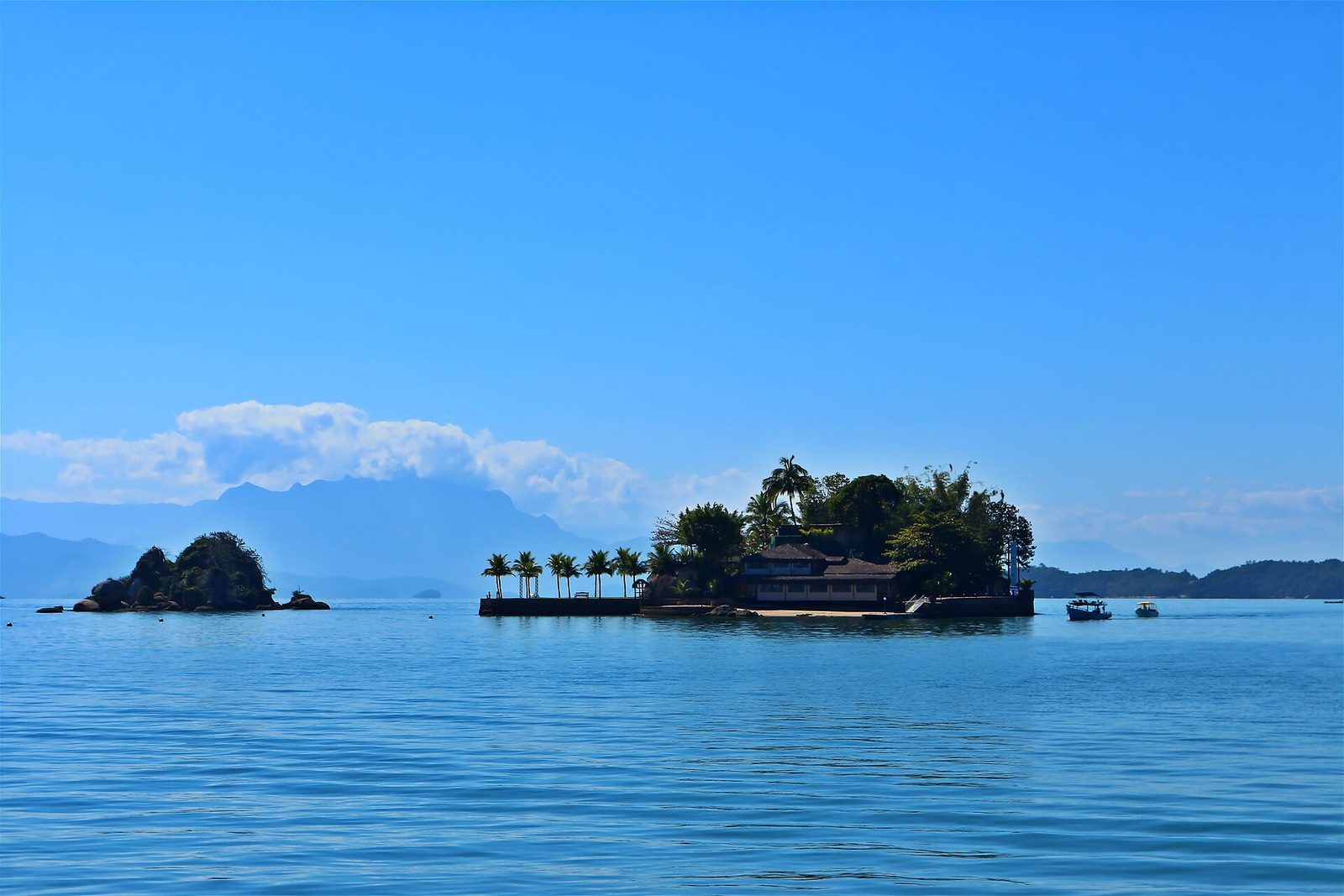
Paraty sits at the back of a wide, protected bay on the stretch of coast Brazilians call the Costa Verde, the green coast, where the mountains of the Serra do Mar drop almost straight into the sea. Because the land comes down so steep and so close to the water, the shoreline is broken into countless points, coves, and small beaches rather than a single long strand, and the bay itself is filled with islands — some no more than a rock with a few trees on it, others big enough to carry their own beaches and forest. The same Atlantic Forest that covers the reserve up the mountain runs right down to the tideline here, so the islands and headlands are green to the water's edge, and the bay is backed by forest rather than by building.
That shape is what makes the water so gentle. The islands and the curve of the coast break up the ocean swell before it reaches the inner bay, so for much of the year the water lies calm, warm, and clear, especially in the mornings before the wind gets up. It is water made for swimming, snorkeling, and easy pottering about in small boats rather than for battling surf. The ocean-facing beaches south of town, around Trindade, are a different and wilder story; inside the bay, the mood is sheltered and slow, and that is exactly what most people come out onto the water for.
It also means a boat is not a luxury here but the natural way to see the place. Many of the finest beaches and the best snorkeling simply have no road, and never will, because they sit on islands or on stretches of protected shore. To reach them you go by water, as people always have. Our guide to Paraty's beaches covers the sand you can drive or walk to; this page is about everything that starts at the waterline — the islands, the swim stops, and the boats that string them together.
The classic schooner day
For most visitors, the definitive Paraty day on the water is a tour aboard an escuna, the broad wooden schooner — sometimes called a saveiro — that you see lined up along the waterfront. These are unhurried, sociable boats, built for cruising rather than speed, usually with an open deck for sunbathing, some shade below, and a small bar and galley aboard. They run daily tours out into the bay, and the format has barely changed in years because it works: you turn up, find a place on deck, and let the crew carry you around a loop of islands and beaches while you swim, snorkel, and do very little else.
How the escuna day works
You do not need to plan a route or know anything about boats. A typical tour leaves the town pier in the mid-morning and returns in the late afternoon, making several stops along the way at different anchorages — a beach for swimming here, a clear cove for snorkeling there, a deep-water spot to jump off the deck somewhere else. At each stop the boat drops anchor and you have a stretch of time in the water before everyone climbs back aboard and moves on. Boats vary, and so do their exact routes and how long they linger, but the rhythm is always the same: cruise a while, anchor, swim, cruise again. It is the easy, no-arrangements way to see the bay, and it suits couples, families, and solo travelers equally, since everyone mixes on the same deck.
The pace, lunch, and the mood
The pleasure of the escuna is precisely its slowness. The boats move at little more than a walking pace over the water, which gives you time to watch the islands slide past, to swim properly at each stop rather than hurry, and to eat a long, lazy lunch. Some tours include a simple meal aboard; others stop at an island restaurant or a floating kitchen where you buy your own; drinks are usually sold on board, sometimes with music and a convivial, holiday feel by the afternoon. None of it is fancy. What you are paying for is a whole day afloat in beautiful water at almost no effort, in easy company, and for a first taste of the bay there is nothing better.
What it does and doesn't do well
Be clear-eyed about the trade-offs. Because these are group tours on a fixed loop, they are the most affordable and the most relaxed option, but also the least flexible. You go where the boat goes, you stay only as long as the schedule allows, and at the popular anchorages you will share the water with other schooners doing the same circuit — the Blue Lagoon at midday can be a small crowd of boats rafted together. If you want to snorkel in peace, reach a quiet beach, or set your own pace, the escuna will frustrate you. If you want a cheap, cheerful, sociable day with the work done for you, it is exactly right. Knowing which kind of day you want is how you avoid disappointment.
The private boat: a lancha of your own
If the schooner's fixed loop does not appeal, you can hire a private boat — usually a lancha, a small, faster motorboat, taken for a half or full day with a local skipper who knows the bay. This is the other main way people get out on the water at Paraty, and for a lot of travelers it is worth the difference. A lancha turns the day from a set tour into something you shape yourself.
What hiring a boat gets you
The first thing you buy is speed, and with it, reach. A motorboat covers the distance between stops in a fraction of the time a schooner takes, which means you can get to the farther, quieter corners of the bay and still fit in several stops — or reach a popular spot like the Blue Lagoon early, before the schooners arrive, and have the clear water briefly to yourselves. The second thing you buy is control. You set the route, you linger where you like and skip what you don't, you decide when to eat and where to swim, and a good skipper will read the day's weather and crowds and steer you to whichever coves are calmest and emptiest. For families with young children, for anyone who wants to snorkel undisturbed, or for a group that would rather picnic on a near-empty beach than share a busy one, that flexibility is the whole point.
Cost, sharing, and who it suits
A private boat costs more than a seat on a schooner — you are hiring the whole vessel and the skipper's day rather than buying one place among many — but the gap narrows fast when you share it. Split among a family or a group of friends, a lancha for the day can come out reasonable per head, and you get a trip tailored to exactly what you want. Smaller water taxis work on the same principle for shorter hops, dropping you at a particular island or beach and collecting you later, which is a good way to claim a quiet spot for a few hours. However you arrange it, agree the route, the timings, and the price clearly before you set off, and fix the pickup time firmly if you are being left somewhere with no other way back. We keep the exact figures out of this guide because they move with the season, the boat, and the length of the day; ask when you book, and compare a couple of operators rather than taking the first quote on the quay.
Kayak and stand-up paddle along the shore
For a slower, closer, quieter way onto the water, and one that asks nothing of an operator, there is the kayak and the stand-up paddleboard. The sheltered inner bay, and especially the calm stretches near shore, are well suited to both, and a paddle is one of the gentle pleasures of a stay on this coast — human-powered, silent, and close enough to the water to see straight down into it.
Paddling the near shoreline
This is close-in travel, not a crossing to the far islands. Put in from a calm beach and you can work along the shoreline, nose into little coves the big boats never bother with, drift over rocks and seagrass watching the fish beneath you, and get right up against the forested edge where the trees lean out over the water. It is quiet and unhurried, and because you set the pace you can stop whenever something catches your eye. Boards and kayaks can be rented at some of the calmer beaches and arranged through pousadas and local outfitters, and an hour or two along a sheltered shore is within reach of anyone reasonably comfortable in the water. The finest paddling of all on this coast is deeper in the Mamanguá inlet, where the water is glassier still, but the near shore of the main bay gives you a good, easy taste of it.
Staying safe under your own power
Gentle does not mean careless. Under your own power you are slow and low and easy to miss, so keep well clear of the channels where schooners and motorboats run, and make yourself visible. Two things in particular deserve respect. The first is the wind, which tends to be lightest in the early morning and to strengthen through the day: paddle out against it while you are fresh, so the tired leg home is with the wind behind you rather than against it, and do not let an afternoon breeze push you farther from shore than you can comfortably get back. The second is your own range — it is always easier to paddle out than to paddle back, so turn around with plenty in reserve. Wear a life jacket, tell someone your plan, carry water and sun cover, and keep near the shore rather than striking out across open water. Treated sensibly, a paddle is the safest and most peaceful way there is to be on this bay.
The stops people ask about
The bay holds dozens of islands and anchorages, and a handful of them come up again and again when people plan a boat day. Which ones you actually reach depends on your boat and the weather, and the names shift a little from operator to operator, but these are the stops most travelers have in mind, and most schooner loops take in some combination of them.
Lagoa Azul, the Blue Lagoon
The single most famous stop is the Lagoa Azul, the Blue Lagoon — a shallow, sheltered patch of water between islands where the sea turns a bright, clear turquoise over a pale sand bottom. It is the classic swim-and-snorkel anchorage: warm, calm, and clear enough to watch fish moving below the boat, the shallows alive with small fish. Almost every schooner tour includes it or somewhere very like it, and that popularity is its one drawback — by the middle of the day it can fill with boats. The trick, if you can manage it, is to get there early, which is one of the strongest arguments for a faster private boat or an early start.
Get to the Blue Lagoon early and the water is briefly yours; arrive at midday and you share it with a raft of schooners.
Ilha Comprida
Ilha Comprida — the name means, roughly, long island — is another regular stop, a forested island with clear water around its rocks that makes it one of the better snorkeling anchorages on the standard circuit. Boats anchor off it so people can get in among the rocks, where the water is often clearer than at the sandy-bottomed lagoon and the fish life is richer. It is the kind of stop that rewards bringing your own mask, and a good example of how the island anchorages, rather than the beaches, are where the snorkeling on a bay tour actually happens.
Praia Vermelha and Saco da Velha
Not every stop is an island. Praia Vermelha — red beach, for the tint of its sand — is one of the calm, sheltered beaches inside the bay, reached by boat and prized for being quiet and gentle, a good place to swim and laze rather than to snorkel hard. Saco da Velha, tucked into a protected fold of the coast, is quieter still: a small, calm, deeply sheltered inlet, green and still, the sort of out-of-the-way corner a private boat can reach and a big schooner usually skips. Stops like these are the antidote to the busy anchorages — warm, protected water, a wall of forest behind, and often only a handful of people. Part of the value of a private boat is being able to ask a skipper which of them is calmest and emptiest on the day.
Snorkeling: the islands and what lives around them
Snorkeling is a big part of why people go out on the bay, and the water rewards it — but it helps to know that the clear stuff gathers in particular places. Sandy-bottomed swimming spots are lovely to float in, but the life and the visibility are best around the rocky islands, where reef fish have somewhere to live and the water runs clearer over rock than over stirred-up sand.
Where the water is clearest: Cedro, Pelado, and the rocky islands
Islands such as Cedro and Pelado come up often as the better snorkeling stops in the bay, and the pattern holds for the rockier islands generally: clearer water, boulders and ledges for fish to shelter among, and enough structure below the surface to make floating with a mask genuinely interesting rather than just cooling. Around these islands you get the closest thing the sheltered bay offers to an underwater garden — not a coral reef in the tropical-Pacific sense, but rocky reef alive with fish, worth a slow, unhurried look. Visibility comes and goes with the season, the tide, and the rain, and it is always best on a calm day a few days after any downpour, once the runoff off the mountains has settled out of the water.
What you may see
Mask down, you can expect shoals of small silver and striped fish, wrasses and damselfish and their kin picking around the rocks, the occasional larger fish cruising through, urchins and crabs tucked into the crevices, and, over the sandier patches, rays and flatfish that you notice only when they move. It is undramatic, pottering snorkeling for the most part — no great pelagic spectacle — but it is easy, safe in the calm water, and genuinely absorbing, and it is well suited to children and to anyone happier floating than diving. For where to go for the clearest water and the best of it, and for what the marine life of this coast is really about, our guide to diving and snorkeling on the Costa Verde goes further than a general boat day can.
Snorkeling on a tour, or on purpose
There is a difference between snorkeling as one item on a schooner's loop and going out to snorkel in earnest. On a group tour you get whatever time the schedule allows at each anchorage, sharing the water with the rest of the deck; it is enough to see plenty and enjoy it. If snorkeling is the main thing you came for, a private boat that lets you pick the clearest islands, arrive before the crowds, and stay as long as the fish hold your interest is the better tool. Either way, bring your own mask and snorkel if you can — the gear carried on the boats is hit or miss for fit and condition — and reef-safe sun cover, since you are floating face-down over a living habitat for a good while.
Quiet beaches you can only reach by boat
Some of the best beaches around Paraty have no road to them, and that is exactly why they stay good. Tucked into the coves of the inner bay and set along the shores of the islands are small strands of sand backed by forest, reached only from the water, where on the right day you may share the beach with no one at all. These are the beaches a private boat or a water taxi is really for.
A boat-access beach asks a little more self-sufficiency in exchange for its quiet. There is often no kiosk, no shade but the trees, and no one to sell you lunch, so you bring your own water, food, and sun cover, or check ahead whether a simple beach bar is running that day. What you get for that small effort is close to a private beach: warm, sheltered water for swimming and gentle snorkeling, a backdrop of unbroken forest, and the rare pleasure on a popular coast of a stretch of sand that has not been built on or paved over. Agree your pickup time clearly with the skipper before you are dropped off, since you are entirely dependent on the boat coming back for you, and take everything away with you when it does — there is no one out here to clear up after a careless visitor.
Where you end up depends on the day and the boat, and that is part of the appeal: rather than fixing on one famous name, it is often better to tell a local skipper the kind of beach you want — calm and shallow for children, or clear and rocky for snorkeling, or simply as empty as possible — and let them take you to whichever cove is quietest that morning. On a coast this broken and this full of islands, there is nearly always one more empty beach around the next point.
On a coast this broken and this full of islands, there is nearly always one more empty beach around the next point.
How a bay day compares: the fjord and the big island
A standard boat tour of Paraty Bay is one kind of day on the water, and a very good one, but it is not the only one. Two neighbors offer something different, and it is worth knowing how they compare so you spend your days where they will pay off best.
The fjord at Mamanguá
South of the bay's islands, the coast opens a long, narrow arm of calm water back between two walls of forested mountain: the Saco do Mamanguá, often called Brazil's only tropical fjord. It is the bay at its stillest and strangest, in the best way — glassy water, steep green sides, mangroves and small traditional communities at the sheltered head, and some of the finest, most beginner-friendly kayaking anywhere in the country. A day here is quieter and more contemplative than an island-hopping schooner loop: less swimming from beach to beach, more paddling through mirror-flat water with the mountains rising straight out of it. Boats run in from Paraty, but the Mamanguá is really a place to paddle, and it rewards an unhurried visit or even an overnight. Our guide to the Saco do Mamanguá fjord covers it in full.
A longer day out to Ilha Grande
North of Paraty, past Angra dos Reis, lies Ilha Grande, the great car-free island of forest and coves that holds some of the most celebrated beaches in Brazil, Lopes Mendes among them. It is farther than a standard Paraty boat day and a bigger undertaking — a longer crossing, and really a place that deserves its own day or, better, a night or two rather than a rushed dash there and back. If your heart is set on the famous beaches, it is worth the trip, but do not try to fold it into a casual afternoon on the bay. Our guide to Angra and Ilha Grande explains the crossings and how to make the most of the island.
Choosing between them
The simplest way to think about it: for an easy, sociable day among calm islands and swim stops close to town, take a schooner or a lancha around Paraty Bay. For stillness, paddling, and a landscape with no real equal, give a day to Mamanguá. And for a famous island and a longer adventure, set aside proper time for Ilha Grande. Most people staying several nights happily do the bay and one of the other two across a trip, alternating water days with days in the forest and the town, which is the pattern the reserve is built around.
How and where to book
Getting out on the water at Paraty is easy to arrange, and you have several ways to do it depending on how much you want settled in advance. None of it needs to be complicated, but a little care in the booking saves the odd headache on the day.
The pier at Paraty
The heart of it all is the waterfront at the edge of the historic center, the Cais de Paraty, where the schooners tie up and the day trips begin. You can walk down among the moored boats, see what is going out, and book a schooner tour on the spot, which is the most direct way to do it and lets you look over the boat before you commit. It is also where the touts work, so expect to be approached, and do not feel obliged to take the first and loudest offer — walk the quay, compare a few boats, and choose the one that looks right for you. In the busy season the popular schooners fill up, so booking a day ahead rather than at the last minute is wise.
Agencies, pousadas, and your host
You do not have to book at the quay. Travel agencies in town sell schooner tickets and arrange private boats, most pousadas will book a trip for you, and in high season you can reserve the popular tours online before you arrive. For a private lancha, a kayak trip, or anything off the standard loop, it is worth going through a host or an agency who can point you to a reliable skipper rather than taking pot luck on the waterfront. If you are staying with us, we are glad to line up the right kind of day for your group and steer you to operators we trust; it is one of the things worth asking about when you plan your dates. The Paraty guide has more on the town and how to get your bearings.
Questions to ask before you pay
A few plain questions clear up almost every misunderstanding before it happens. Ask what the trip actually includes and what it leaves out.
- How long is the trip, and what time does it leave and return?
- Which islands and stops does it cover, and how many stops are there?
- How many people will be aboard, and how big is the boat?
- Is lunch included, or is there a stop to buy it, and are drinks sold aboard?
- Is there shade on the boat, and are there life jackets for everyone, including children?
- For a private hire: what is the total price, the route, and the exact pickup time and place?
Settle those before money changes hands, and both a schooner day and a private charter tend to go smoothly.
Boating this coast without harming it
The bay is beautiful because it is still largely intact, and it stays intact only if the people who visit it tread lightly. The islands, the rocky reefs, the fish, and the water itself are all part of the same protected Atlantic Forest system the reserve exists to defend, and a day on the water leaves a mark whether you mean it to or not. A little thought about how and with whom you go keeps that mark small.
Choosing a careful operator
The single biggest choice you make is who you go with. Not every boat on the quay treats the bay the same way, and it is worth favoring the operators who do it well — the ones who moor at fixed buoys rather than dropping an anchor onto the rocks and living reef, who keep their distance from wildlife rather than chasing it for a photo, who carry their rubbish back to town, and who do not blast the water with noise and fuel. You can often tell a careful outfit from a careless one just by watching how they handle the boat and the anchorage. Choosing them, and telling them why, is the most useful thing an ordinary visitor can do for this coast.
How to pick a responsible boat
Favor operators who tie up to mooring buoys instead of anchoring on rock and reef, who keep a respectful distance from wildlife and never feed it, who provide proper life jackets, and who take every scrap of trash back to shore. A smaller, quieter boat with a skipper who clearly knows and cares about the bay beats a cheap seat on a careless one. Ask how they handle anchoring and waste before you book, and don't reward the loudest tout on the quay with your money just because he found you first. Where the demand goes, the fleet follows.
On the water: anchoring, wildlife, and trash
Your own conduct matters just as much as your choice of boat, and it comes down to a few simple habits.
- Take out everything you bring in, including food scraps and anything that blows loose on deck; the bay has no one to clean up after you.
- Don't stand on, touch, or break the rocks and reef where the fish live.
- Don't feed the fish, however tame they seem — it changes their behavior and is bad for them, whatever it does for the photograph.
- Keep your distance from any turtles, dolphins, or seabirds you are lucky enough to see, and let them set the terms of the encounter.
- Use reef-safe sun protection where you can, since much of what you rub on your skin ends up in the water you float in.
None of this asks much, and together it is the difference between a coast that stays like this and one that is slowly loved to death.
Weather, water, and the best time to go
The bay can be enjoyed year-round, but the day and the season shape what you find, and a boat trip in particular is worth planning around the weather rather than forcing on a fixed date.
Season and time of day
The water is warmest and the bay most inviting in the southern summer, roughly December to March, which is also the busiest and rainiest stretch, with hot, humid days broken by heavy afternoon showers. The shoulder months on either side often give the best of it: warm enough water, settled weather, and thinner crowds. Even in the cooler, drier months from about May to September the swimming is pleasant on a sunny day and the bay is at its quietest. Whatever the season, the single most useful rule is to go in the morning. The bay is calmest, clearest, and least crowded early, before the wind gets up and stirs the surface and pushes the color out of the water, and before the schooner fleet converges on the popular anchorages. A gray, windy day, by contrast, flattens the color of the sea and makes for a bumpy, cold ride, so keep a boat day flexible if you can and save it for settled, sunny weather. The difference between a bright morning and a gray afternoon on this bay is enormous.
Seasickness, and staying comfortable
The inner bay is sheltered and usually calm, so seasickness is not the plague here that it is on open water, but the slow roll of a schooner at anchor, or a bumpy ride on a windy day or out toward the more exposed islands, can catch out anyone prone to it. If you know you are susceptible, a little preparation saves the day.
If you're prone to seasickness
Take whatever remedy works for you before you board, not after you feel unwell — by the time the queasiness arrives, it is too late for pills to help much. On the boat, stay up on deck in the fresh air rather than below, keep your eyes on the horizon or the fixed line of the shore, and sit toward the middle of the boat where the motion is least. Eat something light beforehand rather than nothing at all, go easy on alcohol, and stay hydrated. Ginger, in whatever form, helps some people. And choose a calm morning and a sheltered route if you can — the bay's protected water is far kinder to a delicate stomach than the open coast.
For most people none of this will be necessary; the bay is gentle, and the day is more likely to be spoiled by too much sun than by the motion of the boat. But it costs nothing to be ready, and a green-faced passenger can put a damper on an otherwise perfect day afloat.
What to bring for a day on the water
A boat day is more comfortable and a good deal safer with a little kit, and because many of the stops have nowhere to buy anything, it pays to bring what you need with you. None of it is specialized; most of it you already have.
- Sun protection above all: strong reef-safe sunscreen, a hat, sunglasses, and a rash top or light long-sleeved shirt. The sun reflected off the water is fierce even on cloudy days, and sunburn is the single most common thing that spoils a day on the bay.
- More water than you think you need, and some snacks, especially on a private trip or a beach with no kiosk.
- Your own mask and snorkel if you have them; the gear on the boats varies in fit and condition.
- A dry bag for phone, camera, and anything else that must not get wet, plus a little cash for operators, kiosks, and beach vendors, many of whom cannot take cards.
- Water shoes or sandals with grip for rocky entries and slippery decks.
- A light layer and a towel for the ride home, which can feel cool once you are wet and the boat is moving.
- Any seasickness remedy you rely on, taken before you board.
Pack that into a single bag you can carry yourself on and off a boat across a beach, and you are set for almost any kind of day the bay throws at you. Leave the valuables you don't need back at the reserve; a boat day is a day to travel light.
The bay and the forest, in one stay
The real luxury of this coast is not any single island or beach but the range of the bay, and the fact that it sits within reach of a forest most beach destinations lost long ago. From the reserve up the mountain, you wake among the streams, the banana grove, and the canopy, spend a cool morning on the trails or at the seven waterfalls, and then, on the days you want salt water, drive down to Paraty and choose your kind of day on the water — a slow schooner among the islands, a private lancha to a quiet cove, a paddle along a sheltered shore, or a longer run out to the Mamanguá fjord. Forest above and sea below, with a colonial town in between: that combination is the whole reason to be here, and it is why the reserve stands on this particular mountain above this particular bay.
It is the same conviction in both places — protect the forest and the water, and everything else follows — that keeps the bay worth sailing and the mountain worth climbing. The islands stay green to the waterline, and the water stays clear enough to snorkel, for exactly the reason the reserve exists: because enough of this coast has been kept intact. Spend your days moving between the two, and you see both halves of what makes this corner of the Costa Verde rare.
When you are ready to put the pieces together — which boat, how many water days, and how to weave them around time in the forest — we are glad to help, and the reserve makes a calm, uncrowded base for all of it. Start with our stays and booking page to see the chalets and how booking works, and browse the rest of our local guides to see how a day on the bay fits alongside the waterfalls, the town, and the wider coast. The islands will still be there in the morning; take your time, and let the water set the pace.