
Come down off the mountain hungry and Paraty will feed you in a way that tells you exactly where you are. The food of this coast is not borrowed from somewhere else. It grew up here, on the narrow strip of land where the Serra do Mar drops straight into a warm, sheltered sea, cooked by people who took fish from the bay in the morning and pulled cassava and green bananas from a forest garden in the afternoon. Sit down to a proper meal in this region and you are tasting three hundred years of that arrangement: the sea, the small farm, and the forest, all on one plate.
This guide is an introduction to what to eat in Paraty and along the Costa Verde, and to the culture that cooks it. It leans toward the traditional and the local, the dishes you will not find in quite this form anywhere else, because those are the ones worth crossing a mountain for. You will meet a fish stewed until the broth turns the color of deep water, a clay pot of seafood that has become the signature of the whole coast, oysters raised in Brazil's only fjord, a poisonous root turned into daily bread, and a spirit distilled from cane that once made this town's name famous. Some of it you will cook for yourself if you stay with us. Most of it you will find down on the coast, and this is a map to the best of it.
A word before the eating. We are a mountain reserve, not a fishing village or a restaurant, and we will be honest throughout about what comes from where, what is genuinely sustainable, and what a thoughtful traveler ought to think twice about ordering. The pleasures here are real and generous, and they last longest when the coast that provides them is treated with some care.
- The cuisine
- caiçara, the food of the coast's blended Indigenous, Portuguese, and African people
- Paraty's own dish
- peixe azul-marinho, fish stewed with green banana until the broth turns blue-gray
- The staple
- cassava, or mandioca, made into farinha, pirão, and tapioca
- The signature stew
- moqueca, seafood simmered slowly with tomato, onion, pepper, and coriander
- Mamanguá
- often called Brazil's only tropical fjord, known for its farmed oysters
- The spirit
- cachaça, distilled from sugarcane; Paraty's name was once a byword for it
- The caipirinha
- cachaça, lime, sugar, and ice, Brazil's national drink
- Sustainable palmito
- farmed pupunha, the peach palm, in place of the wild and threatened juçara
The table where the mountain meets the sea
To understand the food of Paraty you have to understand the people who first cooked it. The traditional coastal culture of this stretch of Brazil is called caiçara, a blend of Indigenous, Portuguese, and African roots that took shape on the narrow seam between the Atlantic Forest and the Atlantic Ocean. The caiçara lived, classically, a double life, half fishermen and half farmers, turning to the water or to the land as the weather and the season asked. Their cooking is the plain expression of that life, and nearly every dish in this guide traces back to it. We tell the longer story of these communities in our guide to caiçara culture on the Costa Verde. Here we care about what came out of their kitchens, which is some of the most honest and satisfying food in Brazil.
The sea's share
The sea in front of Paraty is sheltered, warm, and studded with islands, and for centuries it fed the families along this shore generously. Fish came in fresh every morning, and the simplest treatment is still one of the best: a whole fish, scaled and grilled, with nothing more than salt, lime, and maybe a little garlic. When the catch was mixed or the day called for something slower, the fish went into a stew. Shrimp came from the estuaries and the mangroves, squid from the deeper water, and shellfish were gathered by hand from the rocks and tidal flats. Nothing was wasted; heads and trimmings went into the broth, and the broth became a sauce or a thickened pirão. This is cooking built on what the tide brought, and it still tastes best eaten within sight of the water it came from.
The roça and the forest
Behind the beach, cut into the forest, was the roça, the small shifting garden that gave the caiçara their starch and their staples. Cassava came first and mattered most, followed by banana, beans, squash, and corn, all grown in modest patches that were worked for a few seasons and then left to rest under regrowing forest. The forest itself was a larder too, giving palm heart, wild fruit, and honey to whoever knew where to look. The plate that results is a marriage of these two worlds: the sea's protein and the garden's starch, tied together with a handful of herbs and a spoonful of something fermented. Once you see that pairing you will notice it everywhere on this coast, because it is the underlying grammar of the whole cuisine.
Azul-marinho, the dish that belongs to this coast
If Paraty has a signature dish, a plate that is genuinely its own rather than borrowed from Bahia or Rio, it is peixe azul-marinho. The name means navy blue, and it is not a poetic flourish. It is a description of what happens in the pot. Fish is stewed together with green, unripe bananas, and as the two cook down the banana turns the broth a deep, cloudy blue-gray, the color of the sea on an overcast day. It is one of those dishes that sounds improbable until you taste it, at which point it makes complete sense: a whole meal drawn from the caiçara sea and the caiçara garden, cooked in a single pot.
Why the broth turns blue
The color is real chemistry, not a trick. Green bananas are full of tannins and starch, and when the unripe fruit and its peel cook in the hot, slightly acidic liquid of the stew, those compounds are released and oxidize, staining the broth and the pot a smoky blue-gray. Ripe bananas will not do it; the effect depends on the fruit being firmly green, the same starchy, barely sweet stage the coastal kitchen prizes for cooking. It is a small piece of everyday alchemy, and cooks here have relied on it for generations without needing to explain it. The result looks unusual on the plate and tastes deeply of the coast: mild white fish, the faint earthiness of green banana, and a broth that carries both.
How it comes to the table
Azul-marinho is usually served as a full spread rather than a lone bowl. Alongside the fish and its blue broth come rice, a pirão thickened from the cooking liquid with cassava flour, and very often a farofa made with banana, so that the same fruit appears in two or three forms on one plate. It is homely, generous, country food, the kind of thing cooked for a family or a gathering rather than plated for show. You are most likely to meet it in a caiçara home, at a community kitchen, or at a restaurant that cooks its own tradition rather than a generic menu, and it is worth asking after precisely because it is not on every table. Order it where you find it, and you are usually eating close to the source of the whole cuisine.
Fish and green banana, stewed together until the pot turns the blue-gray of deep water. It exists in quite this form nowhere else on earth.
Moqueca and the clay-pot stews
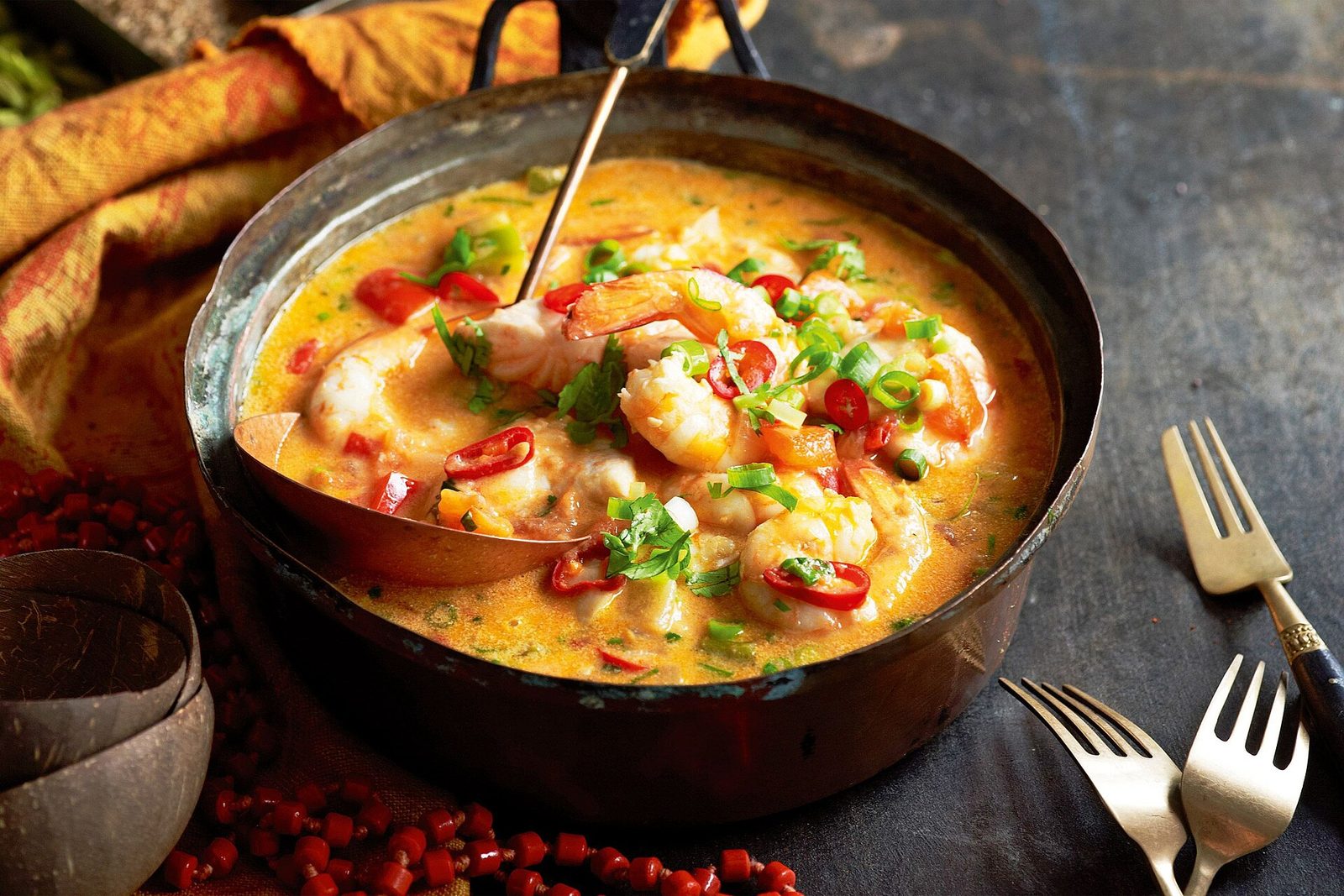
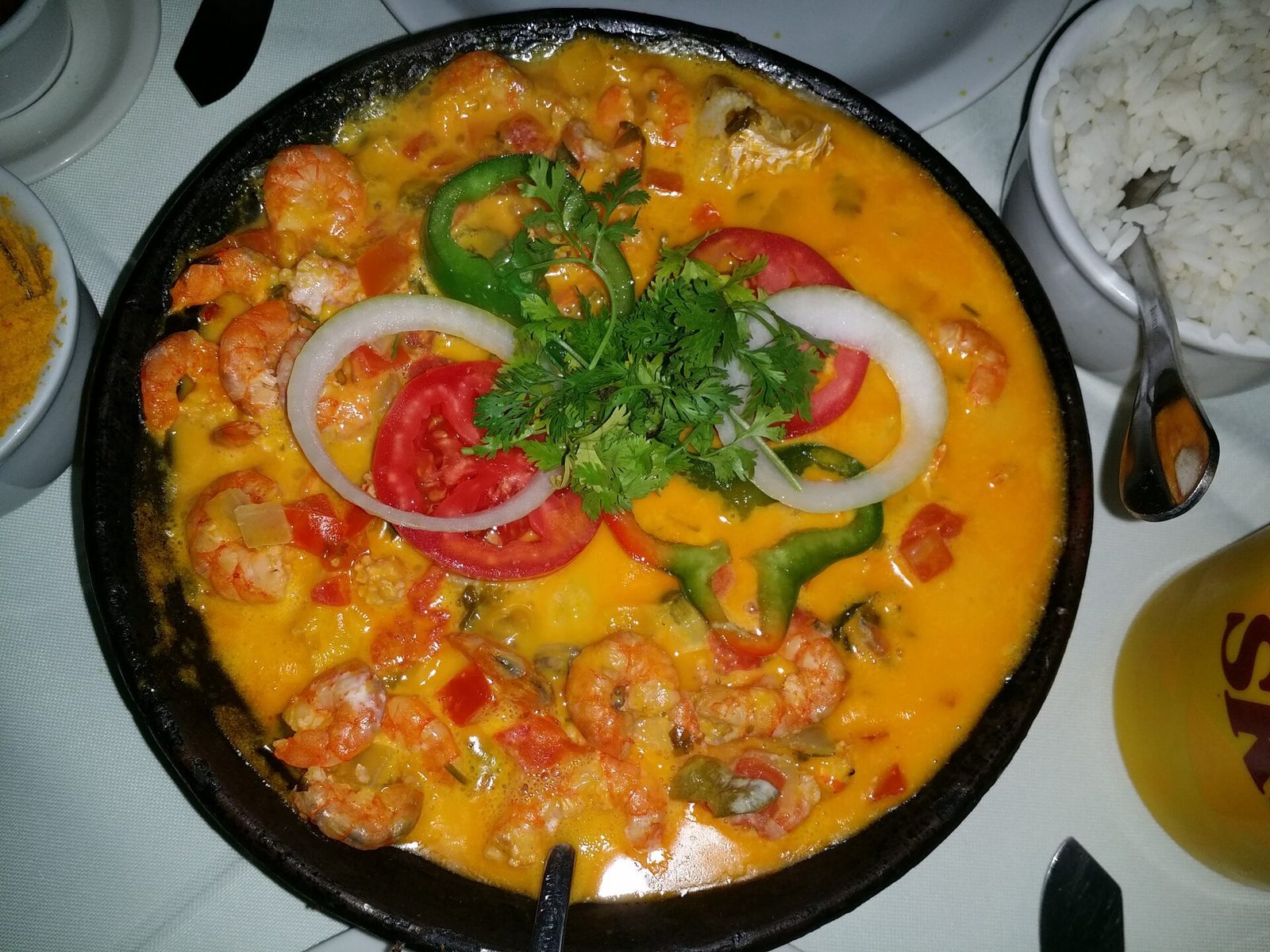
The dish most visitors come looking for, and rightly, is moqueca. It is the great seafood stew of the Brazilian coast, cooked slowly in a heavy pot until the flavors marry, and around Paraty it is a centerpiece of the local table. At its heart moqueca is simple: fish, or shrimp, or a mix of seafood, simmered gently with tomatoes, onions, peppers, and a generous hand of fresh coriander. What lifts it is the slow cooking and the quality of the catch, which is why it tastes so much better a short walk from the boats than it ever will inland.
What goes in the pot
A moqueca is built in layers rather than browned and boiled. The aromatics and the seafood are arranged in the pot, moistened with their own juices and a little liquid, and left to cook down slowly so that nothing toughens. Lime and salt season the fish beforehand; coriander and sometimes green pepper go in toward the end to keep their freshness. The pot itself matters. The traditional vessel is thick clay, which holds a steady, gentle heat and comes to the table still bubbling. Served with white rice and a spoonful of pirão, a good moqueca is one of the most comforting things you can eat on this coast, rich without being heavy, and unmistakably of the sea.
Dendê, coconut, and regional styles
Ask three cooks for a moqueca and you may get three different pots, because the dish changes as you move along the coast. The famous Bahian style, further north, is enriched with coconut milk and dendê, the deep-orange palm oil that gives it a heady color and flavor. The style of Espírito Santo, to the northeast, uses neither, leaning instead on annatto for color and letting the seafood speak more plainly. Around Paraty and the Rio coast you will meet versions along the whole range, some with coconut milk, some without, some golden with dendê and some pale and clean. None is more correct than another. The best approach is to ask what is in the pot that day and order according to your appetite, then notice how the same idea can wear such different clothes.
Shrimp, squid, and the smaller catch
Moqueca and azul-marinho are the headline dishes, but a great deal of the best eating on this coast is simpler and comes from the smaller, everyday catch. Shrimp are a particular joy here, pulled fresh from the estuaries and the shallows and cooked every way imaginable. A handful of the coast's plainest pleasures are worth learning by name:
- Camarão no bafo — whole shrimp steamed in their own shells, peeled at the table and eaten with a squeeze of lime.
- Bobó de camarão — shrimp in a thick, savory purée bound with cassava, one of the coast's great comfort dishes.
- Lula — squid, grilled whole or cut into rings and fried, tender when the cook has a light hand.
- Peixe frito — small whole fish fried crisp and eaten with lime, the unglamorous star of many a beach lunch.
- Sardinha na brasa — fresh sardines grilled over coals, cheap, abundant, and far kinder to the sea than the big predators.
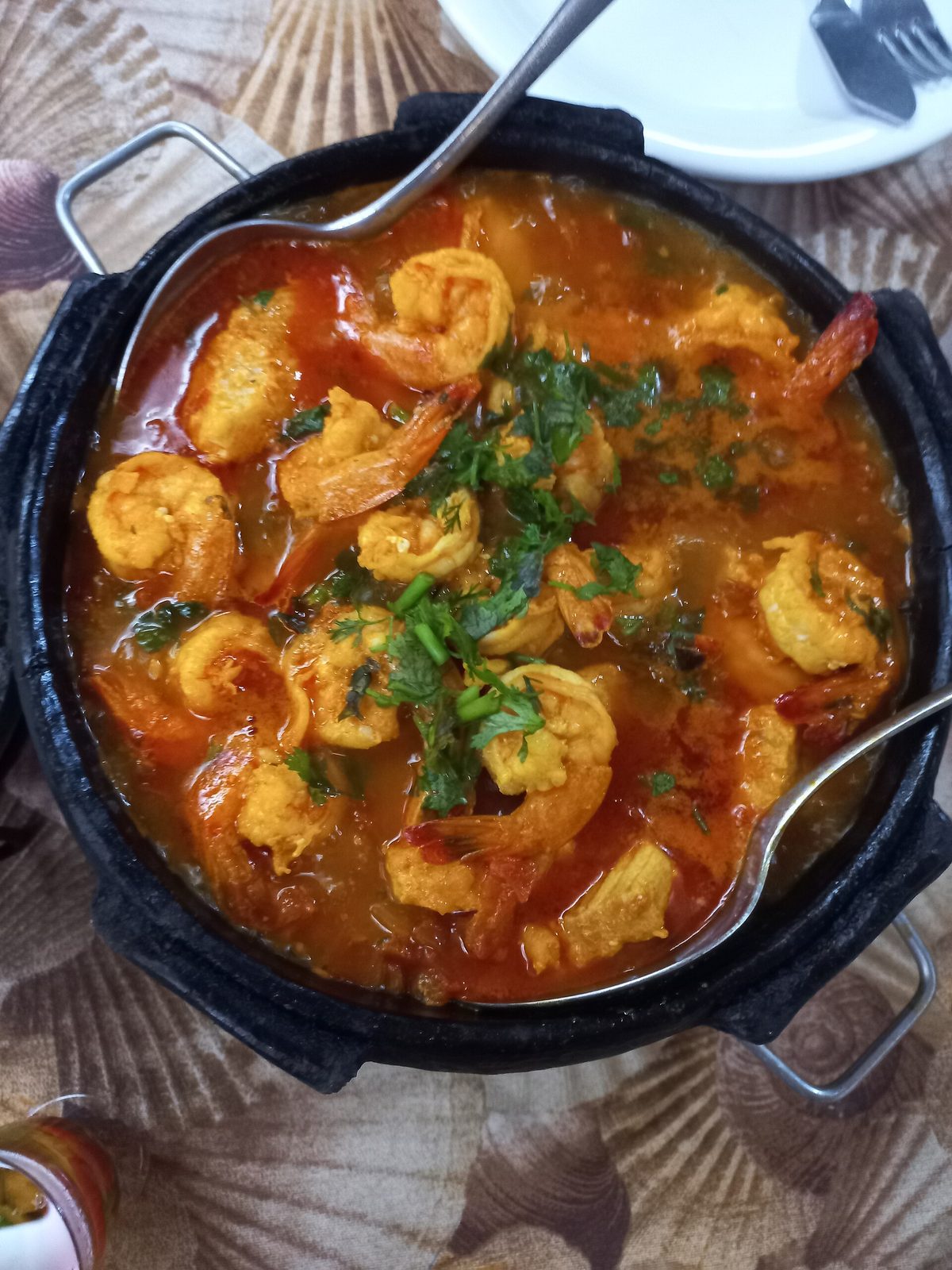
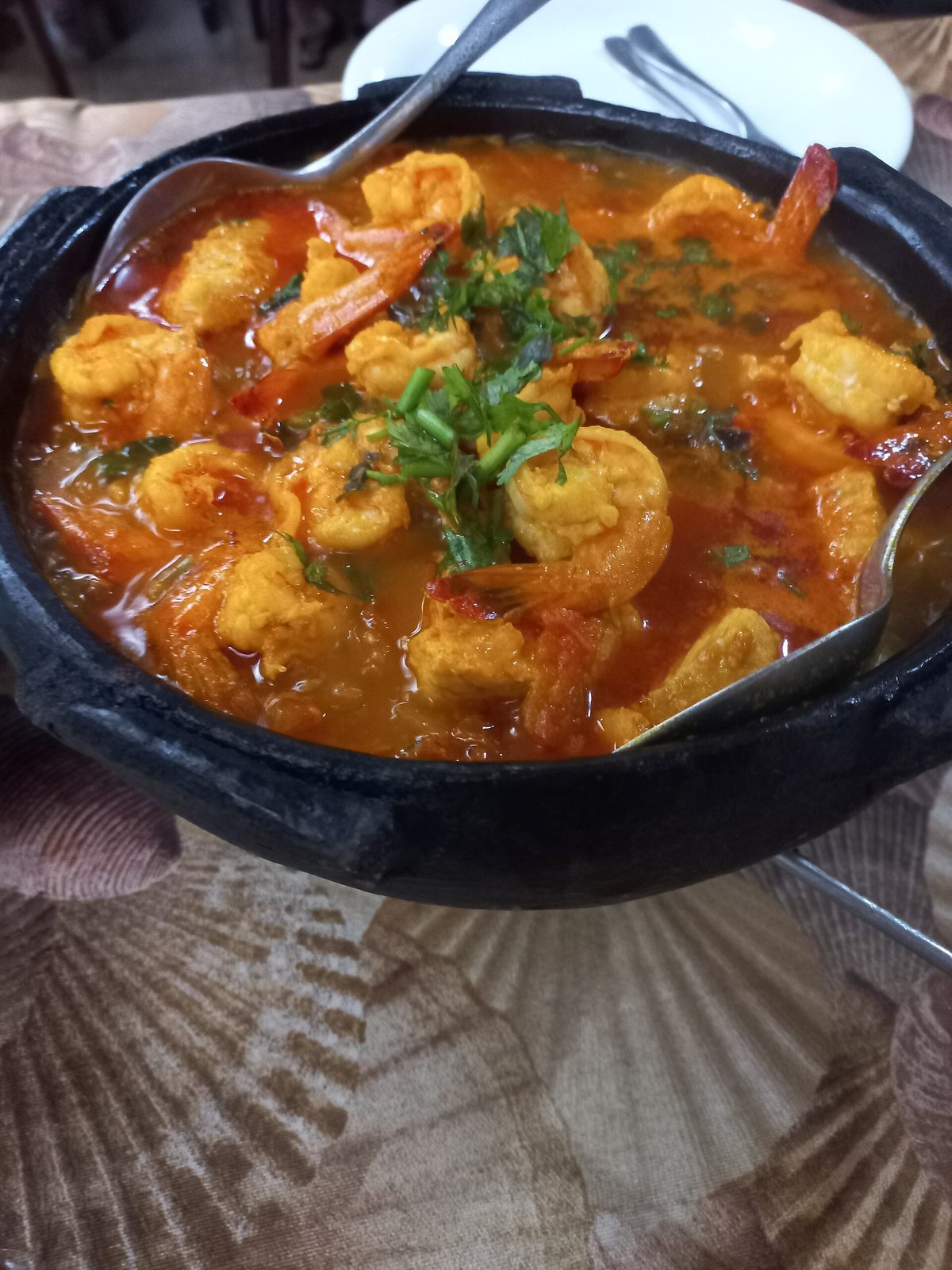
A dark clay pot of shrimp stewed with tomato and coriander, brought sizzling to the table, is as good a lunch as this region offers. Whatever the smaller catch happens to be that day, the same rule serves you: ask what came in that morning and what is plentiful right now, and order that. Eating down the food chain, toward the small and the abundant, is both kinder to the sea and, very often, the tastier choice as well.
The oysters of Mamanguá
Just south of Paraty, a long, narrow arm of the sea reaches back between steep forested ridges into the mountains. This is the Saco do Mamanguá, often described as the only true tropical fjord in Brazil, and its calm, brackish water has become quietly famous for one thing above all: oysters. The sheltered inlet is ideal for raising them, and the caiçara families who live around its shores have turned oyster farming into a mainstay, hanging the shells on ropes and lines in the clean water and harvesting them by canoe. We describe the fjord itself, and how to visit it, on our guide to the Saco do Mamanguá.
Brazil's only fjord, full of oysters
An oyster eaten within an hour of leaving the water is a different creature from one that has traveled, and Mamanguá is one of the few places you can have that experience easily. Boat trips into the fjord often stop at a floating oyster farm or a shorefront kitchen where the oysters are lifted straight from the water, shucked in front of you, and eaten with nothing more than a squeeze of lime. Cold, briny, and impossibly fresh, they are a highlight of the region for anyone who loves shellfish. Because they are farmed rather than dredged from a wild bed, they are also a genuinely sustainable choice, which makes eating them a rare case of pure pleasure with a clean conscience.
Beyond the oyster
The oyster is the star, but it is not the only thing the shallows give. Mussels and other bivalves are gathered and cultivated along this coast, and they turn up steamed in their own liquor, stewed, or added to a mixed seafood pot. Farmed shellfish of this kind are among the best things you can order on a coast where some wild stocks are under real pressure, because they take almost nothing from the wild system and clean the water as they grow. A plate of oysters and mussels from Mamanguá, eaten by the water with a cold drink in hand, is one of those simple coastal meals that stays with you long after fancier ones have faded.
Cassava, from poison to daily bread
If fish is the protein of this coast, cassava is its backbone. Known in Brazil as mandioca, and in some forms as aipim or macaxeira, this humble root is the true staple of the caiçara kitchen and of Brazilian country cooking generally. It grows willingly in poor forest soil, stores itself in the ground until it is needed, and turns up on the table in more forms than almost any other ingredient. It also carries a remarkable history, because one of the two broad kinds of cassava is, in its raw state, quietly poisonous, and the traditional method for making it safe is one of the quiet triumphs of Indigenous and caiçara know-how.
Farinha and farofa
The most common form of cassava on the table is farinha, a coarse, toasted flour made by grating the root, pressing out its liquid, and toasting the meal on a wide, hot pan until it dries into gritty golden crumbs. Brazilians sprinkle farinha over almost everything, the way others reach for salt or bread, to add texture and soak up sauce. Toast that flour in a pan with a little butter, and perhaps some onion, egg, or bits of banana, and it becomes farofa, the crumbly, savory side dish that partners beans, grilled meat, and fish across the whole country. On this coast a banana farofa often accompanies the fish stews, and it is exactly the kind of thrifty, satisfying cooking that a farming culture produces.
Pirão, tapioca, and beiju
Cassava has more forms still. Stir farinha into the hot broth of a fish stew and it thickens into pirão, a smooth, savory porridge spooned alongside the fish to soak up all its flavor; on this coast pirão is very nearly obligatory with a moqueca or an azul-marinho. From the pure starch settled out of the pressed root come other foods entirely: tapioca, the white crepe made by hydrating the starch and cooking it on a griddle until it sets into a soft, foldable round that takes sweet or savory fillings, and beiju, its flatter, more rustic cousin. That a single dangerous root can become flour, porridge, crepe, and side dish, feeding a whole coast for centuries, is one of the small wonders you can taste your way through in Paraty.
Palm heart: a tale of two palms
Palm heart, palmito, is one of the most loved ingredients in Brazil, tender and mild, eaten in salads, baked into savory pies, or cooked into stews and pastas. It is also, on this stretch of the Atlantic Forest, a genuine conservation issue, and understanding it will make you a better-informed diner anywhere in the country. The reason is simple: not all palm heart is harvested the same way, and the difference between two palms is the difference between eating well and eating a threatened tree.
Why juçara is in trouble
The most prized wild palmito in this forest comes from the juçara palm, Euterpe edulis, a slender, single-stemmed palm native to the Atlantic Forest. Its problem is built into its shape. The edible heart is the palm's single growing tip, so cutting it kills the entire tree, which cannot regrow from a severed stem. Generations of harvesting wild juçara for palmito, much of it illegal, have stripped the palm from vast stretches of forest and pushed the species into serious decline. A can of cheap, unlabeled palmito in Brazil may well have cost a wild juçara its life, and with it a tree that would have fed birds and forest animals for decades. It is a textbook case of a delicacy eating its own source.
Pupunha, the palm that lives on
The good news, and the reason palmito can still be enjoyed with a clear conscience, is a different palm entirely: pupunha, the peach palm, Bactris gasipaes. Pupunha grows in clumps and sends up many stems from one root, so a harvested stem is simply replaced by the next one coming up beside it, and the plant lives on to be cut again. It is farmed rather than plundered from the wild, which turns palmito from a driver of forest loss into a sustainable crop. There is also a growing movement to save the juçara by harvesting its fruit, which is very like açaí, instead of its heart, so that a standing tree becomes worth more alive than dead. When you order palmito in Paraty, or buy a jar to take home, ask for pupunha, and you turn a small choice at the table into a small act of protection.
Ordering palmito with a clear conscience
Two palms give the palm heart you eat in Brazil. Pupunha, the peach palm, is farmed, grows in renewing clumps, and is the sustainable choice. Wild juçara is single-stemmed, dies when it is cut, and is threatened across the Atlantic Forest. Ask which one is on your plate; a reputable kitchen will know and will happily tell you. If a jar in a shop is unusually cheap and unlabeled, treat it with suspicion. Choosing pupunha, multiplied across a whole region of diners, genuinely helps take the pressure off a struggling tree.
Banana in the kitchen
Banana is so woven into the food of this coast that it is easy to overlook, but a cook here treats it as two entirely different ingredients depending on how ripe it is. This is a subject close to our hearts, because the reserve is built around an organic banana grove that has been worked for roughly three hundred years, and we cook with its fruit almost every day. The longer story of that grove is on our banana farm page; what matters at the table is the split between green and ripe.
Green banana, the savory side
A green, unripe banana is dense, starchy, and barely sweet, and the coastal kitchen treats it almost like a potato or a plantain. It is boiled and dressed as a savory side, sliced and fried into chips, or, most cleverly, cooked and blended into a smooth, neutral paste called biomassa that thickens stews and enriches breads without changing their flavor. And, of course, green banana is the essential partner to fish in azul-marinho, where its starch and tannins do the double work of thickening the stew and turning it blue. The big cooking banana known as banana-da-terra, closest to what English speakers call a plantain, is the star of the savory side, fried until its edges caramelize into sweet-savory gold beside a plate of beans or fish.
Ripe banana, the sweet side
Let the same fruit ripen a week or two and everything changes. The starch turns to sugar, and the banana moves to the dessert side of the kitchen. Ripe bananas are fried whole and dusted with cinnamon, mashed into fritters, baked into cakes, or cooked down into a soft, dark sweet. In this region ripe banana also appears alongside savory food as a warm counterpoint to a rich stew, which surprises visitors and then quickly wins them over. Brazil grows a whole family of banana varieties, from the tiny, intensely sweet banana-ouro to the tangy banana-prata, and tasting three or four side by side, straight off the plant, is one of the quiet pleasures of eating somewhere the fruit did not have to travel to reach you.
Fruit, juice, and the food of the market
Brazil is one of the great fruit countries of the world, and the warm, wet coast around Paraty grows a bewildering abundance of it. Beyond the banana, expect papaya, mango, pineapple, guava, star fruit, and a long list of tropical fruits that many visitors will never have seen, let alone tasted. Much of it is eaten simply, cut fresh at breakfast or squeezed into juice, and the juice culture here is a delight in itself. Ask for a suco and you can have almost any fruit blended with water or milk into a cold, fresh drink, one of the cheapest luxuries in Brazil on a hot afternoon. A few tropical fruits are worth going out of your way for:
- Maracujá (passionfruit) — tart and fragrant, at its best as a juice or folded into a cool mousse.
- Caju — the cashew fruit, whose bright, astringent juice tastes nothing like the nut and is a Brazilian favorite.
- Graviola (soursop) — creamy, white, and faintly tart, wonderful blended with milk.
- Jabuticaba — a dark, grape-like fruit that grows straight from the trunk of its tree.
- Acerola — a small red cherry packed with vitamin C, almost always drunk as a juice.
- Cupuaçu — a heady-flavored relative of cacao, used in juices, creams, and desserts.
The best window into how people actually eat is the market and the street. Paraty's markets and small grocers show you the season laid out plainly: whatever is piled high and cheap is what is ripe right now, and that is your cue for what to order and what to buy. Along the streets and beaches you will find the small, portable foods that keep a coast fed between meals: pastel, a thin, crisp pastry pocket fried to order around a savory filling; grilled cheese on a stick sold from a cart on the sand; corn boiled, grilled, and baked into cakes and puddings; and the ubiquitous coxinha and other salgados that fill a gap for a few coins. None of it is fancy, and much of it is very good, especially eaten on the move with the sea in view. Follow the locals to the busy stall, order what they are ordering, and you will rarely be disappointed. Market food is where a place tells you the truth about how it eats, and Paraty's truth is generous, fresh, and cheap.
Cachaça and the caipirinha
No meal on this coast is really complete without a word about what is in the glass, and here that means cachaça. Distilled from fresh sugarcane juice, cachaça is Brazil's national spirit, and Paraty's connection to it runs deep. In the days of the colonial gold route, the town's distilleries turned the cane grown on the coastal lowlands into a spirit so well regarded that the very name Paraty became a byword for good cachaça, a kind of shorthand for the drink itself. That heritage is still alive in the traditional pot-still distilleries, the alambiques, in the hills around town, and we cover them and their tastings on our guide to Paraty's cachaça and alambiques.
The spirit that made the town's name
Cachaça is often lazily called Brazilian rum, and while both come from sugarcane the difference matters. Most rum is distilled from molasses, a byproduct of sugar making; cachaça is distilled from fresh-pressed cane juice, which gives it a brighter, grassier, more vegetal character. It comes in two broad styles: the clear, unaged white cachaça, sharp and clean and made for mixing, and the golden, barrel-aged cachaça, mellowed and colored by time in wood and meant to be sipped slowly like a good whisky. The artisanal bottlings from small Paraty distilleries can be superb, and a tasting is one of the more pleasant ways to spend an afternoon in town. Sip the aged ones neat and you will understand why cachaça deserves far better than its reputation as mere cocktail fuel.
The caipirinha and beyond
The white cachaça finds its highest calling in the caipirinha, Brazil's national cocktail and one of the simplest great drinks in the world: fresh lime cut into wedges, muddled with sugar, poured over ice, and topped with cachaça. That is the whole recipe, and made well, with a good spirit and a ripe lime, it is bright, strong, and dangerously easy to drink in the heat. Bartenders improvise on it endlessly with other fruit, passionfruit and cashew and pineapple among them, though a purist will tell you the lime original needs no improving. A caipirinha with a plate of fried fish or a dozen fresh oysters, in the shade with the sea nearby, is about as close to the spirit of this coast as a drink can get.
Where and how to eat in Paraty
Part of the pleasure of eating in Paraty is that the food comes in every register, from a paper cone of fried fish on the sand to a candlelit dinner in the old town. There is no single right way to eat here, and the best trips usually mix them. What follows is general guidance rather than a list of names, for a simple reason: restaurants open, close, change hands, and change chefs, and a place we praised this year might be gone or transformed by the time you arrive. The categories, though, are stable, and knowing them helps you eat well wherever you land.
Pousada kitchens and caiçara homes
Some of the most memorable meals on this coast are the least commercial. Small pousadas and family kitchens often cook a daily menu built around whatever came in that morning, and eating where you are staying, or at a family-run spot a host recommends, is frequently the surest route to the real thing. Better still, in the villages and along the quieter beaches, are the meals cooked in or near caiçara homes and community kitchens, where dishes like azul-marinho and a proper pirão are made the way they have always been made. These are not slick operations, and that is exactly the point. If you want to eat the tradition rather than an interpretation of it, ask your host to help you find a caiçara table, and go with an open mind and a healthy appetite.
The town's tables
The historic center of Paraty has, for its size, a remarkable range of places to eat, from casual corner spots to ambitious restaurants run by cooks drawn to the region's ingredients. You can eat a plate of grilled fish and beans for very little, or sit down to a long, inventive dinner that reworks coastal traditions with real skill, and both are legitimate ways to enjoy the town. Beach kiosks and simple grills handle the sunlit end of the day, while the cobbled streets of the center come alive after dark with tables spilling out under the whitewashed walls. The honest short version is that Paraty has everything from a beach shack to fine dining, and your host or pousada will always have current, trustworthy recommendations, which beats any printed list that started going stale the day it was written.
A few honest questions to ask your host
What came in fresh today, and what is abundant right now? Which local dish should I not leave without trying? Is there a family or caiçara kitchen nearby that cooks the traditional way? Is the palmito pupunha? A good host loves these questions, because they show you want to eat the place as it really is, rather than a generic version of it. The answers will send you somewhere far better than any guidebook, this one included, ever could.
Eating in season, and eating with care
A coast this generous can hide a hard truth: the sea is not endless, and some of what tastes best is under real pressure. Overfishing is a genuine problem along the Brazilian coast, as it is nearly everywhere, and the large, slow-growing, high-value fish, the groupers and snappers and their kind, are exactly the ones most easily fished out. Eating thoughtfully here does not mean going without. It means leaning toward abundance, and a few simple habits keep your eating both delicious and light on the coast:
- Favor small, fast-breeding fish like sardines over big, slow-growing predators like grouper and snapper.
- Choose farmed oysters and mussels, which take almost nothing from the wild and clean the water as they grow.
- Ask for pupunha palm heart rather than wild juçara.
- Order what is in season and piled high in the market, where ripeness and abundance travel together.
- Eat at family kitchens and buy from local growers, so your spending stays on the coast that feeds you.
The real question at a coastal table is not only what tastes good, but what the sea can spare.
None of this asks for sacrifice, which is the happy secret of eating well on this coast: the sustainable choice and the delicious choice are, again and again, the same choice. The freshest fish is the one the boats are landing in numbers; the best fruit is the one in season and cheap; the cleanest-conscience shellfish is the farmed oyster that also happens to taste of the sea itself. A place stays worth visiting only as long as the sea and the forest that feed it stay healthy, and a traveler who eats with that in mind is helping, in a small and pleasant way, to keep it so. The reward is a table that will still be this good for the next people who come down the mountain hungry, and the ones after them.
The shortest line from ground to plate
We come back, at the end, to our own kitchen, because everything in this guide is why we cook the way we do. Reserva Sete Quedas sits high above Paraty's seven waterfalls, and its heart is that three-hundred-year-old organic banana grove and the forest garden around it. When we cook for guests, we are simply drawing the shortest possible line between that ground and the plate: bananas cut green or ripe from our own terraces, herbs and citrus picked minutes before they hit the pan, palmito that is farmed pupunha and never wild juçara, and vegetables from a kitchen garden a short walk from the table. Our full approach, and the chance to join a harvest and cook alongside the kitchen team, is laid out on our farm-to-table page.
We are honest about our limits. We are a mountain reserve, not a fishing operation, so the fish and the oysters on our table come from the coast at Paraty, not from our streams. But that is exactly the arrangement this whole cuisine was built on: the mountain's fruit and starch meeting the sea's catch, the roça and the tide on one plate. When we serve a moqueca or a plate of fried banana-da-terra beside grilled fish, we are cooking the same marriage of forest and sea that the caiçara worked out here over centuries, using produce grown a few steps away and fish landed a short drive down the hill. We are glad, always, to tell you exactly where each part of your meal came from.
That is the real promise of eating in this corner of Brazil. The food is not an add-on to the scenery; it is the scenery, transformed, on a plate you can taste. A fish stewed blue with green banana, an oyster lifted from the fjord, a fritter fried from fruit cut that morning, a caipirinha in the shade, all of it grows out of the same forested, sea-facing land that makes this coast worth the journey. Come hungry. When you are ready, you can plan a stay with us, and the rest of this series, our orientation to the whole region, waits for you on the Local Guides page.