
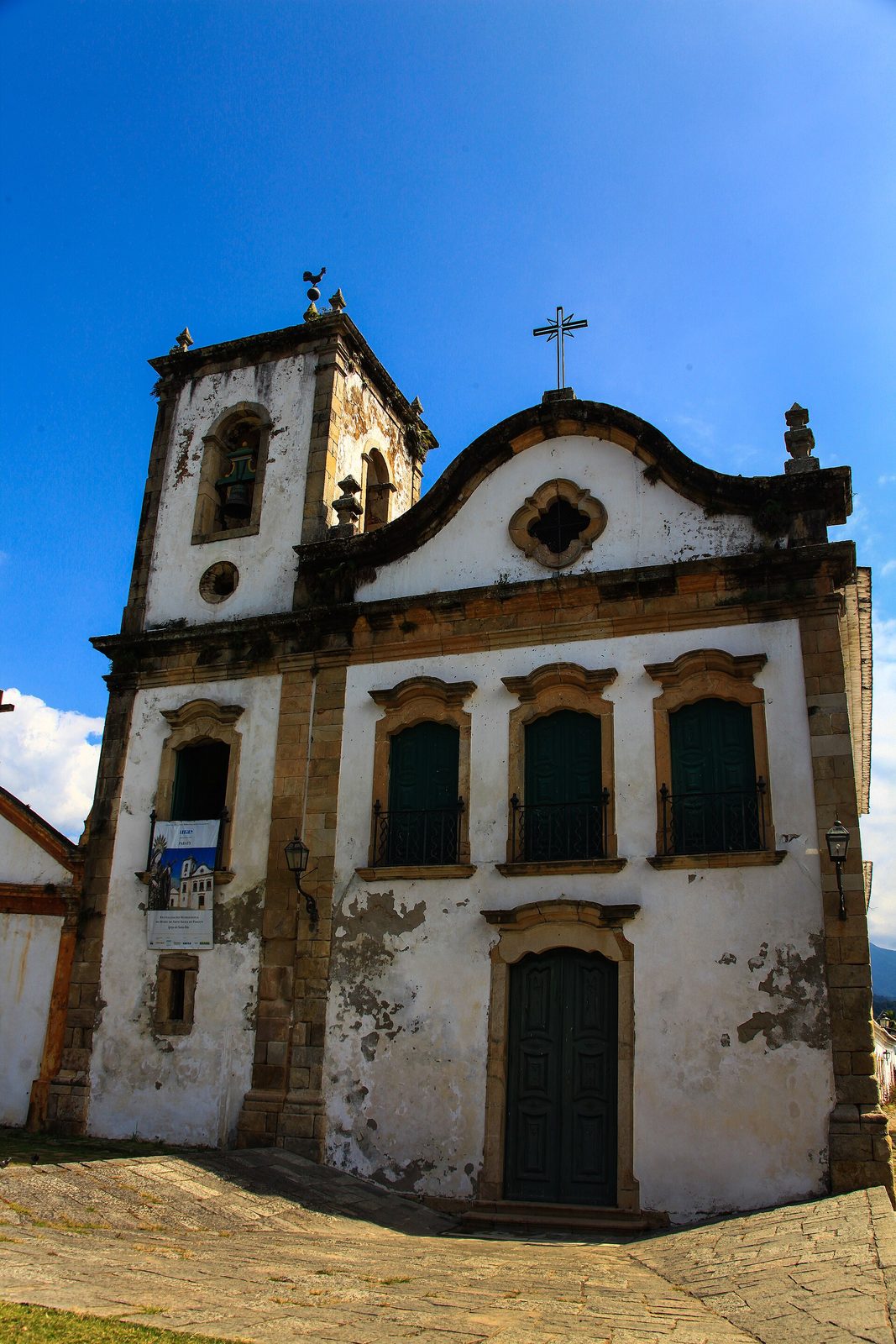
Paraty is a town you can read like a document, if you know what you are looking at. Its historic center is a small grid of low, whitewashed houses and four colonial churches, set on rough stone streets between the green wall of the Serra do Mar and the flat water of the bay. Almost nothing here is accidental. The way the streets are graded, the height of a doorstep, the color painted around a window, the fact that there are four churches in a town you can cross in fifteen minutes — each of these carries a piece of the town's history, and most of them are still doing the job they were built for three centuries ago.
This guide is about that architecture and what it reveals: the plan of the town and why it sits the way it does; the famous pé-de-moleque paving and the clever, almost eccentric design by which the highest tides rise through the streets and wash them clean; the whitewashed colonial house and how it was made from the coast and the forest; and, above all, the four churches, which between them encode the rigid social order of colonial Brazil more plainly than any museum label could. It is a companion to our street-by-street walk through the historic center, going deeper into the buildings themselves.
You do not need to be an architect to enjoy any of this. You need only to slow down, look up and down as you walk, and carry a little of the story with you. A morning among the churches and the cobbles is one of the quiet pleasures of a stay on this coast, and it costs nothing but attention. Our wider Paraty guide sets the town in its region; what follows is the closer look.
- Where
- colonial center of Paraty, Costa Verde, Rio de Janeiro state
- Protection
- historic center listed by IPHAN; a UNESCO World Heritage site since 2019
- Churches
- four colonial churches, each built by and for a different social group
- Oldest
- Igreja de Santa Rita, 1722; now the Museu de Arte Sacra
- Streets
- pé-de-moleque stone, car-free, graded to flood clean on the highest tides
- Houses
- low and whitewashed, with door and window frames picked out in strong colors
- Best light
- early morning and the last hour before sunset
- Visiting
- churches keep variable hours; go quietly and dress modestly
A town laid out by the sea
Paraty was built where it is for a single reason: it was a port. In the eighteenth century this was the point where the gold of Minas Gerais, carried down out of the mountains on mule trains, met the sea and was loaded for Rio de Janeiro and Lisbon. Everything in the town's plan still points back to that trade. The streets run in a compact grid, only a few blocks deep, squeezed between the waterfront on one side and the Perequê-Açu river and the mountains on the others, so that goods could move quickly from ship to warehouse to mule and back again. It is a working layout, not a decorative one, and that is exactly why it has aged so well.
Because it grew as a place of business rather than a planned showpiece, the grid is regular but human in scale. The blocks are short, the lanes are narrow, and there is no grand avenue or central monument — just a series of streets that open now and then into small squares, nearly all of them in front of a church. The town is entirely walkable, and the old center remains genuinely car-free, so the loudest things you will hear are your own footsteps, a little music, and, on the biggest tides, water moving in the lower lanes. You can cross the whole of it in fifteen minutes, but the pleasure is in not hurrying.
Look at the plan with the trade in mind and it starts to make sense. The heavier merchant houses sit where the goods and the money moved; the churches anchor the squares; the streets bend gently toward the quay. The names of the lanes still tell you what they were for. It is a town designed around loading, storing, and shipping, and then, when the gold ran out, around the sugar and cachaça that replaced it. Understanding that the whole place is really a piece of port infrastructure — beautiful, but built to work — is the key that unlocks everything else you will notice on foot.
The stones underfoot, and the sea that cleans them
Pé-de-moleque paving
The first thing your feet register in Paraty is the paving. The streets are laid with large, irregular stones set unevenly by hand into the ground, a surface known as pé-de-moleque — the same name as a knobbly Brazilian peanut brittle, because the lumpy stones look a little like the candy. They are not comfortable, and they were never meant to be. They are heavy, hard-wearing, and set to last, and they have carried mule trains, ox carts, and three centuries of foot traffic without needing to be replaced. Wear flat, sturdy shoes with some grip, watch your step, and take particular care when the stones are wet, because they turn slick.
Walk them slowly and you begin to read them. The stones dip toward a shallow channel that runs down the center of each street, so that rainwater drains along the middle of the lane rather than pooling against the houses. The whole surface is tilted and shaped for water. That is not a minor detail of the paving; it is the clue to the single most remarkable thing about the way Paraty was built.
The streets the sea washes
The old center was deliberately built low, and the streets were graded so that on the highest tides of the month — the spring tides around the new and full moon — the sea rises up through the town, runs along the sloping lanes, and then drains back out as the tide falls. Twice a month, in effect, the town washes itself. For an hour or two the lower streets become shallow canals, and then they empty again, leaving everything rinsed. Locals call these high waters by their own name and simply live around them, drawing a chair or a display table back from the door until the sea goes down.
This is why the doorways look the way they do. The old houses sit with their door-sills raised well above the street on a step or two of stone, keeping the tide out of the rooms while it runs down the lane outside. It is not a flood in the disaster sense; it is the sanitation system the town was designed with, still working exactly as intended. Catch the center at one of these tides near a full moon and you will see the white walls doubled in the thin sheet of water over the cobbles — the image people remember longest.
The whitewashed house
Built from the coast and the forest
Once the plan and the tide are in your head, slow down and look at the houses themselves, because how they were made is as interesting as how they are arranged. These are colonial buildings, most of them one or two stories, raised from what the coast and the forest gave up. The footings are stone, set against the damp. The walls are earth and timber — rammed earth packed hard between forms, or a lattice of wooden staves filled with mud, the techniques the Portuguese brought and adapted here. The floors, beams, and roof frames are hardwood cut from the surrounding hills. The roofs are laid with curved clay tiles, set in overlapping runs so the heavy summer rain sheds fast.
The most telling material is the mortar and the whitewash. Along this shore, lime was burned from crushed shells — a coastal way of making cement long before the modern bagged kind arrived — and on this old whaling coast whale oil was sometimes worked into the mortar and the whitewash to bind and waterproof it. It is worth pausing on that: the walls you are admiring were quite literally made from the bay and the forest. The same coastal know-how that shaped the fishing and boatbuilding communities shaped the buildings, and our guide to caiçara culture tells that side of the story.
Whitewash and the painted frames
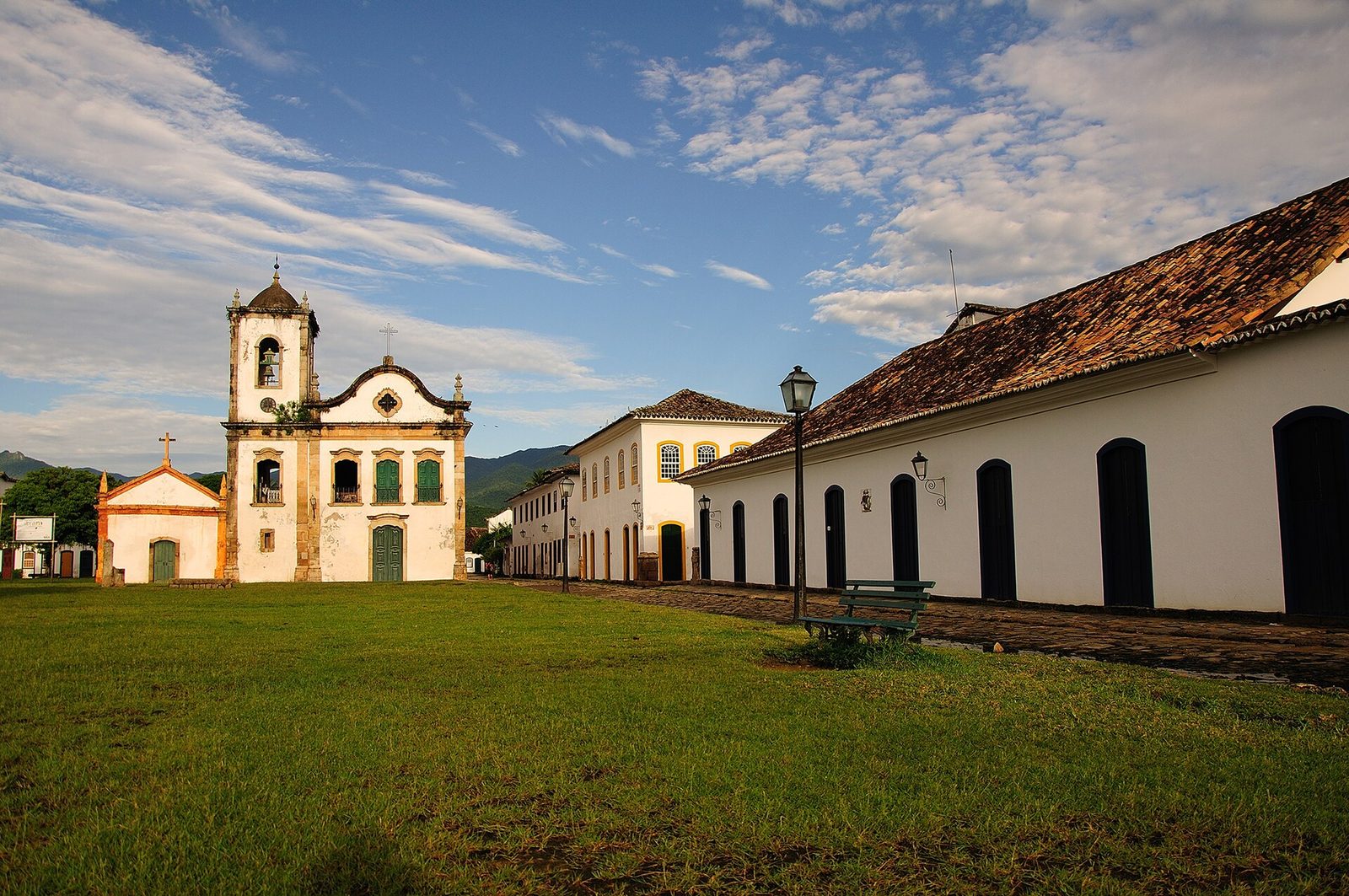
The look everyone photographs — brilliant white walls with door and window frames picked out in strong blues, greens, ochres, and reds — is part function and part tradition. The lime whitewash reflects the fierce sun, keeps the rooms cooler, and was cheap and easy to renew, so it was refreshed again and again over the generations. The colored trim marked out the openings and, in the way of a small town, let a family show a little character within a strict and shared palette. Look for the heavier merchant houses, the sobrados, with their upstairs living quarters over ground-floor storerooms that once held goods waiting for a ship; for the deep, thick-walled doorways that stay cool in the heat; and for the raised stone sills that hold back the tide. None of it is grand in the palace sense. It is the honest architecture of a working port, aged into something quietly beautiful.
Who actually built Paraty
It is easy to admire a town like this and forget to ask who made it. The answer is honest and uncomfortable, and it belongs in any account of the architecture. Paraty was built with the wealth of the gold trade — the reason a remote port could afford stone churches and solid merchant houses at all — and it was built, in large part, by enslaved Africans and their descendants, alongside free craftsmen and the master builders who directed the work. The gold that paid for it came down the mountain on the backs of men and mules; the walls that spent it were raised by hands that owned almost nothing of what they made. Our history of the Brazilian gold cycle sets out how that wealth flowed through the town.
The knowledge itself was a kind of inheritance. Colonial building here ran on trades passed down by doing — the stonemasons who set the pé-de-moleque and the footings, the carpenters who cut and joined the hardwood frames, the lime-burners and plasterers who made and laid the whitewash, the tile-makers and the smiths. There were no architects in the modern sense for most of it; there were master builders and craftsmen working to shared patterns and hard-won rules of thumb about what the wet ground and the coastal weather would bear. That is why the town has such a strong family resemblance from house to house: it was built by people trained in the same traditions, using the same handful of materials, for the same climate.
The churches add another layer to the story, because several of them were built not by the crown or a single wealthy patron but by brotherhoods — lay religious associations that pooled the small savings of their members over years and decades to raise a building of their own. Who belonged to which brotherhood was determined by race and status, and so the very act of building a church was bound up with a person's place in a rigid social order. Which brings us to the four churches, and the society they still quietly describe.
Four churches, four congregations
Paraty has four historic churches, and they are far more than pretty fronts. In the colonial period the town, like the rest of Brazil, was rigidly divided by race and class, and that division was written into where people were allowed to worship. Each of the four churches was built by and for a different group, and walking between them is the clearest way to read the town's social history. It is worth visiting them as a set rather than photographing the prettiest one and moving on, because the meaning is in the pattern — four congregations, four buildings, one small town, and a great deal of distance between them.
In the broadest terms: the main parish church served the colonial white establishment; the oldest church was raised by the free people of mixed descent; another was built by the brotherhoods of enslaved and freed Africans; and the youngest was the more private chapel of the town's wealthy families in the nineteenth century. Two of the four, then, belonged to the elite in different eras, one to the free mixed-race population, and one to the Black community that did the hardest labor of the port and the plantations. The buildings differ in size and richness in ways that track those positions almost exactly, and that is the point.
If you would like a thread to follow, this short route links all four without much doubling back:
- Start at the waterfront with Santa Rita, the oldest church, best photographed early while the light is soft.
- Walk inland to the main square and the Matriz de Nossa Senhora dos Remédios, the mother church.
- Cut a few minutes across to Nossa Senhora do Rosário e São Benedito, and pause on the short walk between it and the grand Matriz.
- Finish at the quiet, seaward corner of Nossa Senhora das Dores.
Read the four as one town
The temptation is to photograph Santa Rita and call it done. Resist it. The four churches only make sense together, because their differences — in size, in richness, in where they stand — map the colonial hierarchy of race and class onto the streets. Give yourself an hour to walk all four in a loop, and read them as one connected story rather than four separate sights.
Igreja de Santa Rita
The oldest face in Paraty
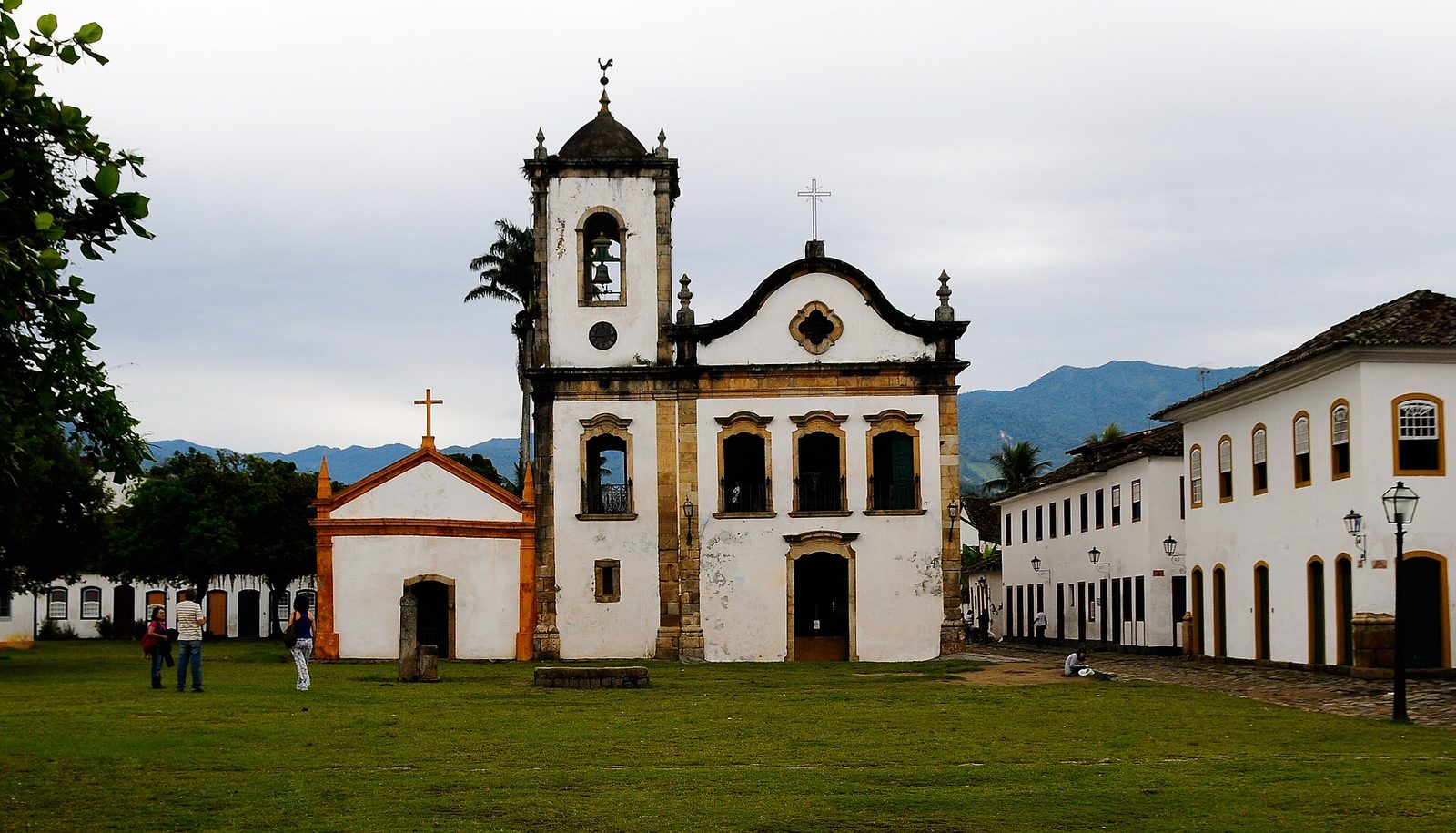
If you have seen one photograph of Paraty, it is almost certainly of Santa Rita. The church stands right at the waterfront, its baroque front rising above the harbor, and it is the oldest of the four, dating from 1722. Its fuller name, Santa Rita dos Pardos Livres, records who built it: the pardos livres, the free people of mixed African and European descent, who were a substantial part of colonial Paraty and who, barred from the white establishment's church, built their own — and built it beautifully. Its position over the water, with wooden boats moored in front and the green wall of the mountains behind, makes it the emblem of the whole town.
Architecturally it is the one to study if you only study one. The facade has the restrained, elegant baroque lines of the early eighteenth century: a single bell tower, a symmetrical front, carved stone framing the doors and windows, and a small upper choir gallery. It is not enormous or heavily ornamented — this was a community of modest means — but the proportions are lovely, and the way it sits low and white against the sea and the forest is a lesson in building for a place rather than against it.
Inside: the Museu de Arte Sacra
Today Santa Rita is no longer an active parish church but the home of the town's museum of sacred art, the Museu de Arte Sacra. Inside you will find carved and painted saints, colonial silver, vestments, and religious pieces gathered from Paraty's churches and the surrounding region, displayed in the cool old nave. It is a small museum, easily seen in half an hour, and it is worth stepping inside as well as photographing the front, both for the objects and for the chance to stand in the oldest interior in town. Opening hours vary and the museum is usually closed at least one day of the week, so treat any schedule you are given as approximate and be glad when the door is open.
The Matriz de Nossa Senhora dos Remédios
The Matriz — the mother church, dedicated to Our Lady of Remedies — is the largest of the four and the religious heart of the town. It anchors the main square in the center of the grid, and it was the church of the white ruling class: the merchants, landowners, and officials who ran the port and grew rich on the gold and the trade that followed it. Where Santa Rita is a small jewel over the water, the Matriz is a broad, four-square presence over a public plaza, built to hold the whole establishment of the town at once and to look the part while doing it.
The unequal towers
Look closely at the front and you will notice that the two bell towers do not match. The present building is, by the account told locally, the third church raised on this site, built over a long stretch of the eighteenth and nineteenth centuries as the earlier ones proved too small or too weak. The story goes that the ground here is soft — remember that the town floods — and that the church could never safely carry the full weight the plans called for, so the work was trimmed to what the wet earth would bear and one tower was left unfinished. Whether every detail of that account is literally true, the unequal towers are real, and they make a fitting emblem for a town built on the edge of the tide: ambition tempered by the ground it stands on.
The square in front of the Matriz is the natural gathering place of Paraty, busiest in the early evening and during the town's festivals, when it becomes the center of everything. Sit on its edge for a while and watch the town go by; the church has looked out over this same scene, in one form or another, for the better part of three centuries. It is the one building that every part of colonial society passed in front of, even when they were not allowed through its door.
Nossa Senhora do Rosário e São Benedito
A few minutes' walk from the grand Matriz stands the church of the enslaved and freed Black people of Paraty: Nossa Senhora do Rosário e São Benedito. Across colonial Brazil, Black brotherhoods organized around Our Lady of the Rosary and around São Benedito — Saint Benedict the Moor, a Black saint — and built their own churches with what little they could gather, often over many long years, because they were shut out of the churches of the white and mixed-race communities. This is that church in Paraty. It is plainer on the outside than the Matriz, and that plainness is not an accident of taste but a direct measure of what its congregation was allowed to own and to earn.
To stand between this church and the Matriz is to read the whole social order of the colonial town in the space of a short walk. Two buildings, a few minutes apart, both raised to worship the same faith — one broad and commanding on its public square, one modest and hard-won on a quieter street — and between them the entire distance that colonial Brazil put between a merchant and the people whose forced labor made him rich. Neither the postcards nor the guided tours always tell that part, but it is the true story of the streets, and it is the reason to see the four churches as a set.
Visit it quietly and with respect, as you would any place that carries this kind of weight. It is a monument not only to faith but to a community that did the hardest work of the port and the plantations and was permitted almost nothing else of its own — and that, out of very little, still built something to stand for it. That fact is worth carrying with you as you walk back toward the prettier, more photographed corners of the town.
Two congregations a few minutes' walk apart, raised to worship one faith from opposite ends of the same cruel order.
Nossa Senhora das Dores
The fourth church, Nossa Senhora das Dores — Our Lady of Sorrows — is the youngest and the smallest, built in the nineteenth century near the water at a quieter edge of the center. If the Matriz was the public church of the colonial establishment, das Dores was the more private, almost domestic chapel of the town's wealthy families in the later coffee era — the moneyed elite who wanted a refined, intimate place of their own rather than the busy mother church on the square. It has a calm, self-contained air quite unlike the others, and a small cemetery is associated with it.
Architecturally it is the most understated of the four, and the most easily missed, which is exactly why it rewards seeking out. Come here when the main square feels crowded and you will usually have the place, the sea light, and the quiet corner more or less to yourself. It is a good reminder that the town's social divisions did not end with the colonial period but carried on, in gentler dress, into the nineteenth century: even among the white and wealthy there were those who wanted a chapel set a little apart from everyone else.
Taken together with the other three, das Dores completes the picture. The elite appear twice in Paraty's churches — once in the grand public Matriz of the gold era, and once in this small private chapel of the coffee era — while the free pardos and the Black brotherhoods each appear once, in buildings whose scale and richness track their place in the order of the day. Four churches, then, are not one too many. They are precisely as many as it took to keep a small colonial society sorted into its separate places, even at prayer.
Details worth noticing
Once you have the big picture — the plan, the tide, the four churches — the pleasure of Paraty is in the small things, and there are a lot of them. The town rewards a slow, patient eye more than a fast camera. Look down as much as up: at the water channels in the middle of the streets, the raised stone door-sills, the worn stones themselves. Then look at the surfaces and the openings, where three centuries of craft and repair are on quiet display. None of it shouts, which is part of why it is so easy to walk straight past.
A short list of things worth slowing down for:
- The raised door-sills, a step or two above the street, built to keep the spring tides out of the rooms.
- The painted frames around doors and windows — deep blues, greens, ochres, and reds against the white — and the heavy old wooden doors themselves, many with hand-forged iron hardware.
- The curved clay roof tiles, laid in overlapping runs, weathered to a dozen shades of red and gray.
- The texture of the whitewash, thick and slightly uneven from many generations of renewal over lime-and-shell mortar.
- Wooden shutters and, here and there, latticed window screens — a way of letting air and light in while keeping the street's eyes out.
- The sobrados, the two-story merchant houses, with living quarters upstairs over what were once ground-floor storerooms for goods bound for a ship.
The churches repay the same attention. Notice the carved stonework framing their doors, the single or paired bell towers, the small upper choir galleries, and the plain lime-washed walls that were rarely as gilded and elaborate inside as the great baroque churches of the mining towns up in Minas — this was a port of modest means, and its churches, even the grand Matriz, wear that modesty honestly. The beauty here is in proportion, material, and setting, not in gold leaf, and it is all the more durable for it.
How the town is protected today
The reason Paraty looks so whole — why there is no glass tower over the rooftops, no illuminated sign bolted to a colonial wall, no stretch of the center that has been quietly modernized out of character — is that the town is protected, and has been for decades. The historic center is listed by IPHAN, Brazil's national institute for historical and artistic heritage, which means the whole ensemble is legally safeguarded: not just the churches, but the streets, the paving, the rooflines, and the ordinary houses that make up the fabric between them.
In practice, protection like this reaches a long way into daily life. Owners of buildings in the listed center cannot freely change fronts, rooflines, window openings, or even the colors of their trim; restoration must respect the original materials and methods; new signage and modern additions are tightly controlled. It can be a burden to live under — repairs are slower and dearer when they must be done the old way — but it is the reason the town you are walking through is a coherent eighteenth-century place and not a handful of monuments stranded in a modern streetscape. The recognition goes beyond Brazil, too: in 2019 Paraty and the wild coast and islands around it were inscribed as a UNESCO World Heritage site, honored for both their cultural and their natural value in a single listing.
You can see the payoff most clearly from a little distance. Climb to the fort or one of the viewpoints above the town and the old center reads as a single low field of white walls and terracotta roofs held between the forest and the bay, with the church towers rising just clear of the tiles — a whole preserved, not a fragment. Our guide to the town's viewpoints and forts points you to the best of those vantage points, and the view is the quickest way to understand what the preservation rules have actually saved.
Visiting the churches with respect
The churches are living monuments, and some still hold Mass, so a little courtesy goes a long way. Hours are variable and not always posted; as a rough rule the churches and the Santa Rita museum tend to open in the morning and may close in the middle of the day or on one or more days of the week, so build in some flexibility and do not pin a whole afternoon on finding a particular door open. If a service is underway, either join it quietly or come back later; it is not a moment for sightseeing.
Before you step inside
These are places of worship first and sights second. Cover your shoulders and knees, silence your phone, take your hat off, and keep your voice low. If a Mass is in progress, wait or come back another time — and put the camera away entirely. A little quiet respect is the price of admission to some of the oldest and most meaningful rooms on the coast.
A few simple courtesies cover almost everything:
- Dress modestly — shoulders and knees covered is a safe standard, and it matters more in an active church than in the museum.
- Keep your voice down, silence your phone, and remove hats inside.
- Do not photograph during Mass, and never use flash near old painted or gilded surfaces; ask before photographing anyone at prayer.
- If there is a donation box, a small contribution helps keep these buildings standing; upkeep in a protected town is expensive.
- Move slowly on the way in and out — the thresholds and the streets outside are uneven, and the raised sills are easy to trip on.
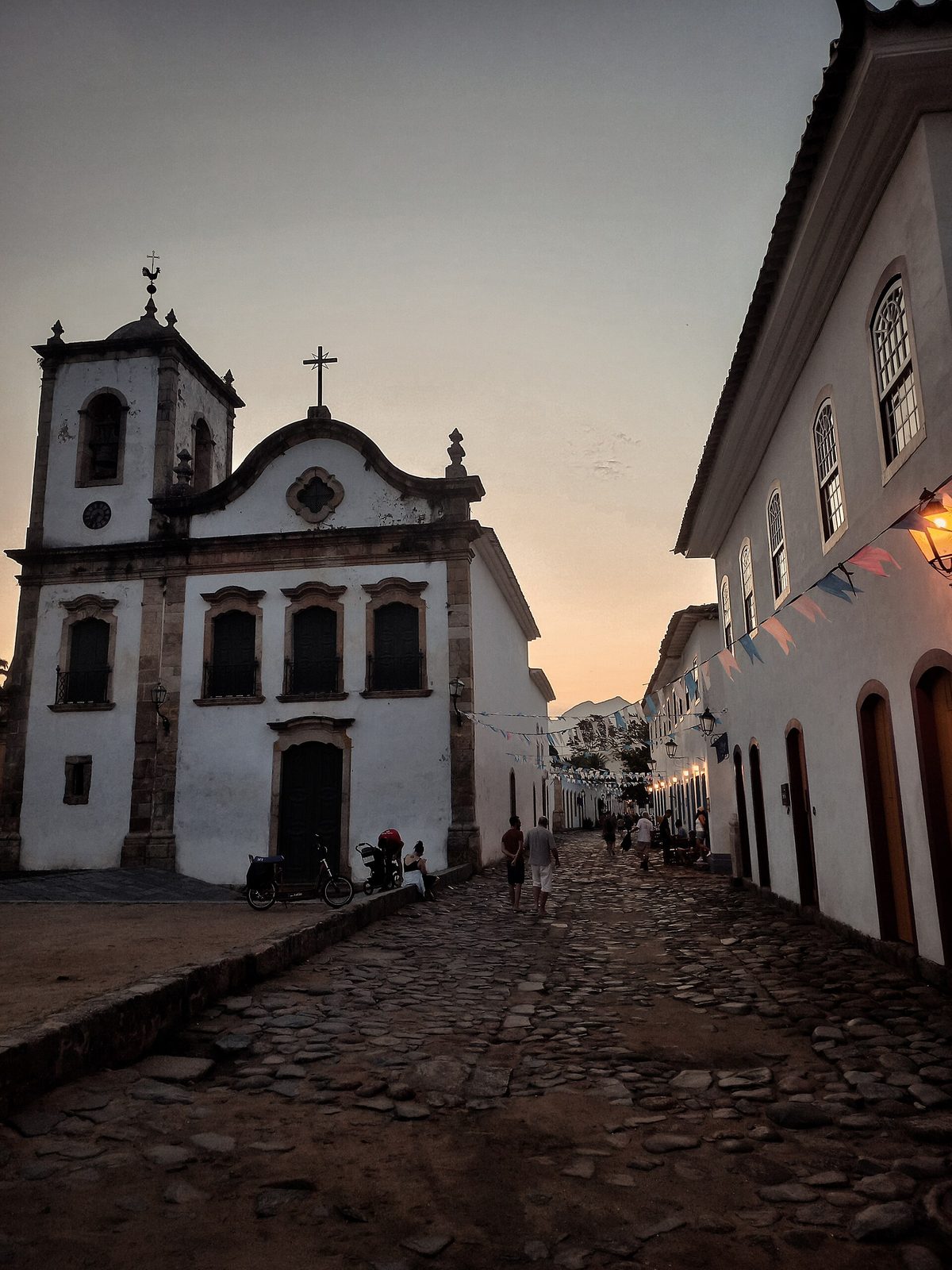
The best time to see the churches, if you have any choice in it, is at the edges of the day. Early morning gives you soft light and near-empty streets for Santa Rita over the harbor. The hour around dusk is quieter still: the crowds thin, the walls are lit against a deepening sky, and the whole center takes on the warm, older character it wears after dark. Come out then, walk between the four churches with no plan beyond looking up at them, and you will understand the town in a way no midday visit can give you.
Building to sit lightly, then and now
Walk out of the old town with all of this in your head and one idea stays with you: the best of Paraty was built from what the place gave up, and built to work with the land and the sea rather than against them. The walls came from the forest and the shore — earth, hardwood, lime burned from shells. The streets were shaped to let the tide clean them instead of fighting to keep it out. The houses were kept low and white and cool for the climate they stand in. None of it tried to dominate the setting; all of it tried to fit. That is an old lesson, and it is exactly the one we try to honor up at the reserve.
The old town's lesson is the reserve's too — build from what the place gives up, keep it low, and let the land keep the last word.
The architecture of Reserva Sete Quedas comes from a different century and a lighter footprint, but the instinct is the same. Our chalets are kept low and well spaced, tucked under the forest canopy rather than cleared out of it, built to sit quietly on a working banana farm and an eco-reserve above the seven waterfalls. We build with the land's own materials and grain where we can, keep the structures small so the forest keeps the last word, and treat the water, the trees, and the birds as the things a guest has really come to see. The colonial town below learned to build with its place; we are trying, in our own way and our own time, to do the same.
If that pairing appeals — a wild green reserve above and a preserved colonial port below, each in its way an example of building to belong somewhere — it makes for a rich few days. Come down the mountain for the churches and the cobbles, then climb back up into the quiet of the forest at the end of the day. You can plan the whole of it through our other local guides, and when you are ready to choose your dates, our stays and booking page is the place to begin. Give the churches a morning, walk them more than once, and let the town's long, honest architecture do the rest.