
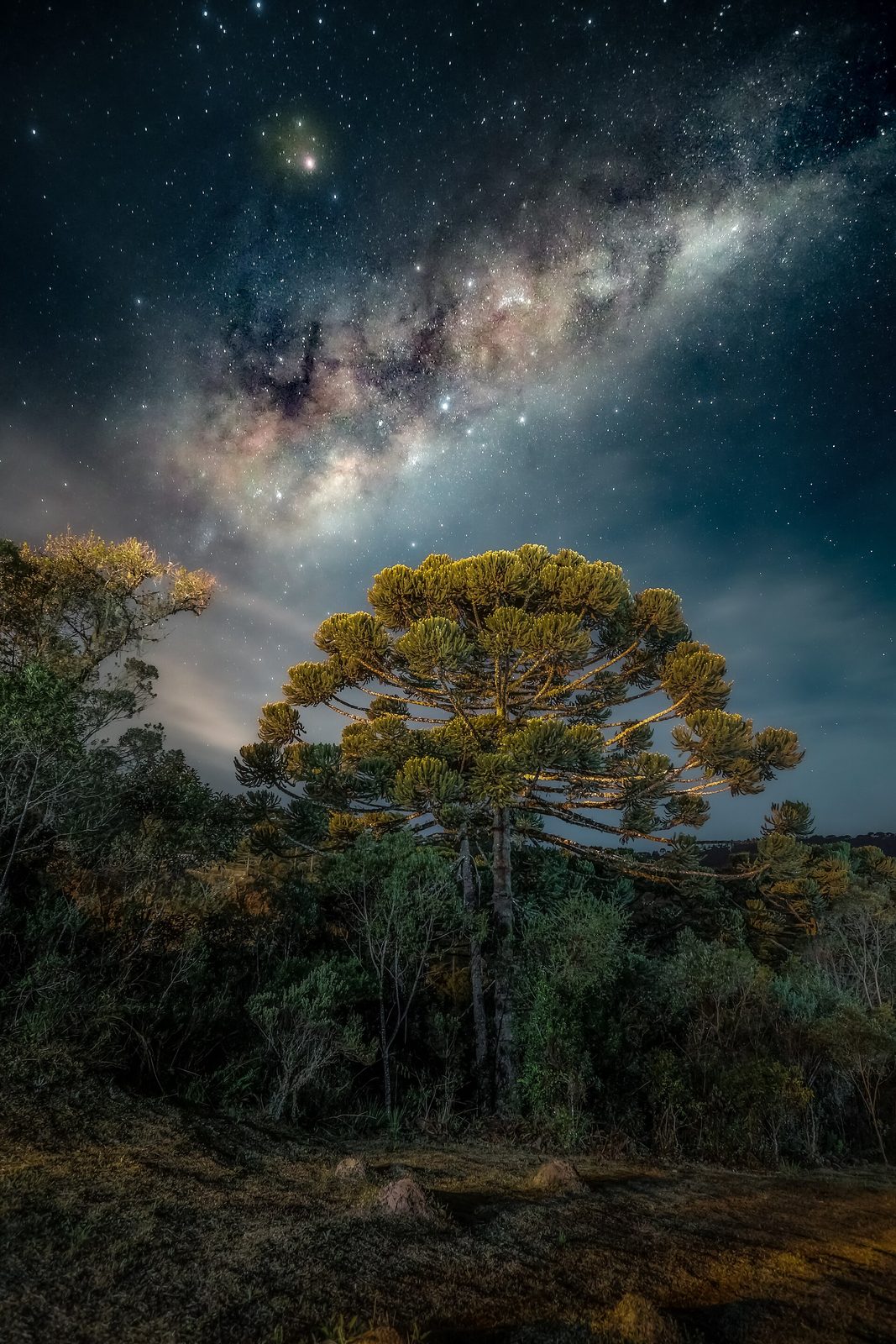
Most guides to a place tell you what to see by day. This one is about what happens after the sun goes down, when the forest quiets, the last light drains out of the west, and the sky above the reserve fills with more stars than most people have seen in their lives. Up here, well above the coast and set back from the glare of towns, darkness is not something to get through on the way to morning. It is one of the reserve's quiet resources, as real as the clean water and the standing forest, and on a clear night it turns the whole valley into an observatory with no roof and no walls.
The sky over Paraty is a Southern Hemisphere sky, which means that for a great many visitors — anyone who grew up north of the equator — it is a genuinely foreign one. The familiar signposts are gone. There is no steady Pole Star in the north, no Big Dipper swinging around it. In their place stand the Southern Cross, the two brilliant pointer stars beside it, and the finest stretch of the Milky Way there is, arching overhead with its bright center almost directly above you on a clear winter night. Once you learn to read it, this sky becomes one of the real rewards of coming this far south.
What follows is a long, practical guide to that sky and how to enjoy it from the reserve: why the darkness here is worth protecting, how to find your way around the southern stars, what to look for through the seasons, and the small, easy habits — letting your eyes adjust, using a red light, being patient — that turn a glance upward into a proper night under the stars. No equipment is required. The sky does the work. You only have to go outside, look up, and give it time.
- Latitude
- about 23 degrees south, near the Tropic of Capricorn
- Sky
- Southern Hemisphere; the Southern Cross and both Magellanic Clouds are visible
- Galactic center
- rides high overhead on winter evenings, around the middle of the year
- Darkness
- low light pollution above Paraty; the reserve keeps its own lighting low
- Best nights
- clear and moonless, away from the days around full moon
- Gear
- nothing required; binoculars help; a dim red light saves your night vision
- Warm-night bonus
- fireflies and forest bioluminescence in the season for them
- Setting
- an 800-acre protected Atlantic Forest reserve above the seven waterfalls
Darkness as a resource
We are the first few generations of humans to have lost the night sky, and most people alive today have never really seen it. City light scatters off the air into a permanent orange haze that erases all but the brightest handful of stars, and by some counts the majority of people on Earth now live where the Milky Way is no longer visible at all. Against that background, a genuinely dark sky has become a rare thing, and a place that still has one holds something increasingly precious. The reserve does, and it keeps it on purpose.
What light pollution costs
Artificial light does not just spoil the view. Wasted light thrown upward and sideways is wasted energy, and it disrupts the living world in ways we are only beginning to reckon with. Night-flying insects, which are the base of much of the food web, are drawn to lights and die at them by the billion. Nesting sea turtles and their hatchlings, migrating birds, foraging bats, calling frogs, and countless nocturnal animals all navigate and behave by natural light and are thrown off by the artificial kind. Fireflies, which flash to find one another in the dark, are dimmed and confused by competing glow. Darkness, it turns out, is a habitat, and light pollution is a way of destroying it without ever cutting down a tree.
Why the reserve stays dark
Keeping the reserve dark is not an accident of remoteness; it is a decision, and it follows directly from the way the place is built. The chalets are off-grid-minded and run on their own power, with no floodlights, no illuminated signage, and no wash of light spilling into the forest and up into the sky. Outdoor lighting is kept low, warm, and pointed downward at the ground where it is actually needed, so that you can find a path without erasing the stars overhead or disturbing the animals that own the night. This is of a piece with the whole approach to running a working retreat inside a protected forest, which you can read about on our sustainability page: the same restraint that protects the water, the soil, and the wildlife also protects the night. A dark sky is simply what you get when a place decides not to shout.
What a dark sky gives back
The reward for all that restraint is a sky most visitors have never experienced. On a clear, moonless night here, the stars come out not by the dozen but by the thousand, layered so thickly that the familiar constellations can be hard to pick out of the crowd. The Milky Way is not a rumor but a solid, mottled band of light running clean across the sky, split by dark lanes of dust. In true darkness you can begin to notice subtler things: the faint pyramid of the zodiacal light leaning up from the horizon after twilight, sunlight scattered off dust in the plane of the solar system; and, when Venus blazes at its brightest, the faintest of shadows it can cast on a pale surface. None of this requires a telescope. It only requires a sky that has been left alone, which is exactly what the reserve works to provide.
Getting your bearings in a southern sky
The first night under an unfamiliar sky can be pleasantly disorienting, and the honest truth is that you do not need to name a single thing to enjoy it. But a little orientation goes a long way, and the southern sky has a few landmarks so distinctive that you can learn them in one evening and keep them for life. Start by facing south — we will find true south properly in a moment — and let your eyes wander. What looks at first like random scatter resolves, with a little patience, into patterns.
The sky turns around the southern pole
Everything in the sky rises in the east and sets in the west, carried by the turning of the Earth, just as it does everywhere. What changes in the Southern Hemisphere is the center of the wheel. Northern skywatchers have Polaris, a moderately bright star sitting almost exactly above the north pole, around which the whole sky pivots. The south has no such convenient marker. The south celestial pole sits in a dim, empty patch of sky with only a faint star near it, so you cannot simply point to it. Instead, the southern sky appears to rotate clockwise around that blank spot, and the stars closest to it never set at all, circling the pole all night long while the rest rise and sink.
The Southern Cross and its pointers
The most famous pattern in this sky is the Southern Cross, Cruzeiro do Sul, the small, kite-shaped constellation that appears on the Brazilian flag and on the flags of several southern nations. It is compact and easy to miss among brighter neighbors until you learn it, and the trick to being sure you have the real one is to look for the two bright stars just beside it, the pointers, which are Alpha and Beta Centauri. These two point toward the Cross and help you tell it from the larger, fainter False Cross nearby that fools beginners every season. Alpha Centauri is worth a moment of wonder in its own right: it is the closest star system to our Sun, a little over four light-years away, which in the vastness overhead makes it practically next door. From this latitude the Cross is not quite always in the sky; it wheels down toward the horizon and back up through the year, standing highest and best on evenings in the southern autumn and winter.
Once you have found the Cross and its pointers, you can use them to find true south, which is a genuinely useful piece of old navigator's knowledge. Take the long axis of the Cross, the line from its top star down through the bottom one, and extend it about four and a half times its own length out into the empty sky. That brings you very near the south celestial pole. Drop straight down from there to the horizon, and where you meet the ground is due south. No compass, no instrument, just four stars and a bit of imagination — the same method that guided people across the southern oceans for centuries.
Night to night, season to season
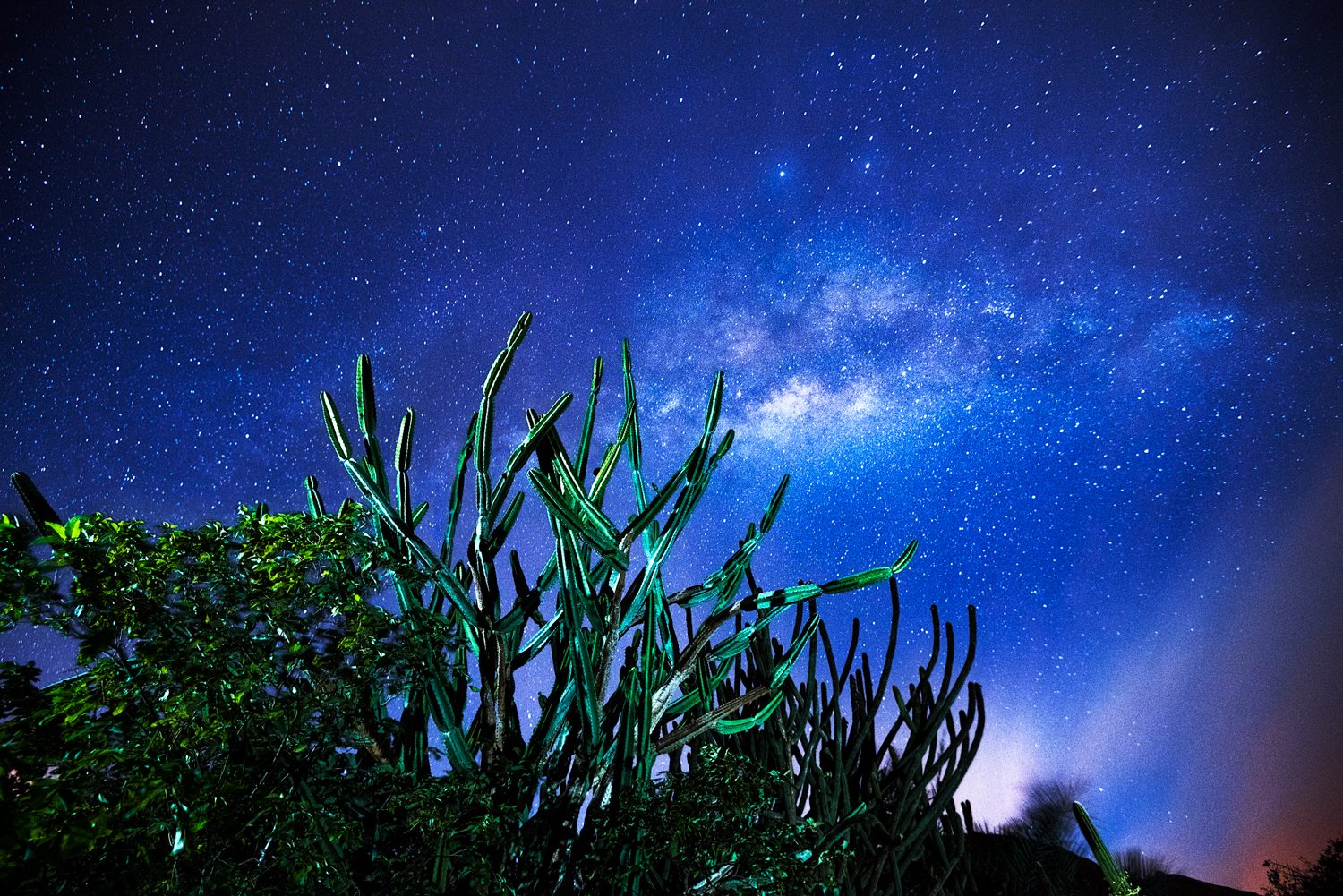
Two kinds of motion shape what you see. The first is nightly: over the hours, the whole sky drifts westward as the Earth turns, so a constellation low in the east after dinner can be high overhead by midnight. The second is seasonal, and it is why the sky is a calendar. Because the Earth also circles the Sun, the stars return to the same place about four minutes earlier each night, which adds up to roughly two hours a month, so the evening sky slowly turns over through the year. In the warm months you get the brilliant stars of the southern summer — Sirius, the brightest star in the sky, and Canopus not far behind, with Orion standing high and, to northern eyes, upside down. In the cool months those give way to Scorpius and Sagittarius and the bright core of the Milky Way. Come back in a different season and you get, in effect, a different sky, which is one more reason there is no single best time to look up here.
The Milky Way and its bright center
If the reserve's dark sky has one headline attraction, it is the Milky Way, and specifically the part of it that most northern visitors have never properly seen. What you are looking at when you look at the Milky Way is our own galaxy, seen edge-on from the inside: a flat disk of a few hundred billion stars, with us sitting partway out toward the rim, so that when we look along the plane of the disk we see the massed light of countless distant stars blurring together into a band. Every point of that band is a sun.
What you are actually looking at
The band is not uniform. It is brightest, widest, and most detailed in one direction — toward the constellations Sagittarius and Scorpius — because that is the direction of the center of the galaxy, some twenty-six thousand light-years away, where the stars are packed densest around a supermassive black hole. That glowing bulge, mottled with star clouds and torn by dark rifts of dust, is the single most spectacular stretch of sky visible to the naked eye, and here is the geographic luck of the reserve: at this southern latitude, near the Tropic of Capricorn, the galactic center passes almost directly overhead. In the Northern Hemisphere it never climbs far above the southern horizon, dim and foreshortened. Here it rides high, standing nearly at the zenith, seen through the least possible thickness of atmosphere. This is the good seat.
The best months to see the core
The bright center is a seasonal sight, because the Earth has to be on the correct side of the Sun for that part of the sky to be up at night. The best window for evening viewing is the southern winter, roughly the middle of the year, when Sagittarius and Scorpius climb high after dark and the core stands overhead for hours. On a clear, moonless winter night here, well away from any town glow, the core is not a faint smudge but a genuine feature of the landscape, bright enough to be unmistakable and rich enough to keep binoculars busy for an hour. In the warmer months the core is still there but sits low or rises only before dawn, so if seeing the Milky Way at its most dramatic is high on your list, the cooler mid-year months are the ones to aim for.
Standing under it is the whole point. Find an open spot with a clear view — a deck, a clearing, a place where the forest opens overhead — lie back so you are not craning your neck, and simply take it in. Let the band resolve out of the dark as your eyes adjust. Trace it from one horizon to the other. Notice the dark lanes, which are not gaps but clouds of dust blocking the light of stars behind them. There is no rush and nothing to accomplish. A dark sky rewards exactly the kind of slow, unhurried attention the forest teaches by day.
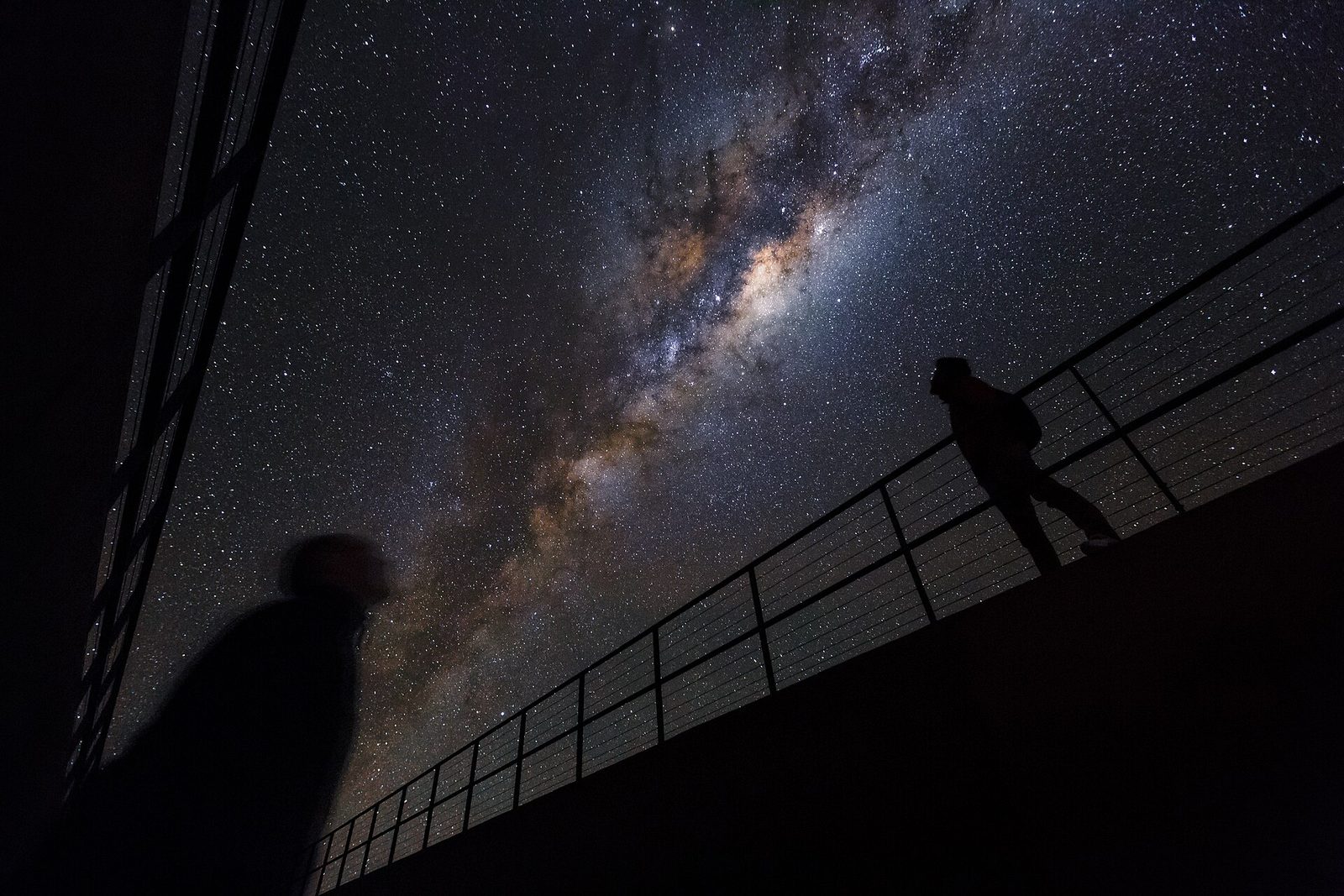
On a clear winter night the bright heart of our own galaxy stands almost directly overhead here — the densest, most detailed stretch of the Milky Way there is.
The Magellanic Clouds and the southern showpieces
Beyond the Milky Way itself, the southern sky holds a set of objects that northern observers simply cannot see, or see only poorly, and they are among the best reasons to make the most of a dark night this far south. Some are visible to the naked eye as soft patches of light; others reward a pair of binoculars; a few are famous targets for any telescope. You do not need to chase them all. Even knowing that they are up there, and being able to pick out one or two, adds a great deal to a night outside.
The two Magellanic Clouds
The two most remarkable naked-eye sights of the far southern sky are the Magellanic Clouds, a pair of soft, detached patches of light that look at first like torn-off pieces of the Milky Way drifting on their own. They are not clouds at all, and they are not part of our galaxy. They are two separate dwarf galaxies, companions to the Milky Way, held in its gravity and slowly orbiting it: the Large Magellanic Cloud, roughly a hundred and sixty thousand light-years away, and the Small Magellanic Cloud, farther still. When you look at them you are looking at other galaxies with your own eyes, their combined light having traveled for well over a hundred thousand years to reach you. From these latitudes they are visible on any clear, dark night, riding highest and showing best on evenings in the southern spring and summer. A pair of binoculars turns each smudge into a granular field of clusters and glowing gas, and near the Small Cloud you will find one of the finest globular star clusters in the sky.
Clusters and nebulae
The southern Milky Way is studded with star clusters and glowing nebulae, and a few stand out even to the unaided eye. Omega Centauri, high in the autumn and winter sky, is the largest and brightest globular cluster visible from Earth — to the naked eye a fuzzy star, but in binoculars a great ball of hundreds of thousands of ancient suns, and one of the genuine wonders of this sky. The Carina Nebula, a huge, bright cloud of glowing gas even more extensive than the more famous Orion Nebula of the north, sprawls across the autumn evening sky and is easy to find under dark conditions. Tucked beside the Southern Cross, the small, sparkling Jewel Box cluster shows subtle color in binoculars or a small telescope. These are the kinds of sights that make a dark southern sky feel almost overstocked, and any one of them is worth a long look.
The dark constellations
There is one more southern sight that most people miss because it is made of nothing. Right beside the Southern Cross lies the Coalsack, a conspicuous dark patch against the bright river of the Milky Way — not an empty hole but a dense cloud of dust blotting out the stars behind it. It is the most obvious of many dark lanes and rifts that thread through the southern Milky Way, and it points to a whole way of seeing the sky that the peoples of the Southern Hemisphere developed long ago. Where later stargazers connected bright stars into pictures, many southern cultures, from Australia to the Andes, also read shapes into the dark clouds between the stars, seeing animals and figures in the shadows themselves. On a truly dark night here, with the Milky Way blazing overhead, you can see exactly why: the dark shapes are as vivid as the bright ones.
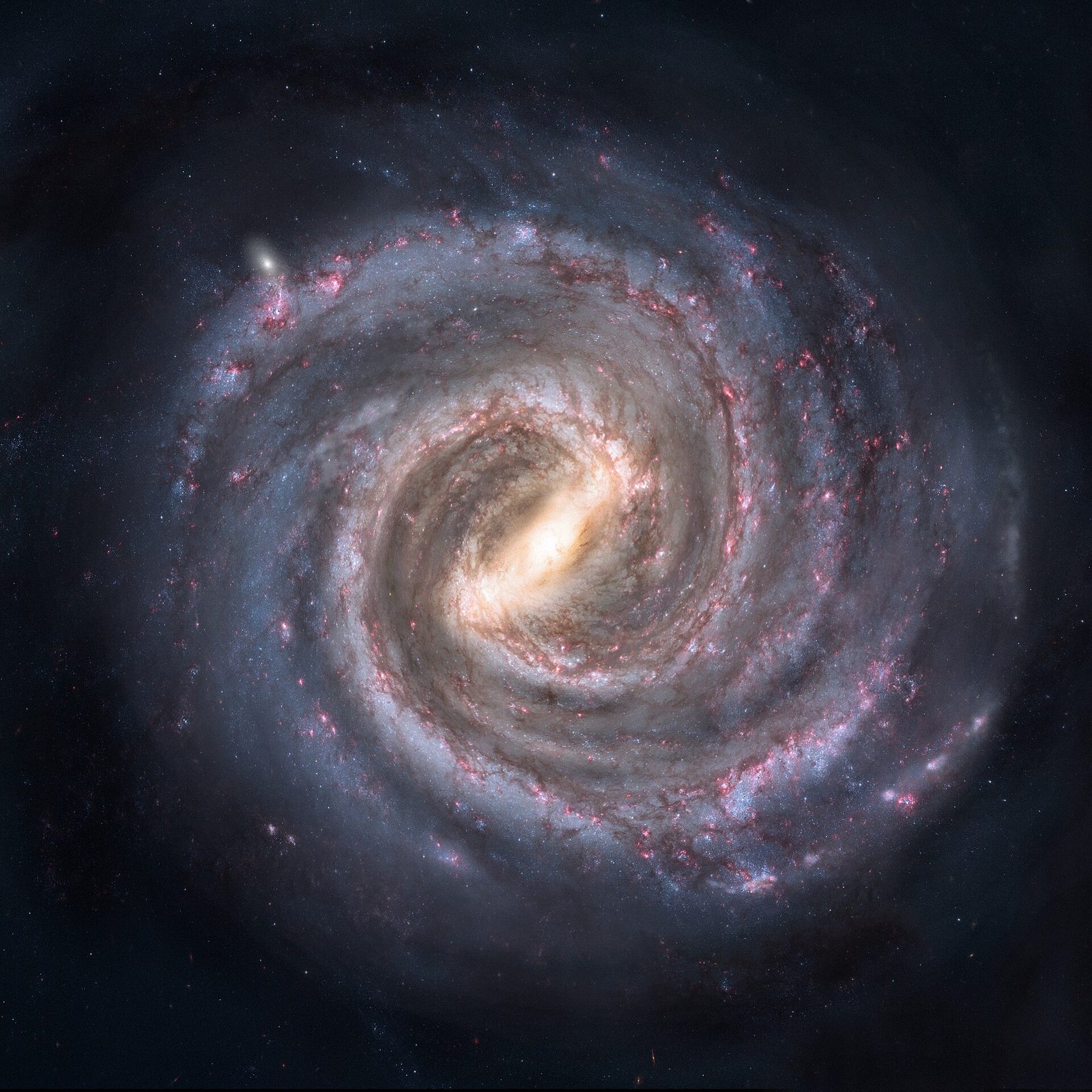
A gentle honesty is worth adding here, because it saves disappointment. Photographs of galaxies show glorious spiral arms in blues and pinks, and it is tempting to expect the same at the eyepiece. The eye does not work that way. To the naked eye and even through most telescopes, distant galaxies are faint gray smudges, beautiful in their own quiet way but nothing like the pictures. The color and structure in astrophotographs are drawn out by long exposures that gather light the eye cannot store. Knowing this in advance turns a possible letdown into a deeper appreciation: that dim smudge is an entire galaxy of billions of stars, and the fact that you can see it at all, across such a gulf, is the marvel.
Planets and the moon
Not everything bright in the sky is a star. The planets and the moon are the nearest and most changeable things overhead, and they follow their own rhythms that reward a little attention over the course of a stay. Unlike the fixed patterns of the stars, these wander, and where they sit on any given night depends on the date, so this is a matter of looking and noticing rather than memorizing.
The wandering planets
Five planets are visible without any equipment, and the ancients called them wanderers because they drift against the fixed stars along a single line across the sky, the ecliptic, which is the plane of the solar system seen edge-on. A quick way to tell a bright planet from a bright star is that planets tend to shine with a steady light while stars twinkle, because a planet shows a tiny disk rather than a single point. Venus is the brightest of all, the dazzling morning or evening star low near the horizon after sunset or before dawn. Jupiter is next, and a steady pair of binoculars will show its four largest moons as tiny points strung out in a line beside it, the very sight that helped Galileo overturn the old picture of the heavens. Saturn looks like a steady yellowish star to the eye, and needs a small telescope to reveal its rings. Mars glows a distinct reddish color, and Mercury is the elusive one, hugging the horizon in twilight. From time to time the planets gather close together, or the moon glides past one of them — quiet events worth catching if the timing of your stay lines up.
Reading the moon's phases
The moon is the great ruler of the night, and understanding its phases is the single most useful piece of planning for a stargazer. A full moon is a beautiful thing, bright enough to walk by without a light and to cast sharp shadows through the forest, but its glare washes the fainter stars, the Milky Way, and the deep-sky objects right out of the sky. The days around new moon, when the moon is absent from the night sky, are by far the best for seeing the galaxy and everything dim. So the rhythm is simple: come around new moon for the deep, dark sky, and come around full moon if it is the moon itself and a bright, silvered landscape you want. For looking at the moon through binoculars or a telescope, a half or crescent moon actually beats a full one, because along the line dividing its day and night side the low sunlight throws the craters and mountains into dramatic relief, while a full moon looks flat and glaring.
Plan your nights around the moon
If clear views of the Milky Way and the southern showpieces matter to you, try to time your stay for the week or so around new moon, when the sky is at its darkest. A first-quarter moon sets around midnight, so it leaves the small hours dark; a last-quarter moon rises after midnight, leaving the evening dark — either can work if you plan your looking to the right end of the night. The nights on either side of a full moon are the ones to avoid for faint objects, and the ones to choose if you would rather stroll the reserve by moonlight and admire the moon itself. A quick check of the moon phase before you book, or before you plan a given night, does more for your stargazing than any piece of equipment.
Meteors through the year
Few things make people gasp like a bright meteor, and a dark sky over the reserve is a fine place to catch them. A meteor is a small piece of debris, often no bigger than a grain of sand, burning up high in the atmosphere as it slams into the air at enormous speed. On any clear, dark night you will see a few of these random, sporadic meteors if you watch long enough. Several times a year, though, the Earth passes through a denser stream of debris shed by a comet or asteroid, and the rate climbs into a proper shower.
How a shower works
During a shower, the meteors all seem to shoot outward from a single point in the sky, called the radiant, in whatever constellation the Earth happens to be heading toward as it plows through the debris stream. Because the Earth crosses these same streams at the same points in its orbit each year, the well-known showers recur on a dependable seasonal schedule, and several of the year's richest ones favor observers in the Southern Hemisphere, with radiants that climb high in this sky. Rather than chase exact peak dates, it is enough to know that the year is dotted with them, spread across the seasons, and that the reserve's dark sky gives you the best possible chance of seeing the faint ones as well as the bright. Some of the finest, such as the stream of dust left behind by Halley's Comet, are seen best in the hours before dawn.
How to watch one well
Watching a meteor shower is the most relaxed astronomy there is, and equipment only gets in the way. The whole method is to get comfortable and look at as much sky as possible. Find an open spot, lie back on a reclining chair or a mat with a blanket, and take in a wide swath of the sky rather than staring at any one point — meteors can flash anywhere. Give your eyes at least twenty or thirty minutes in the dark to adapt, avoid looking at any bright light or phone screen, and then simply be patient. Rates come in fits and starts: you may see nothing for ten minutes and then three in a rush. After midnight is generally better than the evening, because the part of the Earth facing its direction of travel sweeps up more debris, like a windshield in the rain. A dark, moonless night makes all the difference. Bring warmth, bring patience, and let the sky surprise you.
The forest's own light
Not all the light on a warm night comes from the sky. The Atlantic Forest has its own living light, and on the right night, in the right season, the darkness at ground level can be almost as remarkable as the darkness overhead. This is bioluminescence — light made by living things through chemistry — and the forest around and below the reserve produces several kinds of it. It is weather-dependent and never guaranteed, which is part of what makes an encounter with it feel like a gift.
Fireflies, and the synchronized displays
The most magical of these are the fireflies. On warm, humid nights, especially in the spring and early summer, the forest edges and clearings can fill with their drifting, blinking lights, each flash a male signaling to a mate in a code particular to his species. The Atlantic Forest is home to some of the fireflies famous for the strangest trick of all: synchronization, whole groups flashing on and off together in rhythm, a pulse of light running through the dark trees. It does not happen every night or everywhere, and it depends on season, warmth, and humidity lining up, but when it does it is one of the more astonishing things the forest offers. The same low lighting that protects the stars protects the fireflies too, since artificial light drowns out their signals and scatters them.
Glowing beetles and cold fire in the leaves
Fireflies are not the only lights below the canopy. Click beetles carry a pair of steady glowing spots that shine like small green headlights as they move. And in the leaf litter, on damp fallen wood, you can sometimes find the faint, eerie glow of bioluminescent fungi — foxfire, an old name for the cold light given off by certain mushrooms as they digest rotting wood. It is dim enough that you will only see it once your eyes are fully adapted to the dark, which is a good reason to switch off every light for a few minutes and simply wait. Our guide to the wildlife of the reserve goes further into the creatures of the night here, but for a stargazer the lesson is a happy one: turning off your lamp to protect your night vision for the stars is also the way to discover the forest's own quiet glow.
How to stargaze well
Stargazing asks almost nothing of you, but a handful of simple habits separate a frustrating night from a wonderful one, and none of them cost anything. The single most important is also the one people most often skip, so it comes first.
Let your eyes adapt to the dark
Human eyes take time to reach their full sensitivity in darkness — the better part of half an hour, and longer for the faintest stars. During that time the eye is quietly rebuilding a light-sensitive chemical that a single glance at a bright white light will destroy in an instant, sending you back to the start. This is why the sky seems to fill with more and more stars the longer you stay out, and why the first five minutes are always the least impressive. Protect that adaptation fiercely. Do not check a bright phone. If you need light to see your feet or your gear, use a dim red light, because the eye's night-sensitive cells barely register red and your adaptation survives it. A trick for spotting the faintest objects, once you are adapted, is averted vision: look slightly to one side of a dim smudge rather than straight at it, and it often brightens, because the edges of your vision are more sensitive to faint light than the center.
Give your eyes half an hour in the dark and the sky doubles; the faintest stars only come out for the patient.
Binoculars before a telescope
People assume serious stargazing needs a telescope, but the best first instrument by far is an ordinary pair of binoculars. They are cheap, need no setup, show a wide piece of sky right-side up, and are easy to hold and aim, and they transform the experience. A pair of binoculars will resolve the Milky Way into uncountable stars, reveal the four moons of Jupiter, split the Magellanic Clouds into clusters and glowing patches, turn Omega Centauri into a ball of light, and show the craters along the moon's terminator. A telescope reaches farther — the rings of Saturn, galaxies as faint smudges — but it shows a narrow slice of sky, takes practice to aim, and can frustrate a beginner. Start with binoculars and your own eyes, learn the sky, and a telescope will make far more sense later if you want one.
An app, warm clothes, and patience
A few small comforts round it out.
- A star app on your phone can hold up a live map of the sky and name what you are looking at, which is a fine way to learn — but only if you switch it to its night or red-screen mode, or it will wreck the dark adaptation you worked to build. A printed star wheel set for southern latitudes is a lovely low-tech alternative that never glows.
- Dress warmer than you think you need to. The reserve sits up in the mountains, and clear nights lose their heat quickly; even in the warm season a still night can turn cool, and standing around looking up is not exactly aerobic. Bring layers, and something for your head.
- Get comfortable. A reclining chair or a mat and blanket lets you look straight up without craning your neck, which is the difference between ten minutes and two happy hours. A hot drink helps.
- Above all, be patient and let the night come to you. Give the clouds time to pass, give your eyes time to adjust, and give yourself permission to simply lie there and look. The sky rewards the unhurried.
The reserve after dark
A night sky is best enjoyed from a place you feel easy in, and the reserve after dark is a gentle place — but it is a wild forest at night, and a few sensible habits let you relax into it rather than jump at every sound. The good news is that stargazing here rarely requires going far. Some of the best sky is straight up from a chalet deck or an open clearing, where you can settle in comfortably with the forest at your back.
The voices of the night
The first thing you notice on a still night here is that the forest is anything but silent. On a warm, wet night the frog chorus rises off the streams in an extraordinary wall of calls, dozens of species at once, each with its own note. Owls call from the dark canopy, insects keep up their steady background hum, and now and then something larger rustles through the leaf litter. None of this is cause for alarm — it is the ordinary soundtrack of a healthy forest going about its nocturnal business — and it is one of the quiet pleasures of stargazing here that you lie under the stars inside a living, sounding forest rather than a dead quiet. Let the sounds become part of the night. Learning what a few of them are, which our wildlife guide can help with, only deepens the experience.
Staying safe and gentle in the dark
Simple care keeps a night outside easy and worry-free, for you and for the forest. The point is not fear but competence: a little sense lets you enjoy the dark fully.
A few simple rules for being out after dark
Wear closed shoes, and watch your footing on trails and rough or wet ground, which is harder to read at night. Carry a light — a headlamp with a red mode is ideal, red to protect your night vision, white for when you actually need to see the path. For stargazing, stick to open, familiar ground: a deck, a clearing, a spot you have seen by day, rather than pushing into the forest on dark trails. On warm nights, be snake-aware and never put a hand or foot where you cannot see, since some snakes are active after dark; our wildlife guide covers this calmly and in full. Let staff know if you plan to be out late, keep to areas you know, and there is no need to wander far — the best sky is usually right overhead. Keep noise and light low, both as a courtesy to other guests and so as not to disturb the animals whose night it is.
Photographing the night sky
A dark sky is a powerful draw for a camera, and the Milky Way over the forest is a genuinely spectacular subject. Night-sky photography has a real learning curve, and this is only a starting orientation rather than a full course — our dedicated Paraty photography guide goes deeper into gear and technique for this region — but the basics are worth knowing before you point a camera up in the dark.
The basic recipe
Photographing the stars comes down to gathering as much light as possible without letting the stars smear as the Earth turns. That means, first of all, a steady tripod, because the exposures are far too long to hand-hold. Set the camera to manual, open the lens to its widest aperture, raise the sensitivity well up, and use an exposure of some seconds — short enough that the stars still record as points rather than trailing streaks, which depends on how wide your lens is. Focus is the part people get wrong most: autofocus fails in the dark, so switch to manual and carefully focus on a bright star or distant light using the magnified live view until it snaps to a crisp point. Shoot in the camera's raw format if you can, trip the shutter with a timer or remote so you do not shake the camera, and include something earthly in the frame — a lone tree on the ridgeline, a silhouetted figure at a railing, the dark edge of the forest — to give the sky a sense of place and scale.
What the camera sees that the eye cannot
The wonderful and slightly disorienting thing about night photography is that the camera sees more than you do. A long exposure piles up light that your eye discards moment to moment, so a photograph of the Milky Way glows with color and detail — pinks of glowing gas, the tea-brown dust lanes, thousands of stars — that you cannot perceive standing right there. This is not cheating; it is simply what a camera is for. It does mean you should look with your eyes first and photograph second, so that you actually experience the night rather than spending it hunched over a screen. Take the picture, certainly. But then put the camera down, lie back, and let the real sky, quieter and subtler than any photograph, have the last word.
A night sky and the stillness of the forest
There is a natural kinship between lying under the stars and the slow, attentive forest time that the reserve is built around, and it is worth naming, because the two go together better than almost anything else you can do here. By day, the practice of unhurried, sensory attention among the trees — what our guide to forest bathing and shinrin-yoku describes in full — is a way of settling the nervous system and coming back into your body and your senses. A night under the stars is the same practice in a different key.
Everything that makes stargazing work is also what makes forest bathing work: you slow down, you stop trying to get anywhere, you let your senses open and your eyes adjust, and you give it time. Lying still in the dark, listening to the frogs and the water and the small movements of the forest while the great slow wheel of the sky turns overhead, is about as deep a form of rest as this place offers. It puts the day's worries in a useful perspective — it is difficult to stay wound up about an inbox while looking at the light of a galaxy that left its stars before there were cities. Many guests find that a slow evening under the stars, following a slow day in the forest, is the moment a stay here finally does its quiet work on them. The two halves, the green day and the dark night, are really one long exercise in paying attention to something larger than yourself.
The clearest skies, season by season
The last practical question is when to come for the best chance of clear, dark nights, and the honest answer starts with a caveat: this is a mountain rainforest, and cloud, mist, and rain are part of its character in every season. No one can promise you a clear sky on a given night. What you can do is tilt the odds and match your visit to what you most want to see, and the two main seasons offer a real trade-off. Our guide to the best time to visit weighs all of this in more detail, but here is the short version for a stargazer.
The dry season and winter clarity
The cooler, drier months of the southern autumn and winter, roughly the middle of the year, tend to bring the most settled weather and the clearest, steadiest skies. Lower humidity means better transparency, so the stars look sharper and the faint objects come through more easily, and long stretches of fair weather raise your odds of catching a genuinely clear night. This season carries a wonderful bonus for the stargazer: it is exactly when the bright center of the Milky Way rides high overhead in the evening. If seeing the galactic core and the southern deep-sky sights at their best is your priority, and you do not mind cool mountain nights, this is the season to aim for. Bring warm layers; clear winter nights up here can be genuinely cold.
The warm, wet months
The warmer, wetter months of the southern spring and summer are cloudier and more humid, with more frequent rain, so clear nights can be harder to come by and you may have to take your chances between passing weather. But this season has its own rewards. The nights are warm and comfortable for lying out under the sky. It is the season of the fireflies and the loudest frog chorus. The Magellanic Clouds ride high in the evening, brilliant Orion and Sirius and Canopus command the summer sky, and by the small hours of late summer the Milky Way's core is already climbing back into the pre-dawn east. The practical wisdom in this season is simple: watch the sky, and when it clears — often it opens up beautifully after a rain, or in the small hours — be ready to step outside and make the most of it. A clear night in the wet season, warm and washed clean, can be as fine as any.
Under the same dark sky
Everything on this page comes back to a single idea that the reserve is built around: that some things are worth protecting precisely because they are quiet, dark, and easy to lose. The night sky is one of them. It costs nothing to keep and everything to squander, and a place that keeps its lights low and its forest whole ends up holding a piece of the world that most people no longer have access to at all. The dark that shelters the fireflies and the frogs and the owls is the same dark that lets the Milky Way pour across the sky overhead. You cannot protect one without the other, and here, happily, no one is trying to.
So the invitation is a simple one. Come, and on a clear night step away from your chalet, let your eyes adjust, and look up. You do not need to know a single constellation, though you will learn a few whether you mean to or not. Find the Southern Cross and follow it down to true south. Trace the Milky Way from horizon to horizon and find the bright core standing overhead. Watch for a meteor, listen to the forest, feel the cool air, and let the slow turning of the sky do to your mind what the forest does to it by day. If you would like to plan a stay around dark, moonless nights and the seasons of the clearest skies, the practical details are on our stays and booking page, and the rest of our local guides will help you fill the daylight hours between one starry night and the next. The sky above the reserve has been there all along, exactly as it is now, waiting for anyone willing to turn off the lights and look.