
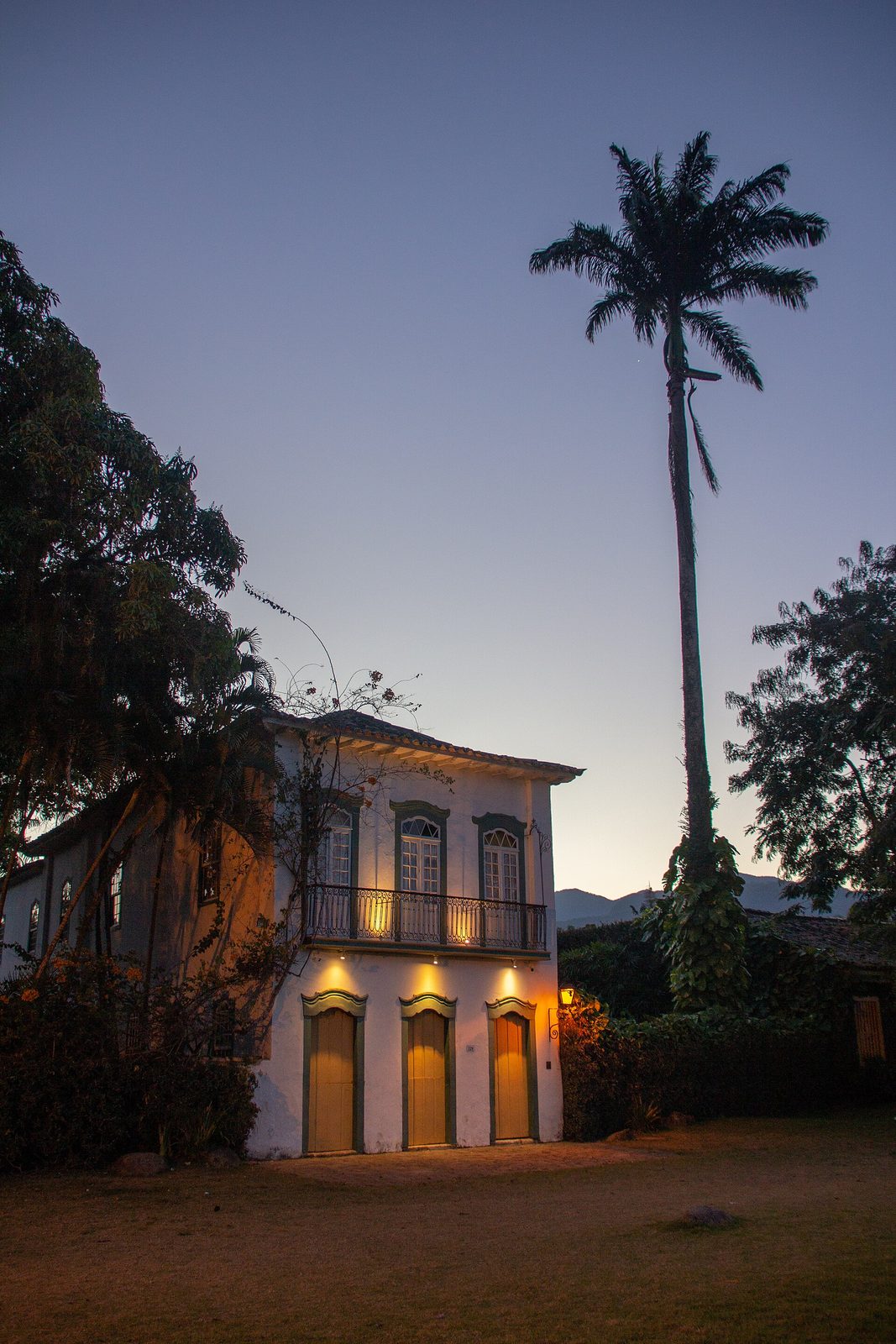
Paraty is one of those rare places that seems to have been arranged for a camera long before cameras existed. The old town was laid out in the seventeenth and eighteenth centuries as a port for gold coming down from the mountains, and almost everything about it — the low whitewashed houses, the deep-set doors painted in bold colors, the streets paved with great rounded stones, the church towers standing just above the rooftops — happens to catch light in a way that photographers find hard to resist. Add the sea that slides into the streets on the biggest tides, the mountains that rise green and steep behind the town, and a bay scattered with islands, and you have a subject that will keep you busy for as long as you care to stay.
This guide is about where, when, and how to make good photographs in Paraty and in the forest and water around the reserve. It leans on principles rather than gear. The most useful things you can bring here are patience, an eye for light, and a willingness to get up early and stay out late. Good equipment helps at the margins, but the town has been photographed beautifully on everything from view cameras to phones, and it will reward whatever you carry as long as you pay attention to timing and weather.
It is also a place that asks for a certain amount of care. People live and work in the historic center; the forest is a protected remnant of one of the most threatened ecosystems on earth; and the tides, the rivers, and the wet rock can all turn dangerous if you stop paying attention. Good photography here is bound up with good manners and good sense, and this guide tries to keep the three together.
What makes Paraty worth photographing
Start with the whitewash. Nearly every wall in the old town is painted a plain lime white, and that white is the surface on which all the light of the day gets recorded. In the morning it goes cool and faintly blue; at midday it can be brutal and flat; in the last hour before sunset it warms to cream and then to a soft gold. Because the walls are low and the streets are narrow, light bounces from one side to the other, filling shadows and softening faces. You rarely fight harsh contrast here the way you would in a city of tall glass buildings. The town is, in effect, one large natural reflector.
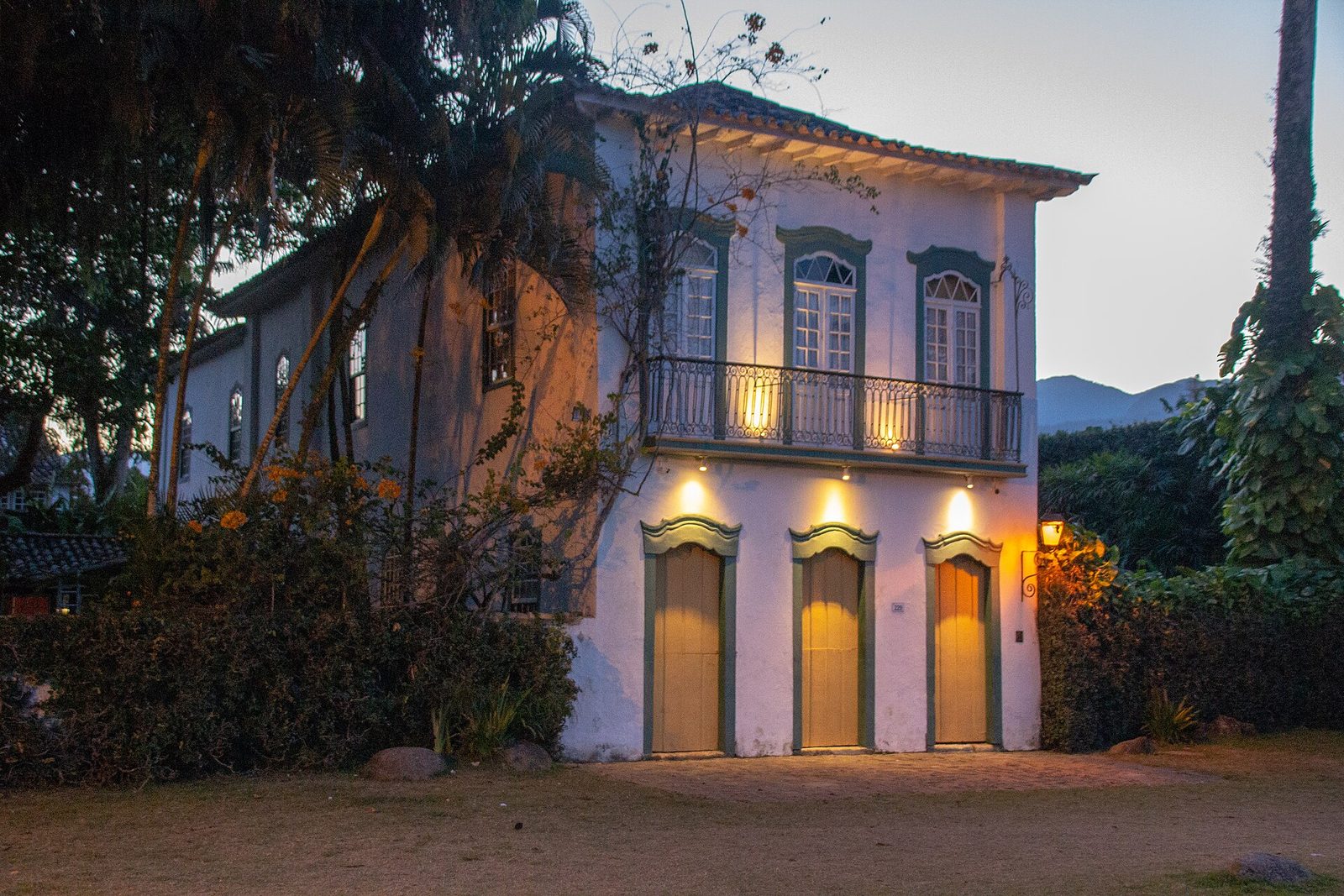
Against that white, the color does its work. Doors, window frames, and shutters are painted in strong blues, ochres, reds, and greens, a tradition that once helped residents tell one house from another. For a photographer this means you can build a frame around a single saturated element — a blue door, a red boat — and let the white around it do the rest. Restraint pays off. A picture with one clear color against the whitewash almost always reads better than one crowded with competing hues.
Then there is the coastal light itself. Paraty sits where steep forest meets a sheltered bay, and the air is often heavy with moisture. That humidity scatters light and, especially near dawn and dusk, can lay a gentle haze over the water and the hills. Some photographers arrive wanting hard, clear skies and feel cheated by the softness. Learn to want the softness instead. Haze separates the ridgelines into pale layers, turns the bay to pewter and rose, and gives the whole scene a sense of depth that a cloudless blue sky never will. The weather here is part of the subject, not an obstacle to it.
Reading the weather, the seasons, and the light
Paraty has two broad moods. The southern-hemisphere summer, roughly November into March, is hot, green, and wet. Mornings often open clear and bright, then clouds build over the mountains through the afternoon and break into rain, sometimes hard rain, by evening. This is the season of full rivers and thundering waterfalls, of dramatic skies and fast-changing light, but also of washed-out afternoons and gear that never quite dries. The cooler months, roughly May into September, are drier and steadier, with more reliable clear mornings and gentler seas, which many photographers prefer for boat trips and long days in the field.
Whatever the season, the shape of the day matters more than the calendar. The hour after sunrise and the hour before sunset are worth more than the entire middle of the day put together. In those windows the light rakes across the cobblestones, picks out the texture of old plaster, and turns the bay to metal. Midday is for scouting, eating, and resting; save your best walking for the ends of the day.
Because Paraty lies not far from the Tropic of Capricorn, the sun climbs fast and drops fast. The soft golden window at each end of the day is shorter than it would be farther from the equator, so be in position and ready before it begins rather than wandering toward your spot as it fades. Watch the sky in the west through the afternoon; a band of cloud low on the horizon can either kill a sunset or, more often, catch fire and make it. Overcast days are not wasted days. Flat gray light is unkind to wide vistas but flattering to close work — a weathered door, a fishing net, a face — where you want detail and color without deep shadows. Read the weather each morning and match your subject to the light you are actually given.
The signature shot: the streets that become mirrors
If Paraty has one image that everyone eventually chases, it is the sight of the historic center under water. On the highest tides, seawater rises up through the old drains and low streets until a thin sheet lies across the stones, and the whitewashed houses and church towers double themselves in the reflection. The town was built to let this happen; the tides were meant to wash the streets clean. For a photographer it is a gift, but a gift that takes planning, patience, and tact to receive well.
Reading the tide
The flooding is not random and it is not daily. It comes with the biggest tides of the month, which cluster around the new moon and the full moon, when the sun and the moon pull together. Look at a tide table for the Paraty area and find the days when the high water reaches its greatest height; those are your candidates. Do not rely on an exact time or an exact level from a guide like this one, because both shift through the year and with the wind and rain — check a current table close to your visit and read it yourself. Arrive well before the predicted peak so you can watch the water come up, because the best reflections often form on the way in or the way out, when there is enough water to mirror the buildings but not so much that it swamps the scene.
Finding the frame
Once the water is lying still, the pictures nearly make themselves — but only if you get low. The reflection is strongest when your lens is close to the surface, so crouch, or set the camera just above the sheet of water and compose from there. Look for a stretch of street where a church tower or a run of colored doors stands at the far end, so the reflection has something worth repeating. Keep the real building and its double both in the frame, and give the reflection room; a common mistake is to cut it off too soon. Perfectly still water is the whole point, so shoot in the calm between footsteps and gusts, and be ready to wait for a lull.
Respecting the people who live there
These are streets where people live, run shops, and try to get home with dry feet. The flood that delights you is, to a resident, a chore and sometimes a loss. Do not block doorways, do not set a tripod where it trips someone, and never wade into a shop's entrance for a better angle. Ask before you photograph a person's home from close range, keep your voice down at dawn, and give way to anyone whose day you are standing in the middle of. The picture is not worth a stranger's morning.
The flood that delights you is, to a resident, a chore and sometimes a loss.
Golden hour in the historic center
The last hour of daylight is when the old town is at its most photogenic, and the best way to use it is simply to walk. As the sun drops, the whitewash warms, the shadows stretch along the stones, and the crowds thin. Rather than fixing on one spot, move slowly through the historic center and let the light lead you; a lane that looked ordinary at noon can turn golden and inviting as the sun slips low. Keep the camera ready and your eyes on the walls, watching where the warm light lands.
Santa Rita and the waterfront
The small church of Santa Rita, standing where the town meets the water, is the picture most people come for, and for good reason. Its simple white front and twin bell openings face roughly toward the water, so it catches warm light late in the day and glows against a deepening sky. Work it from several distances: a wide frame that sets the church against the bay and the boats, a medium one that isolates the front, and a closer study of the tower and its lines. Come back after the sun is gone, too — the church takes artificial light well, and the sky behind it moves through blue to violet in the half hour after sunset.
The colored doors and the quiet lanes
Away from the waterfront, the reward is smaller and more patient work. The town's doors and windows, painted in blue and ochre and oxblood, are subjects in themselves. Look for a single door catching side light, a bicycle leaning on white plaster, a cat in a warm rectangle of sun. Keep backgrounds clean and let the whitewash breathe around your subject. The uneven cobblestones photograph best when raking light picks out their rounded shapes, so shoot down a lane with the sun low behind or ahead of you. Evening also brings out the town's lanterns and shop lights, which you can balance against the last of the sky for a warmer, lived-in feel.
Blue hour, the forts, and the high viewpoints
When the sun has set, do not pack up. The half hour that follows — the blue hour — is often the best light of the day for wide views of Paraty. The sky holds a deep, even blue, the town's lights come on, and the balance between natural and artificial light is briefly perfect. This is the time to be somewhere high or open, looking back over the rooftops and the bay. For where to stand, the companion guide to the town's viewpoints and forts is worth reading before you go, but a few principles hold wherever you end up.
The fort and the overlooks
The old fort on the hill at the edge of town, built to guard the port, doubles as one of the easiest high viewpoints, with cannon and stonework in the foreground and the bay spread out beyond. Higher still, the roads and trails that climb into the hills give longer views over the whole town and its islands. Getting to a viewpoint for blue hour means arriving before sunset, scouting your composition in daylight, and being willing to wait through the fading light for the moment the town switches on. Bring a headlamp for the walk back down, and keep it red or dim so you do not blind yourself or ruin anyone else's long exposure.
Making blue hour work
Blue hour is dim, and that changes how you work. A steady support — a tripod, a wall, a bag resting on a railing — lets you keep the sensitivity low and the image clean while the shutter stays open for a second or more. Lock focus while there is still light, then leave it. Expose for the sky and let the town lights register as warm points; if anything, err slightly dark, because the deep blue is part of the mood. Watch the balance minute by minute, because the window closes fast, and take frames throughout — the perfect balance between sky and streetlight lasts only a few minutes, and you want to be shooting when it arrives.
The bay and the islands from a boat
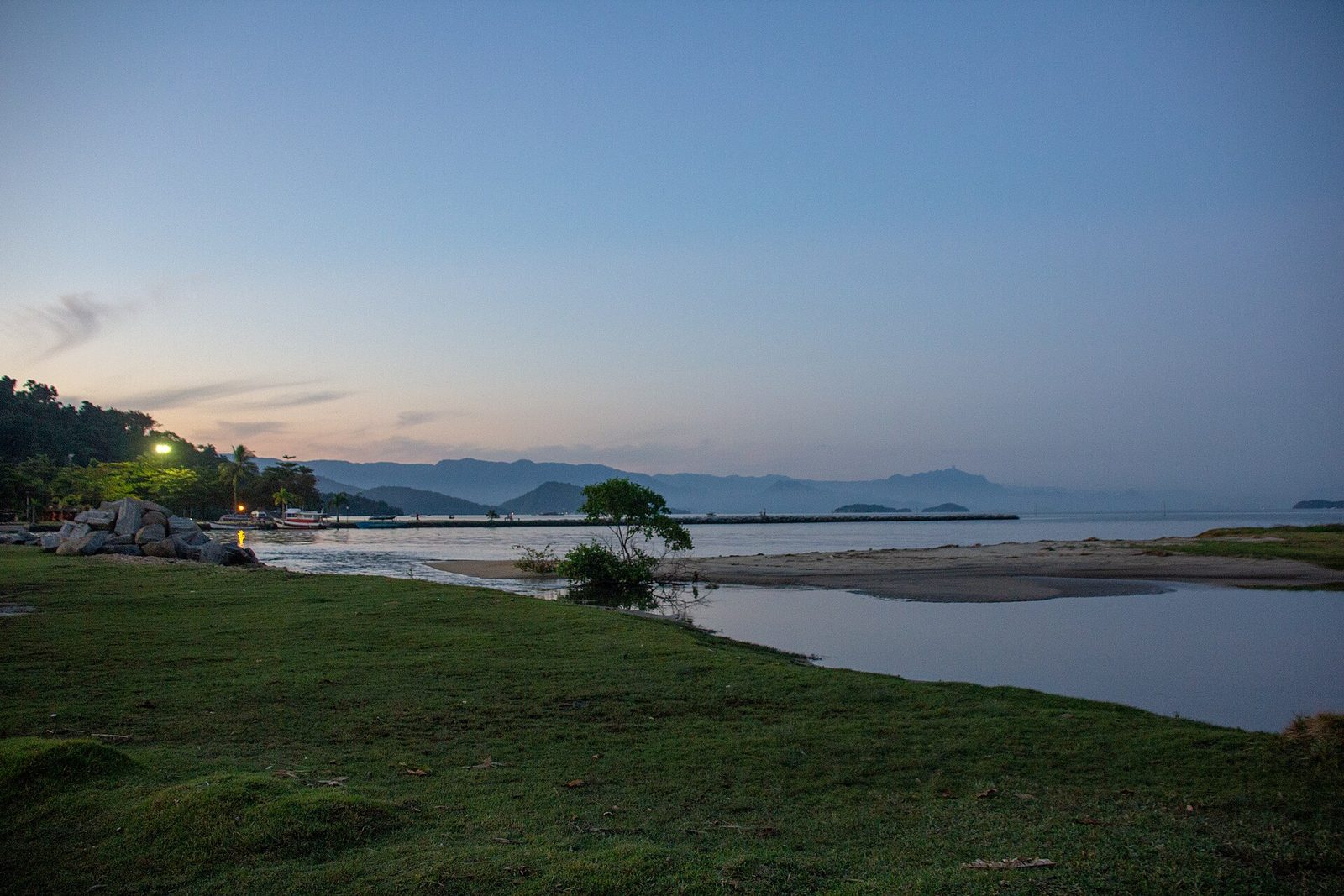
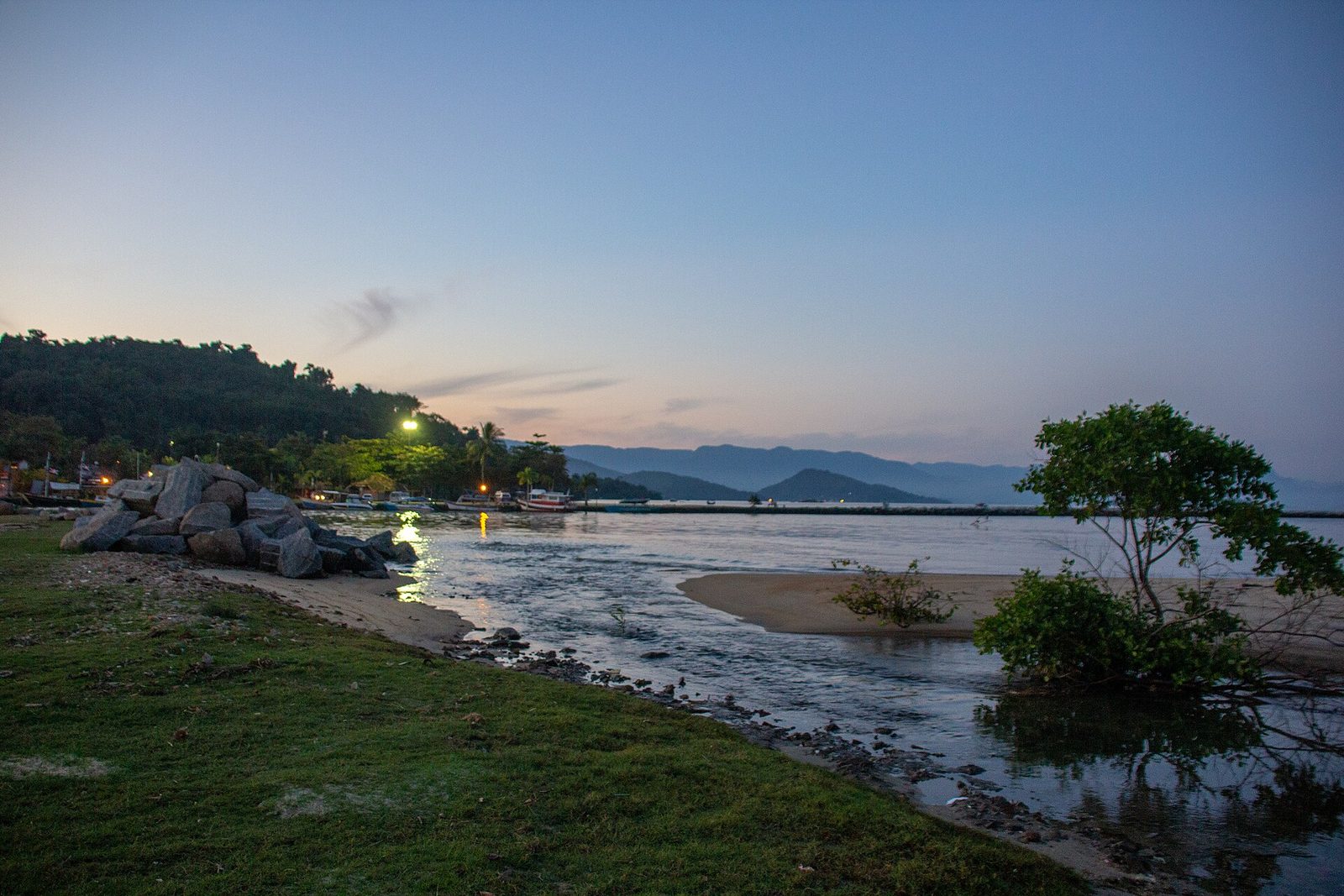
Sooner or later you will want to get out on the water. The bay in front of Paraty is scattered with islands, coves, and beaches, most of them reachable only by boat, and a day among them is a day of a different kind of photography — open horizons, changing angles, and the town seen from the sea. Traditional wooden schooners and small motorboats run trips out through the islands, and the light on the water is the whole reason to go.
Shooting from a boat means accepting movement. The deck rocks, the boat turns, and your horizon will not hold still, so keep your shutter quick enough to freeze the motion and take more frames than you think you need. A few habits make the day easier:
- Keep a shutter speed fast enough to freeze the deck's movement, and shoot in short bursts.
- Brace against a rail or the cabin and keep your elbows tucked in.
- Guard against salt spray; wipe the lens often and avoid changing lenses in the wind, where spray and grit can reach the sensor.
- Look back toward the town and mountains as often as ahead at the islands.
For composition, use the water and the sky as the two big simple shapes and let a third element organize the frame — an island, a passing boat, a swimmer, the silhouette of the schooner's mast. Early and late, the sun lays a path of light across the water that you can shoot straight into for silhouettes, letting the hills and boats go dark against the brightness. When the sun is low and the sea is calm, a foreground of dark rocks against the lit water gives the picture depth and a place for the eye to start.
Waterfalls: silk, stone, and safety
The mountains behind Paraty are full of running water, and the reserve itself sits above a run of seven falls. Photographing them well is mostly a matter of two things: getting the soft, flowing look of moving water, and staying safe long enough to enjoy it. The wider guide to the waterfalls of Paraty covers which falls are which; here we are concerned with how to photograph them.
The silky-water look
The dreamy, silky look of a waterfall comes from a long exposure, one that lets the water blur into a smooth ribbon while the rocks and leaves stay sharp. To do that you need the camera held perfectly still, which means a tripod or a solid rock to rest it on, and you need to cut the amount of light reaching the sensor so the shutter can stay open. In the dim green light of the forest you can sometimes manage this by lowering the sensitivity and closing the aperture, but in brighter conditions a neutral-density filter — in effect a pair of sunglasses for the lens — is the tool that makes it possible. Experiment with the length of the exposure; a fraction of a second keeps some texture in the water, while several seconds turn it to mist. Overcast days are ideal, because flat light avoids the blown-out white water and inky shadows that harsh sun creates in a ravine.
Staying safe on wet rock
No photograph is worth a fall. Wet rock near moving water is treacherous, often coated in a film of algae that is far more slippery than it looks, and the water itself can rise fast and without warning after rain upstream. Move slowly, test each foothold, and keep three points of contact when you scramble. Watch the sky and the river; a calm pool can become a dangerous flow in minutes during the wet season. Keep your gear in a dry bag when you are not shooting, mind the spray drifting onto your lens, and never set up in the throat of a fall or on rocks the water could reach if the river came up.
The forest and its birds
The Atlantic Forest that wraps the reserve is one of the richest habitats on earth and one of the most rewarding to photograph, though it asks more patience than the town ever will. It is a world of green shade, sudden shafts of light, and animals that are heard far more often than seen. If your interest runs to birds in particular, the reserve's birdwatching guide is the place to start; the notes here are about making pictures once you are out among the trees.
Light in the canopy
Forest light is low and contrasty. The canopy filters most of the sun, leaving a soft green gloom broken by hard bright shafts where a gap lets the sun through. Those shafts are tempting but tricky; expose for them and the shade goes black, expose for the shade and they blow out. Often the kindest light is a bright overcast, which fills the forest evenly and lets you hold detail everywhere. Look for the small scenes — a single leaf lit from behind, a spider's web strung with mist, the pattern of trunks receding into haze — as much as for grand vistas, which the tangle of the forest rarely offers. A drop of water on foliage after rain, catching a shaft of light, can carry a whole frame.
Patience and reach
Birds and other wildlife reward stillness. The animal that flees when you crash toward it will often come to you if you sit quietly at the edge of a clearing and wait. A longer lens lets you keep a respectful distance and fill the frame without disturbing the subject, which matters both for the picture and for the animal. In the dim light you will be working near the limits of a hand-held shot, so brace yourself, breathe out as you release the shutter, and take many frames in the hope that one is sharp. Learn a few of the local birds by their calls and you will know where to point the lens before you ever see them. Above all, do not bait, crowd, or chase wildlife for a photograph; a picture taken at the animal's expense is not worth having.
The animal that flees when you crash toward it will often come to you if you sit quietly and wait.
The night sky from dark country
One of the quiet luxuries of being above the town, away from its lights, is a genuinely dark sky. On a clear, moonless night the stars come out in numbers that surprise anyone used to a city, and the band of the Milky Way can arch overhead. This is country made for night photography, and the reserve's guide to the night sky will help you know what you are looking at. A few craft notes will help you record it.
Night photography rewards planning as much as any other kind. You want a night with no moon, or with the moon already set, and a sky as clear as the humid climate allows; the drier months tend to give steadier, cleaner nights. Get well away from any lamp or window, let your eyes adjust for a good twenty minutes, and bring a red light so you can see your gear without wrecking your night vision or anyone else's. Frame with a strong dark foreground — a ridgeline, a tree, the roofline of a chalet — so the picture is a landscape under stars, not just a field of dots.
The settings for a starfield follow a simple logic. You need to gather a lot of faint light, so open the lens as wide as it goes, raise the sensitivity, and keep the shutter open — but not so long that the stars smear into short trails as the earth turns. A wide lens tolerates a longer exposure before the stars streak; a narrow one shows the movement sooner. Focus is the hardest part in the dark: aim at the brightest star or a distant light, magnify it on the screen, and turn the focus by hand until it shrinks to a hard point. Take a test frame, check the corners, and adjust. Dress warmer than you think you need to; standing still under a clear sky, even here, gets cold, and the best night pictures come to those willing to wait out the hours.
Photographing people with respect
Paraty is a living town, not a stage set, and its people — fishermen, shopkeepers, cart drivers, children playing in the lanes — are part of what makes it worth photographing. They are also people, with a right to go about their day without a stranger's lens in their face. Good street and portrait work here begins with respect, and respect makes better pictures, not worse ones.
The simplest rule is to treat people as people. Learn a few words of Portuguese — a greeting, a please, a thank you — and use them. If you want a close portrait, ask first, with a smile and a gesture toward the camera; most people say yes, and the ones who say no have earned that answer. A photograph made with someone's knowledge, where they meet your eye, almost always beats one taken from across the street. When you do work more candidly, do it openly, at a human distance, without hiding the camera or using a long lens to pick people off from afar.
Buy the coffee, hire the boat, eat at the table, and let the pictures come out of the encounter rather than replacing it. Spend time in a place and its people stop performing for you and start ignoring you, which is when the honest frames appear. Be especially careful with children — photograph them only with a parent's clear agreement — and with anyone who is struggling or vulnerable, whose hard moment is not your material. If someone asks you to delete a frame, delete it. None of this costs you anything worth keeping, and all of it earns the trust that lets you keep working in a place long after the hit-and-run photographer has worn out their welcome.
Keeping your gear alive in the wet
Paraty is a wet, humid place, and the same moisture that softens the light and swells the rivers is hard on cameras. Water, salt, and humidity are the three things most likely to end a day's shooting or a camera's life here, and a little forethought prevents most of the trouble. None of it requires special equipment, only habits. A few things are worth carrying every day:
- A microfiber cloth, and a spare, to wipe spray and drizzle from the lens.
- A rain cover, or a plain plastic bag and a band, for sudden downpours.
- A dry or padded bag with a few silica gel packets to pull moisture out between outings.
- A large sealable bag for the cold-to-warm trick when you leave an air-conditioned room.
- Spare batteries, since humidity and long exposures drain them faster than you expect.
Rain and humidity
Assume it will rain, and carry a way to keep the camera dry even when the sky is clear. A simple rain cover or a plastic bag will get you through a downpour, and a cloth to wipe the front element is essential, because spray and drizzle will speckle the glass constantly. Near the sea, salt is the quiet danger — it clings, it corrodes, and it smears — so wipe down anything the spray has touched at the end of the day with a barely damp cloth and then a dry one. When you come in soaked, get the camera out of the wet bag, wipe it down, and let it breathe rather than sealing the damp inside with it.
Condensation, the hidden hazard
The trap that catches most visitors is not rain but condensation. Step out of an air-conditioned room or car into the warm, wet outside air and your cold lens and camera will fog on the spot, the same way a cold drink sweats on a hot day. A fogged front element you can wipe; moisture that condenses inside the lens or on the sensor is a real problem and can take hours to clear. The cure is to let your gear warm up slowly before you expose it. Put the camera in a sealed bag before you leave the cool room and let it come up to outside temperature still sealed, so the moisture forms on the bag instead of on the glass. Plan for it: if you know you want the dawn light, take the camera out of the cold well before you need it.
The cold-to-warm trap
Bringing a cold camera from an air-conditioned room straight into Paraty's warm, humid air fogs the lens and can trap moisture inside it. Seal the gear in a plastic bag while it is still cool, and let it warm to the outside temperature before you open the bag. A few minutes of patience saves a morning of wiping fog.
Drones: the rules and the courtesies
A drone can make extraordinary pictures of Paraty — the grid of the old town, the sweep of the bay, the green wall of the mountains — but flying one here comes with real legal and social obligations, and it is easy to cause offense or worse. Fly only if you are willing to do it properly.
Brazil regulates drones through its civil aviation authority, ANAC, and through the airspace body DECEA. In practice that means most drones must be registered, flights are subject to rules on where and how high you may go, and airspace clearance is required in many areas. The specifics change, and it is your responsibility to check the current requirements before you fly rather than trust a guide written at one moment in time. Keep the aircraft in sight, well clear of people and buildings, and never over a crowd. If you are unsure whether a flight is allowed, treat that doubt as a no.
The law is only half of it. A drone is loud, intrusive, and to many people alarming, and the reserve and the town are places people come to for quiet. Do not fly over homes, over a beach where families are resting, or low over the historic streets, where the noise carries between the walls. Keep well away from wildlife; a drone near a nesting bird or a roost can do real harm, and the forest's peace is part of what protects it. Launch and land away from other people, fly early when few are about, and bring the aircraft down the moment anyone seems bothered. The best aerial photographers here are the ones you never noticed were flying.
Before you fly a drone
Drone flights in Brazil are governed by ANAC rules and DECEA airspace clearance, and the requirements can change — confirm what applies before you launch, and do not fly if you are unsure. Beyond the law, fly with courtesy: keep away from people, homes, and wildlife, avoid the quiet of the historic center and the beaches, and land the moment your flying disturbs anyone. A good aerial shot is never worth breaking the peace or the rules.
A simple one-day photo plan
If you have only one full day and want to use it well, here is a plan that puts you in the right place at the right light. Treat it as a skeleton, not a schedule; the tides, the weather, and your own legs will change the details.
- Before dawn, be in the historic center as the sky lightens. The streets are empty, the light is soft and cool, and if the tide is high you may catch the reflections before anyone else is about.
- Through the morning, work the doors, lanes, and waterfront while the light is still kind, then slow down as it hardens toward midday.
- At midday, get out of the sun. Rest, eat, back up your files, clean your gear, and scout locations for the evening rather than shooting in the flat overhead light.
- In the early afternoon, take a boat into the bay or head up a river to a waterfall, using the softer subjects — water, forest, islands — that suit the harsher light and the chance of afternoon cloud.
- For the last hour of sun, be back in the historic center or up at a viewpoint, walking with the warm light as it rakes the walls and the bay.
- Stay through sunset and well into the blue hour, when the town lights come on and the sky deepens; this is often the best frame of the day.
- After dark, if the sky is clear and the moon is down, go up and away from the lights for the stars.
The one thing that will rearrange this plan is the tide. If a great flooding tide falls in the late afternoon rather than at dawn, build the day around it and shift everything else to fit. The same goes for weather: a clearing storm at sunset or a rare crystal night is worth dropping any plan for. The photographers who come home with the best pictures of Paraty are the ones who hold their schedule loosely and follow the light and the water when they offer something.
Making the reserve your base
Everything in this guide is easier from a base that puts you close to the light. The reserve sits high above the town and its seven waterfalls, wrapped in forest and birdsong, with the bay and the historic center a short way down the mountain. From here the dark sky is at your door, the falls and the trails begin where the chalets end, and an early start does not cost you an hour on the road — you can be in the streets before dawn and back in the forest by afternoon without ever feeling rushed.
The reserve's whole reason for being is the thing that makes it worth photographing: a working, centuries-old organic banana farm and eight hundred acres of protected Atlantic Forest, kept deliberately low-impact so that the water runs clean and the wildlife stays. That conservation ethic is worth carrying into your photography. Tread lightly, leave the forest and the streets as you found them, keep your distance from the animals, and remember that the quiet, the darkness, and the clean water are exactly what you came to record. Photograph the place in a way that helps it stay worth photographing.
When you are ready to plan a visit around the light — a flooding tide, a moonless night, the fullest waterfalls of the wet season — the stays and booking pages will help you choose your dates and your chalet, and the rest of our local guides will fill in the birds, the viewpoints, the history, and the trails that this photographer's guide only points toward. Bring patience, bring respect, and bring more memory than you think you need. Paraty will give you the pictures if you give it the time.