
The sea along this coast is not a wall of open ocean but a sheltered, green-rimmed world of bays and islands, and that shape is the first thing to understand about its wildlife. Where the mountains of the Serra do Mar drop straight into the water, the coast breaks into countless coves, points, and forested islands, and behind them the water lies warm, calm, and, on a good day, clear. Calm, warm, productive water is water full of life. The same protected Atlantic Forest that covers the reserve up the mountain runs down to the tideline and keeps the runoff clean, the mangroves at the river mouths turn out fish by the shoal, and the rocky islands give reef fish somewhere to live. It adds up to a coast that is quietly rich beneath the surface, if you know how to look and what to expect.
And expectation is the whole game here, because the marine wildlife of the Costa Verde is often oversold. Sea turtles and dolphins are genuinely part of the place, seen with some regularity by anyone who spends time on and in the water. Whales are a different matter, and it is only fair to say so plainly at the top: you do not come to Paraty to watch whales, and no honest operator will promise you one. The great whales are an offshore and largely other-region story on the Brazilian coast, and we will treat them honestly rather than dangling a sighting we cannot deliver.
This is a practical, honest guide to what actually lives in these waters and what you might reasonably hope to meet: the sea turtles and where you may see them, the excellent turtle-conservation base at Ubatuba, the dolphins of the bays and how to behave around them, the truth about whales, the rays and reef fish and small life that reward a snorkel, the mangroves that feed the whole system, the real threats these animals face, and how to watch any of them without doing harm. For guests based up in the forest above the seven waterfalls, the sea is the other half of the coast, and it repays the same patience the trails do.
- Where
- the Costa Verde, the sheltered bays of southern Rio de Janeiro and the north coast of Sao Paulo state
- Most likely sightings
- green sea turtles and inshore dolphins, seen with some regularity by people on and in the water
- Sea turtles
- the green is the one you are most likely to meet inshore; hawksbill and loggerhead turn up less often; five of the world's seven species occur in Brazilian waters
- Whales
- humpbacks migrate far offshore and are not reliably seen from Paraty; right-whale watching happens much farther south
- Turtle conservation
- Projeto Tamar, Brazil's national sea-turtle program, keeps a well-known visitor base at Ubatuba
- Best turtle and reef sightings
- snorkeling around rocky islands and on calm, clear boat days
- Watching ethic
- keep your distance, never feed or touch, and let the animal set the terms of the encounter
- Nurseries
- the mangroves and estuaries where the coastal rivers meet the bay
Why these bays are so full of life
A sheltered, island-dotted coast is a productive one, and the reasons are worth understanding because they explain where the animals gather and why. The first is simply shelter. The islands and the curve of the coast break the ocean swell before it reaches the inner bays, so the water lies calm for much of the year. Calm water is clear water, and clear, warm, shallow water lets sunlight reach the bottom, which is where the food chain starts. Seagrass and algae grow on the rocks and in the sandy shallows, small animals graze them, larger animals eat the grazers, and so on up to the turtles and dolphins people come to see.
The shape of the coast
The Costa Verde is a drowned mountain coast. The Serra do Mar comes down so steep and so close to the sea that its lower ridges and valleys are half-submerged, and what would be hilltops elsewhere are islands here. That geography gives the coast an enormous length of sheltered shoreline for its size, folded into bays within bays, and every rocky point and island edge is a little habitat of its own. Reef fish need structure to hide in and feed around, and a broken, rocky coast provides it in abundance. This is not a coral coast in the tropical-Pacific sense, but its rocky reefs do much the same job.
Where the forest meets the sea
The second reason is the forest itself. Because so much of this coast is still wrapped in intact Atlantic Forest, the water running off the mountains and out of the rivers arrives relatively clean, carrying nutrients but not the sewage and sediment that choke a developed shore. A forested watershed is the quiet partner of a healthy bay. The reserve's own logic, protecting the forest so the streams run clear, is the same logic that keeps this coast alive underwater, only played out on a larger scale. Where the forest has been cleared and the coast built over, the water suffers first and the wildlife thins out; where it stands, the sea below stays productive.
Warm water, but not a coral sea
It helps to set the register correctly. This is subtropical water, warm and pleasant for swimming much of the year but cooler and greener than the postcard Caribbean, and its life is abundant rather than gaudy. You will not float over rainbow coral gardens. What you get instead is a living rocky reef, shoals of fish, the occasional larger animal cruising through, and, on the days the sea is kind, real clarity. Judged for what it is rather than what it is not, it is a genuinely rich coast, and an honest one.
An honest word about what you will actually see
Before the animal-by-animal tour, it is worth being clear about the odds, because managing your expectations is the surest way to enjoy this coast rather than feel let down by it. Marine wildlife is wild. Nothing here is a scheduled show, nothing is fed or corralled to perform for boats, and that is exactly as it should be. Some days the sea gives you a turtle grazing under your fins and a pod of dolphins crossing the bow; some days it gives you clear water and good fish and no charismatic megafauna at all, and that is still a good day out.
Roughly, the odds run like this, from near-certain to vanishingly rare:
- Reef fish and the small life of the rocks: close to guaranteed on any decent snorkel over rocky water.
- Sea turtles, above all green turtles: seen with some regularity by people who snorkel the right places or spend time on boat trips, though never on demand.
- Dolphins: seen fairly often from boats crossing the more open water, as a matter of luck and timing rather than certainty.
- Rays: around, but shy and easy to miss unless you are looking over the sand.
- Large whales: not a Paraty attraction at all, and any close encounter would be a genuine rarity worth remembering for life.
The right frame of mind is to go out for the sea itself, the islands and the clear water and the whole living coast, and to treat every turtle or dolphin as a bonus rather than the point. People who book a boat day expecting a wildlife spectacle can come back grumbling; people who go for a swim in beautiful water and happen upon a turtle come back delighted. Same coast, same day, different expectations. This guide exists partly to make sure you are the second kind of visitor.
Sea turtles of the Costa Verde
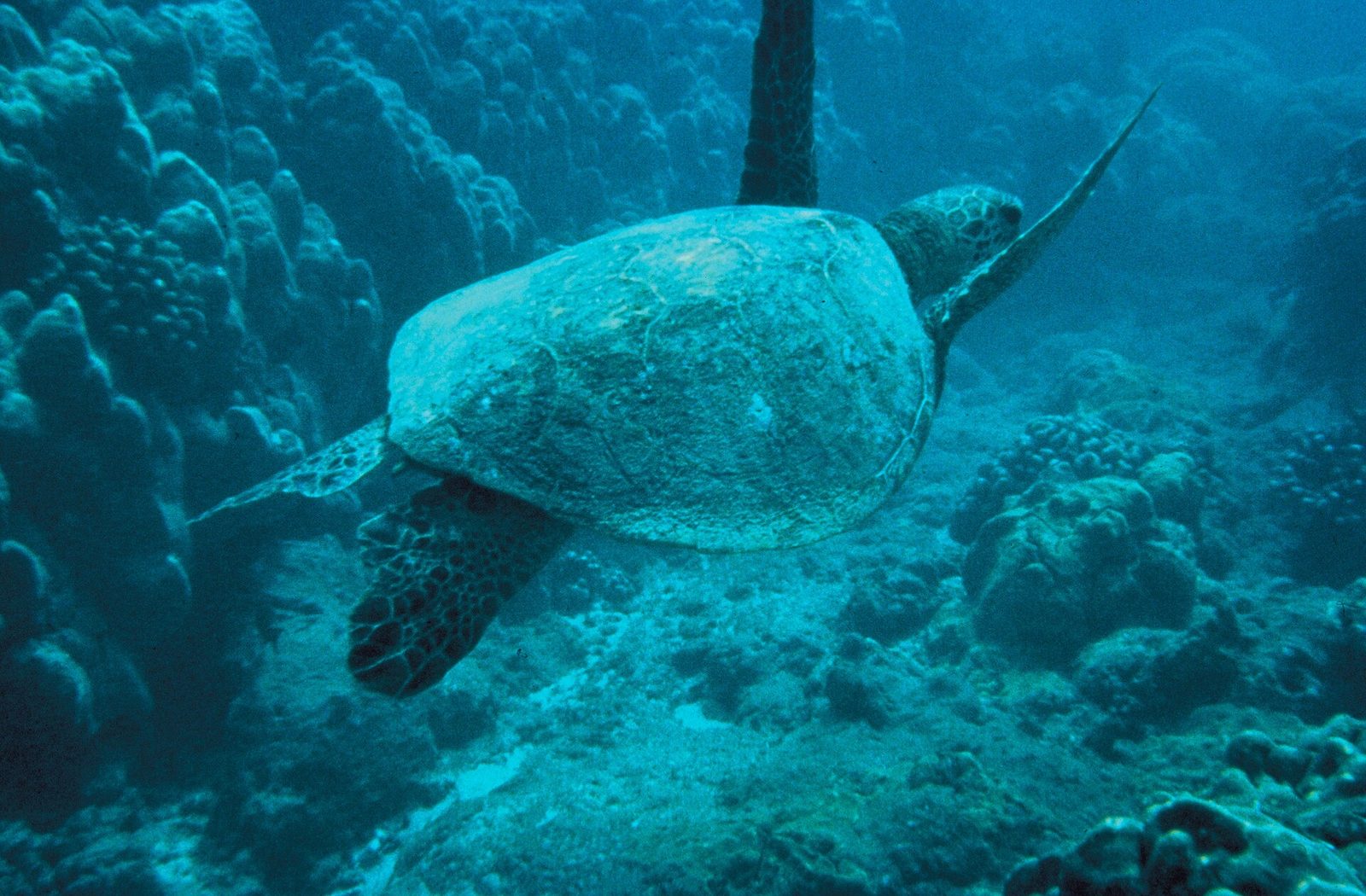
If there is one wild marine animal you have a real chance of meeting here, it is a sea turtle, and specifically a green turtle. Turtles are the heart of this coast's wildlife appeal precisely because they are both charismatic and reasonably encounterable, and because there is a serious conservation story attached to them that gives a sighting more weight than a simple tick on a list. Five of the world's seven sea-turtle species occur in Brazilian waters, but for a snorkeler or a boat passenger on this stretch of coast, the odds are heavily weighted toward one.
The green turtle, the one you are likely to meet
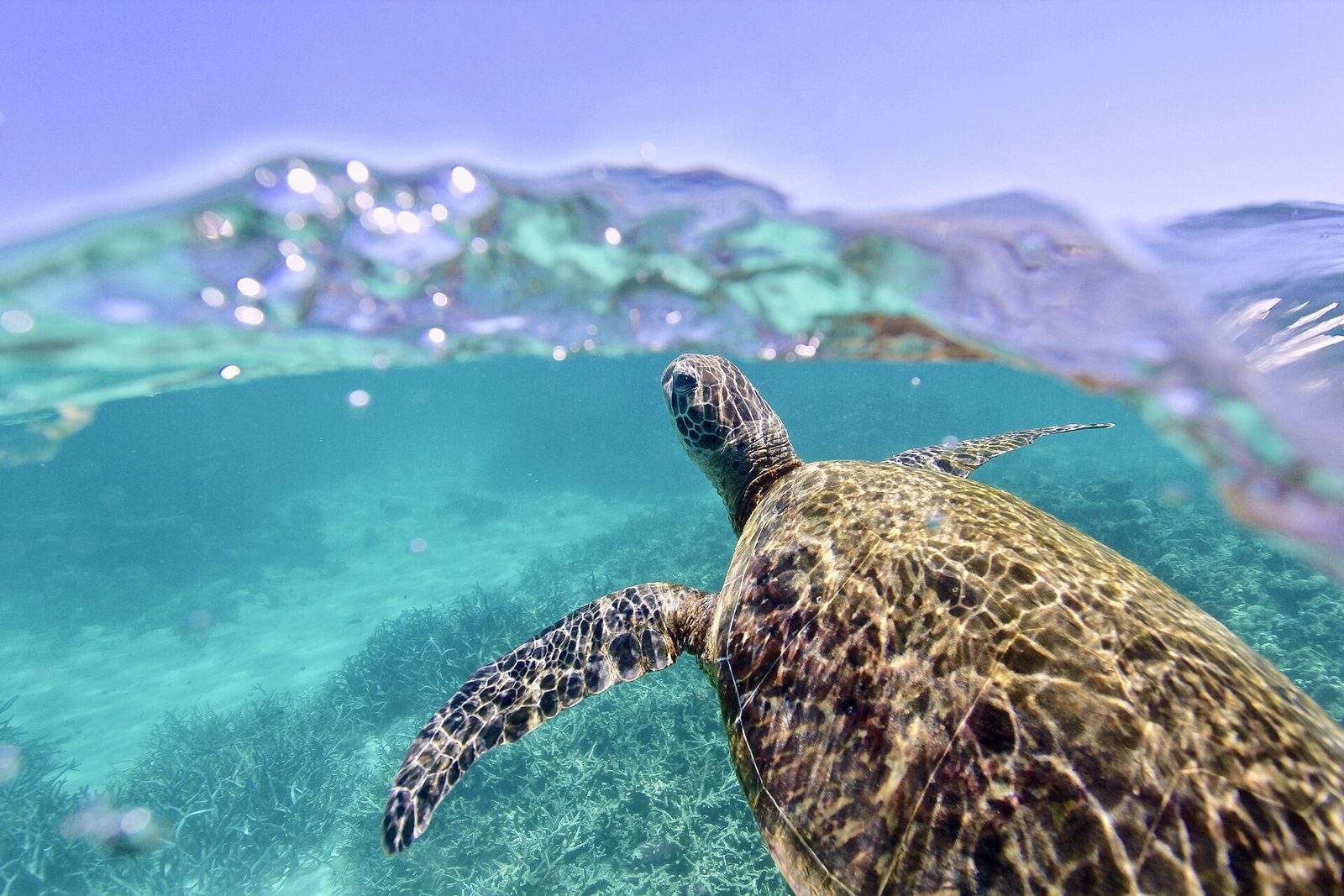
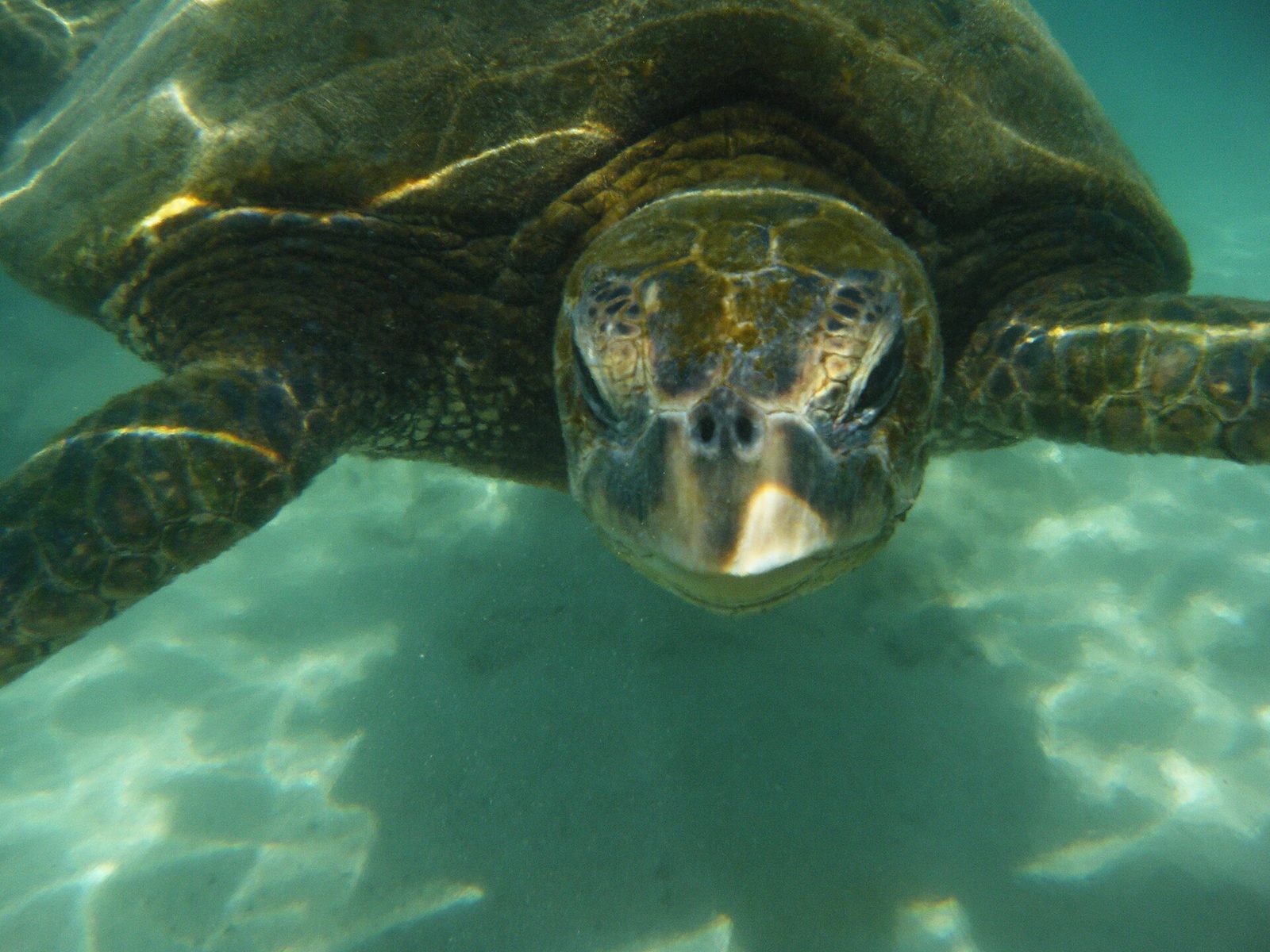
The green turtle is the sea turtle of the shallows here. Young greens, in particular, favor exactly the kind of rocky, algae-covered inshore water that rings these islands and points, because as they grow out of their open-ocean infancy they settle into coastal feeding grounds and graze. Adult green turtles are among the few largely plant-eating sea turtles, feeding on algae and seagrass, and it is that appetite that brings them into the shallow, sunlit water where a person with a mask can see them. A green turtle you meet grazing over a rocky shallow is very often a youngster growing up in the relative safety of the bay, which is a lovely thing to understand as you watch one.
Hawksbills and loggerheads, less often
The other two you might conceivably encounter are the hawksbill and the loggerhead, both less common inshore here than the green. The hawksbill is a reef specialist with a narrow, beaked face, a turtle of rockier, structure-rich water, and a less frequent sight. The loggerhead is a bigger, blunt-headed, powerful turtle that nests on Brazilian beaches farther up the coast and spends much of its life in deeper water, so it is more an offshore animal than a snorkeler's companion. Meeting either is a piece of luck rather than an expectation. Naming them matters, though, because it tells you that the water you are floating in is part of the range of several species, not just one.
Where and how you might see one
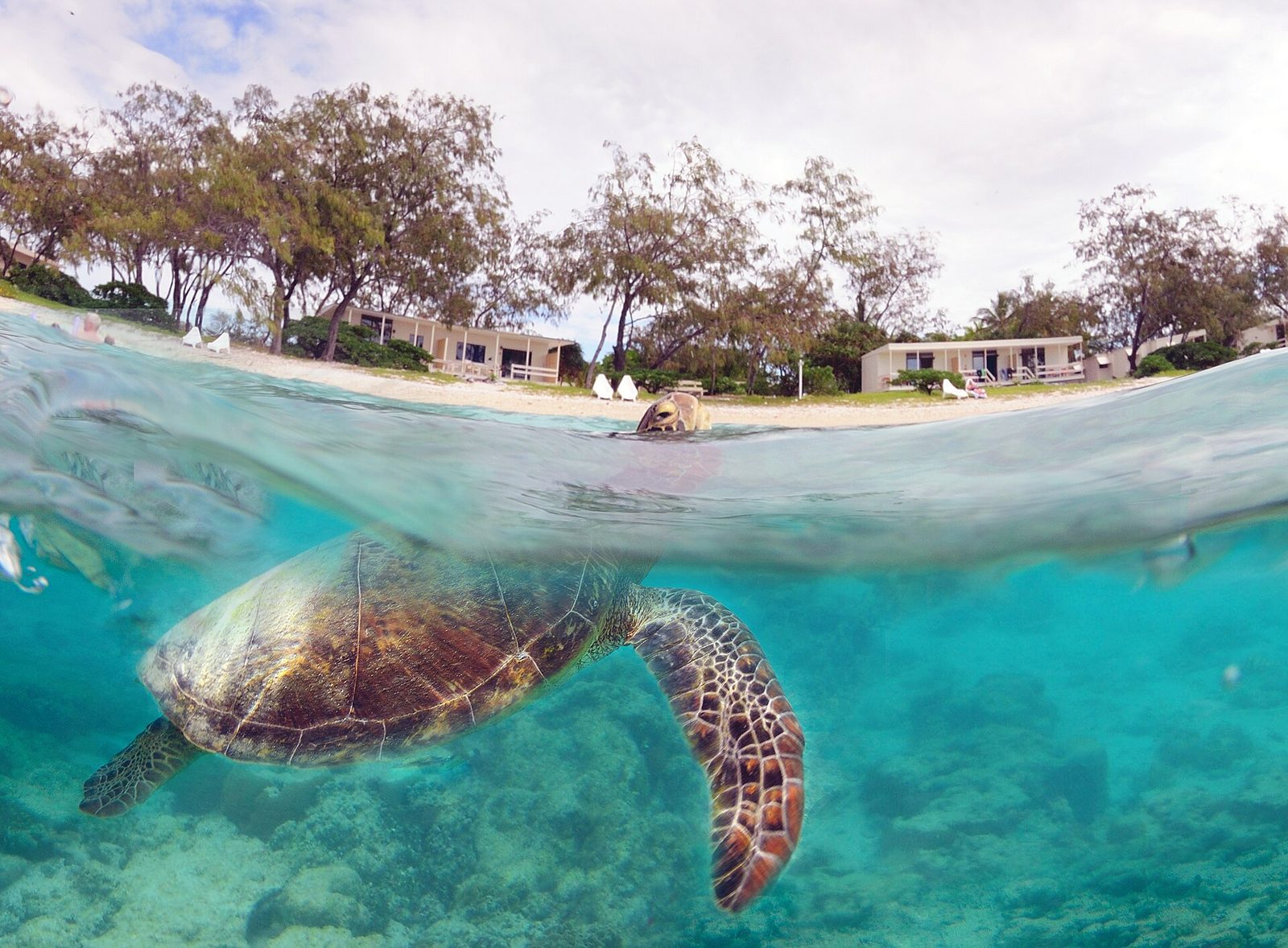
Two settings give you the best chance. The first is snorkeling around the rocky islands, where a turtle may be grazing on the algae-covered rocks or resting on the bottom; move slowly, keep your distance, and let it carry on. The second is from a boat, where you may spot a turtle's head break the surface for a breath, a small dark knob that appears, huffs, and slips under again. Boat crews who know the bay often catch these before passengers do. Our guide to Paraty's islands and boat tours covers the trips that put you in the right water; wherever you go, the etiquette is the same, watch and never chase.
Projeto Tamar and the turtles at Ubatuba
If you want a close, reliable look at sea turtles, and especially if you are traveling with children, the surest place on this coast is not the open water at all but Projeto Tamar's visitor base at Ubatuba, down the coast in the north of Sao Paulo state. It is the rare attraction that manages to be a genuinely good family outing and a serious conservation operation at the same time, and it fits naturally into a Costa Verde trip.
What Tamar is and does
Tamar is Brazil's national sea-turtle conservation program, running since 1980, with bases up and down the coast. The name is a contraction of tartarugas marinhas, sea turtles. Its work is real conservation science rather than a show: protecting nesting beaches, reducing the number of turtles killed in fishing gear, and rehabilitating injured animals. Over the decades it has become one of the country's best-known conservation efforts, and the visitor centers exist partly to fund that work and partly to explain it. Both jobs it does well. The Ubatuba base is one of its main visitor centers and a good one.
What you will see there
What you actually walk among are large tanks and pools holding the several sea-turtle species found off the Brazilian coast, greens and loggerheads and hawksbills among them, along with rays, fish, and displays that walk you through the turtles' life cycle and the threats they face. It manages to be absorbing for adults and a sure hit with kids, which is not an easy balance to strike. Our guide to Ubatuba sets it in the context of a day in that town, alongside the beaches and the aquarium, and explains how to fold it into a trip down the coast.
Why it fits with the reserve
For us there is an obvious kinship. Tamar is doing on the coast what we try to do in the mountains, using a small, well-run visitor operation to pay for the protection of wild animals and wild places. Seeing a turtle recovering in a Tamar tank and then, days later, glimpsing a wild green turtle grazing off a rocky island is the whole story in two scenes: the animals need the shallows kept clean and the nets kept off them, and places like Tamar and this reserve exist to make the economics of protection work. A visit is time well spent, and not only for the children.
Dolphins in the bays
Dolphins are the other marine animal you have a fair chance of seeing, usually from a boat crossing the more open stretches of the bays, occasionally from a headland. They are never guaranteed, but they are around, and a pod crossing the bow or rolling through the water nearby is one of the small thrills of a day on the water. As with turtles, the pleasure is sharper when you know a little about who you are looking at and how to behave.
The resident inshore dolphin
The dolphin most at home in these sheltered waters is the Guiana dolphin, a small, gray inshore dolphin that Brazilians often call the boto-cinza. Unlike the far-ranging oceanic dolphins, this is a coastal animal that lives in bays and estuaries along the Brazilian coast, moving in small groups through exactly the kind of protected water the Costa Verde is full of. Being a resident rather than a passer-through, it is the dolphin you are most likely to see going about its ordinary life close to shore, fishing the shallows and the river mouths. Quiet, unshowy, and easy to overlook, it is nonetheless a true local.
The visitors and the open-water groups
Beyond the resident inshore dolphins, other groups pass through or work the more open water. Bottlenose dolphins, the familiar large, robust dolphin, occur along this coast, and various oceanic dolphins live farther out and are seen mainly by those who venture offshore. Which you meet is largely a matter of where the boat goes and pure chance on the day. None of them performs for you, and that is the point; a wild dolphin doing wild things on its own terms is worth more than any trained one.
How to behave around them
Dolphins bring out the worst boating instincts in people, and it is worth resisting them. The rule is simple: let the dolphins decide. A responsible skipper eases off the throttle, holds a steady, predictable course, and never drives at a pod, cuts across it, or chases it for a photograph. If dolphins choose to approach the boat or ride the bow, that is their decision and a gift; if they move off, you let them go. Never feed them, never crowd them, and if there are calves in the group, give them a wide berth, because a frightened mother and calf pay a real price for a careless boat. Watching well means watching quietly.
Whales: the honest version
Now the whales, and here honesty matters most, because this is where marketing most often outruns the truth. The short version: Paraty is not a whale-watching destination, large whales are not reliably seen from these bays, and you should not plan a trip, or a boat day, around the hope of one. That is not a grudging admission but a plain fact of where the whales are and where Paraty sits. What follows explains why, and where whale-watching in Brazil actually happens, so you can chase whales properly if that is your dream, or set the idea aside and enjoy what this coast does give.
Humpbacks pass, far offshore
Humpback whales do migrate along the Brazilian coast, and their numbers have recovered encouragingly from the years of whaling. But their great breeding and calving ground is far to the north of here, on the Abrolhos Bank off the coast of Bahia, and the serious humpback-watching in Brazil happens there and along that northeastern coast, not off Paraty. When humpbacks move along the southeastern coast on migration they are generally well offshore, out beyond the islands, and a sighting from the sheltered bays around Paraty would be a rare stroke of luck rather than anything you can count on. Real numbers, real recovery, wrong latitude for a Paraty boat day.
A whale off Paraty is a stroke of luck, not an item on the itinerary; plan your days around what the bays reliably give, and treat any sighting as a gift.
Right whales, much farther south
The other great whale of the Brazilian coast is the southern right whale, which comes up from the cold southern ocean to calve in sheltered bays during the cooler months. But it does so much farther south than Paraty, chiefly along the coast of Santa Catarina, where a stretch of shore is protected partly for them and where seasonal right-whale watching is a genuine and well-organized activity. That is a different trip in a different region, hundreds of miles down the coast. Along this stretch, the one large whale that does turn up from time to time is the Bryde's whale, occasionally seen well offshore, but again, not from the beach and not on any schedule.
What this means for your trip
So set whales aside as a Paraty expectation. If whale-watching is what you truly want, plan a dedicated trip to the right region and the right season and do it properly. Here, keep your eyes on the water for the animals this coast actually offers, turtles, dolphins, rays, and the endless small life of the reef, and let a whale, in the vanishingly unlikely event one appears offshore, be the surprise of a lifetime rather than a promise broken. An honest coast is a more satisfying one to visit than an oversold one.
Rays, reef fish, and the small life
Strip away the charismatic headliners and what remains is the real substance of this coast's marine life: the rays over the sand, the crowds of reef fish around the rocks, and the endless small creatures that reward anyone willing to float quietly and look closely. This is what you will actually spend most of your underwater time watching, and it is genuinely absorbing once you stop waiting for something bigger to swim past.
Rays over the sand
Over the sandy patches between the rocks live the rays, flat and pale and easy to miss until they move, when a patch of seabed suddenly lifts and glides away. Stingrays rest half-buried in the sand, and you may also see the more dramatic eagle rays cruising in open water with their wingtips breaking the surface. Rays are shy and no threat if left alone, but a stingray resting in shallow sand will defend itself if trodden on, which is worth remembering where you wade rather than swim.
The stingray shuffle
Where you are wading in shallow, sandy water rather than swimming, shuffle your feet along the bottom instead of taking high steps. A resting ray will feel you coming and slip away, and the only time one uses its sting is when a foot comes down squarely on top of it by surprise. Shuffling stirs a little warning through the sand ahead of you and gives the animal its chance to leave. It is a simple habit that protects you and doesn't harm the ray, and it is worth teaching children before they run into the shallows. Rays want nothing to do with you; give them the half-second they need to move.
The reef-fish crowd
Around the rocky islands, the reef fish are the near-guaranteed reward. Mask down, you can expect shoals of small silver and striped fish, wrasses and damselfish picking around the rocks, parrotfish and their kin grazing the algae, the occasional larger fish cruising through, and, in the crevices, urchins, crabs, and brittle stars. It is undramatic, pottering snorkeling, no great pelagic spectacle, but easy, safe in the calm water, and genuinely interesting once your eye adjusts. Our guide to diving and snorkeling on the Costa Verde covers where the clearest water and the best of this life gathers.
The overlooked small stuff
Look closer still and a second layer appears: the anemones and hermit crabs in the tide pools, the tiny gobies and blennies darting over the rock, the sea slugs and worms and shells that most snorkelers swim straight past. For children especially, a rocky tide pool at low water is a whole small world, and a patient half-hour there often beats a fast circuit of a reef. The small life is the foundation everything else stands on, and learning to see it changes the way the whole coast looks.
The mangroves and estuaries that feed it all
None of the life above would be half so abundant without the muddy, unglamorous places most visitors overlook: the mangroves and estuaries where the coastal rivers meet the sheltered bays. These are the nurseries of the coast, and it is no exaggeration to say that the turtles, dolphins, and reef fish people come to see are all, at some remove, fed by them. If the bays are the coast's larder, the mangroves are the kitchen.
A mangrove is a forest that grows in salt water, its arching roots standing in the tidal mud where fresh water and salt water mix. That tangle of roots is one of the richest habitats on the whole coast. It traps sediment and keeps the water clear, it shelters the young of countless fish and crustaceans from the larger predators of the open bay, and it turns the leaf litter of the forest into food for the smallest links of the marine food chain. An enormous share of the fish that live their adult lives out on the reef, and that feed the dolphins and larger fish, begin life in the safety of the mangrove roots. Clear the mangroves and you starve the reef; keep them and the whole bay stays productive.
The estuaries do a related job on a larger scale, mixing the nutrient-rich fresh water off the mountains with the salt of the bay to create the conditions that make sheltered coasts so much more fertile than open ones. This is also where the resident inshore dolphins hunt and where much of the traditional caicara fishing has always taken place, because the people of this coast learned long ago that the river mouths are where the fish gather. It is quiet, buggy, muddy country, not the pretty part of a beach holiday, but it is the engine room, and it deserves respect rather than drainage and development. Much of what threatens the marine wildlife of this coast is, at root, the loss of these nurseries.
The real threats these animals face
It would be dishonest to write a warm guide to this wildlife without being straight about what endangers it, because the threats are real, largely human, and directly connected to how visitors behave. None of this is meant to sour a trip; understanding the pressures is the first step to not adding to them, and to appreciating why the animals you do see are worth protecting.
Plastic and what a turtle mistakes it for
Plastic pollution is the threat that touches every animal here, and turtles most cruelly of all. A drifting plastic bag looks, to a hungry sea turtle, very like a jellyfish, and swallowed plastic kills turtles slowly and miserably. Smaller fragments work their way up the food chain into fish, birds, and dolphins. Almost all of it starts on land, carried down the rivers and dropped on the beaches, which means it is one of the few great marine threats an ordinary visitor can directly reduce, by carrying out every scrap they bring in and picking up a little more besides.
Boat strikes and bycatch
The two threats that kill the larger animals outright are boat strikes and bycatch. Turtles must surface to breathe and dolphins travel near the surface, which puts both in the path of fast boats; a propeller strike is often fatal. Bycatch, the accidental catching of turtles, dolphins, and other non-target animals in fishing nets and gear, is a major cause of death worldwide and one of the things Projeto Tamar works hardest to reduce. Slower, more careful boating and better fishing practices are the answers, which is why the choice of a responsible operator is not a trivial one.
Disturbance, development, and disease
Then there are the slower harms. Coastal development destroys the mangroves and pollutes the shallows; sewage and sediment cloud the water that the reefs and seagrass need. Constant disturbance from boats and swimmers pushes shy animals off the feeding and resting grounds they depend on. Green turtles on degraded, warm, near-shore waters are prone to a tumor-causing disease that has been documented along parts of the Brazilian coast, a grim reminder that a turtle's health is tied to the health of the water it lives in. The common thread is that the animals suffer when the coast is treated carelessly, and recover when it is protected.
How to watch wildlife responsibly
Set against those threats, the way you personally watch these animals matters more than it might seem, because tourism is now one of the biggest and most constant pressures on coastal wildlife, and it can just as easily be a force for protection. Watching well is not complicated, and it comes down to a few firm habits and one good decision about who you go out with. Get those right and your presence does little harm and may do real good, by making living animals worth more than dead ones.
Distance, no feeding, no touching
The core of it is restraint. Keep your distance from every wild animal, in the water and from a boat, and let the animal set the terms of the encounter rather than closing in to improve your view or your photograph. Never feed wildlife, however tame it seems and whatever it does for the picture, because feeding changes behavior, damages health, and teaches animals to associate people and boats with food, which ends badly for them. Never touch or chase a turtle, dolphin, or ray, never try to ride or grab one, and never corner an animal against a rock or a shore. If you find yourself moving toward an animal, you are already too close.
Watching wildlife the right way
Keep your distance and let the animal decide how close the encounter gets; if it moves away, you let it. Never feed, touch, chase, or crowd a turtle, dolphin, or ray, and give mothers with young an especially wide berth. From a boat, insist on a slow, steady, predictable course and never let a skipper drive at or cut across a pod. Take out every scrap you bring in, use reef-safe sun protection, and choose operators who clearly know and respect the animals over the ones who promise the closest approach. A good sighting is one the animal walks away from unbothered. Where the demand goes, the fleet follows, so spend your money on the careful crews.
Choosing a careful operator
The single biggest choice you make is who takes you out. Favor the operators who keep their distance from wildlife rather than chasing it, who slow down in animal-rich water, who moor at fixed buoys instead of dropping anchor onto living reef, and who carry every scrap of rubbish back to shore. You can often tell a careful crew from a careless one just by watching how they handle the boat. Choosing them, and telling them why, is the most useful thing an ordinary visitor can do, and our guide to responsible tourism on this coast goes further into how to travel here lightly.
The best places and seasons, kept honest
People always want a map and a calendar, the exact spot and the exact week, and the honest answer for wildlife is that it does not work that way. Wild animals move, conditions change, and anyone who promises you a turtle at a named rock on a named day is selling something. What can be said, kept qualitative and truthful, is where the odds are better and when the water tends to be at its best, and that is genuinely useful for planning without overpromising.
Where the odds are better
The pattern is consistent once you know it, and it is worth matching the setting to the animal you hope to see:
- Turtles and reef fish: snorkel the clearer, rockier islands and points on a calm day, where the food and the shelter are, rather than the open, sandy beaches.
- Dolphins: watch the more open water of the bay crossings from a boat, and let luck do the rest.
- A guaranteed close look at turtles: the Projeto Tamar base at Ubatuba, which never disappoints.
- The small life: any rocky shore and its tide pools at low water will do.
None of this is a promise of a sighting, only a way to stack the odds in your favor. Snorkeling around a clear, rocky island on a calm morning remains the single best thing you can do to meet a turtle in the wild on this coast.
Seasons and conditions
Rather than fixed months, think in terms of conditions. The water is warmest and most inviting in the southern summer, which is also the rainiest and most crowded stretch; the cooler, drier months bring clearer water and thinner crowds but a cooler swim. The single most reliable rule is to go out on a calm, settled day, ideally in the morning before the wind gets up, and, for clarity, a few days after any heavy rain, once the runoff off the mountains has settled out of the water. Clarity and calm matter far more than the calendar for what you will actually see.
Managing your expectations, one more time
The most important variable is not place or season but attitude. Go out for the sea itself and let the animals surprise you. Some days deliver a turtle and a pod of dolphins; some deliver clear water and good fish and nothing with a name. Both are good days on this coast, and the visitor who understands that is never disappointed.
For families and curious kids
This is a wonderful coast for children who like animals, provided the expectations are pitched right and the day is built around near-certain small wonders rather than a hoped-for big one. A child who is promised a turtle and sees none goes home sulking; a child who is turned loose in a tide pool and then, as a bonus, glimpses a turtle from the boat goes home converted. The trick is to stack the sure things and let the rare things be gifts.
A few ideas tend to land well with younger visitors:
- Projeto Tamar at Ubatuba, for a close, reliable look at real sea turtles and the science of saving them, the surest wildlife hit on the whole coast.
- Tide pools at low water on any rocky shore, where crabs, small fish, anemones, and shells turn a patient half-hour into a treasure hunt.
- An easy snorkel in calm, shallow water over rocks, with a well-fitting child-sized mask, to watch the reef-fish crowd up close.
- A gentle boat trip on a calm morning, with the job of being first to spot a turtle's head or a dolphin's fin, which keeps young eyes fixed on the water.
- The stingray shuffle taught as a game before anyone wades in, so safety comes wrapped in fun.
Set alongside that, the point worth making to children is the honest one: these are wild animals, not a show, and the reason we can see them at all is that people work to protect the sea they live in. It is the same lesson the forest teaches up at the reserve, where the land wildlife rewards the same patience and quiet; our guide to the wildlife of the reserve is the mountain half of the same story. Kids who learn to watch quietly and expect nothing tend to see the most, on the water and in the trees alike.
The sea below the forest
The marine wildlife of the Costa Verde is best understood as one more expression of the thing this whole coast still has and most of Brazil's shoreline has lost: enough intact nature, protected on purpose, to keep the living systems working. The turtles graze the shallows because the water is clear enough to grow their food; the reefs stay busy because the mangroves keep turning out young fish; the dolphins work the bays because the estuaries are still fertile. It is the same conviction that stands behind the reserve, only played out underwater: protect the habitat, and the animals look after themselves.
That is why a stay up in the forest above the seven waterfalls and a day out on the water below it belong together. You wake among the streams and the banana grove and the canopy, spend a cool morning on the trails, and then, on the days you want salt water, drive down to Paraty and out among the islands, watching for a turtle over the rocks or a fin crossing the bay, holding your distance and taking your rubbish home. Forest above and sea below, both kept alive for the same reason and enjoyed the same quiet way. It is an honest coast, and it repays honest expectations with more than it promises.
When you are ready to plan the water half of a stay, we are glad to point you to the careful operators and the calmest days, and to help you weave a boat trip or a snorkel around your time in the forest and the town. Start with our stays and booking page to see the chalets and how booking works, and browse the rest of our local guides to see how a day on the water fits alongside the waterfalls, the islands, and the wider coast. Go out for the sea itself, watch quietly, and let the turtles find you.