
Paraty keeps time by its festivals. For a small colonial port pinned between the mountains and the bay, an astonishing amount happens here across the year: religious feasts inherited from the eighteenth century, a street Carnival with its own strange local invention, an internationally known literary festival that fills the town with writers, and a rolling program of food, film, and music weeks in between. Ask a Paraty family what part of the year it is and they are as likely to answer with a festival as with a month. The calendar here is not a list of events laid over the town; it is closer to the town's own heartbeat.
This guide walks through that calendar honestly — what each festival is, what it means, roughly when in the year it falls, and how it changes the place while it lasts. One thing has to be said at the very top, because it matters more than anything else on this page: almost all of these dates move. The great religious festivals follow the Church's movable calendar, hung on Easter and Pentecost, which shift by weeks from one year to the next; Carnival moves with them; and even the cultural festivals reshuffle their dates from year to year. So everywhere below you will find a season or a month, never a fixed date. Before you book a single night around any of these, confirm the current year's dates for yourself.
A word on spirit, too. Several of these festivals are living community traditions rather than shows staged for visitors. The Festa do Divino above all is a devotion, centuries deep, that belongs to the people of Paraty and the valleys around it; you are welcome to witness it, but as a respectful guest, not a spectator at a performance. That distinction runs through this whole guide, and it is the right frame of mind to carry into a town whose celebrations are, first and last, its own.
- Festival town
- Paraty's year turns on religious feasts, Carnival, and cultural festivals
- Festa do Divino
- tied to Pentecost; falls around May or June, and the date moves each year
- Carnival
- movable, usually February or early March; home of the famous Bloco da Lama
- Bloco da Lama
- revelers coat themselves in dark tidal mud near Jabaquara beach
- FLIP
- the international literary festival, usually held in the winter months; dates and lineups vary
- Festival da Cachaça
- celebrates the region's sugarcane spirit; held in August
- Also
- an environmental film festival, Semana Santa processions, saints' days, and music weeks
- Golden rule
- festival weeks fill the town, so book far ahead and confirm the year's dates
A town whose year is a calendar of festivals
Two things made Paraty into a festival town. The first is its colonial Catholic past. This was a wealthy port in the age of gold and, later, sugar and cachaça, and with that wealth came churches, brotherhoods, and a full round of feast days, saints' days, and processions that the town has kept up, in some cases, for the better part of three centuries. The second is the caiçara culture of the coast — the fishing and farming communities of the bay and the forest, with their own music, their own patron saints, and their own reasons to gather. Layered on top of both, more recently, is a cultural revival that turned the beautifully preserved town into a natural stage, and drew in a literary festival, a cachaça festival, film weeks, and more.
The setting does half the work. Paraty's historic center is a compact grid of whitewashed houses, cobbled lanes, and small squares in front of colonial churches, and it is entirely car-free, which makes it one of the finest open-air stages in Brazil. A procession can wind through it, a drum band can fill it, and a book fair can spill across it, all without a single car in the way. If you want to understand where these festivals physically happen — the church steps, the Praça da Matriz, the waterfront quay — our guide to the historic center maps the ground they unfold on.
The year has a rough shape. Carnival arrives in the heat of late summer; Semana Santa and its solemn processions follow in autumn; the Festa do Divino comes as autumn turns to winter; and the cooler, drier winter months carry the cultural festivals — the literary festival, the cachaça festival, film and photography and music weeks — along with the fishermen's midwinter saint. Some of these are sacred and centuries old; some were invented in living memory. Together they mean there is rarely a month in Paraty with nothing going on. For the town in the round, beyond its festivals, our broader Paraty guide sets the scene; what follows is the calendar itself, taken one celebration at a time.
The Festa do Divino Espírito Santo
If you see only one of Paraty's festivals, and you care about tradition over spectacle, let it be the Festa do Divino Espírito Santo. It is the oldest and most deeply felt of them all, a celebration of the Holy Spirit that the town has kept for centuries, brought across the Atlantic from Portugal and its islands and rooted here in the colonial period. It is tied to Pentecost, and so it moves with the Church's calendar; in practice it falls in the second half of autumn, around May or June, but the exact dates change every year and must be checked.
What the Divino celebrates
Pentecost marks the descent of the Holy Spirit on the apostles, fifty days after Easter, and the Festa do Divino is the folk celebration of that mystery. In Paraty, as in the Azorean and Portuguese tradition it descends from, the festival carries a curious and beautiful old idea: the crowning of an Emperor of the Divine, often a child, who symbolically reigns over the feast. It is a devotion built on humility and charity dressed in the borrowed clothes of empire — a reminder, in the old telling, that the Holy Spirit's kingdom turns the world's order upside down. A novena of nights, with prayers, music, and gatherings, leads up to the climax on Pentecost itself, so the festival is not a single day but a slow, mounting season of devotion.
The folias and the bandeira
The heart of the Divino is carried through the streets and the countryside by the folias — small groups of singers and musicians, with guitars, drums, and voices, who travel from house to house in the weeks around the feast. With them goes the bandeira, the banner of the Divine: a red flag bearing the dove of the Holy Spirit, carried door to door to bless homes and to gather offerings for the celebration and for the poor. To receive the bandeira is an honor; families welcome it in, offer what they can, and are sung a blessing in return. It is one of the most moving things you can happen upon in Paraty — a knot of musicians at a doorway, the red flag lifted, an old melody that has been sung on these streets for generations.
Processions, feasts, and its meaning
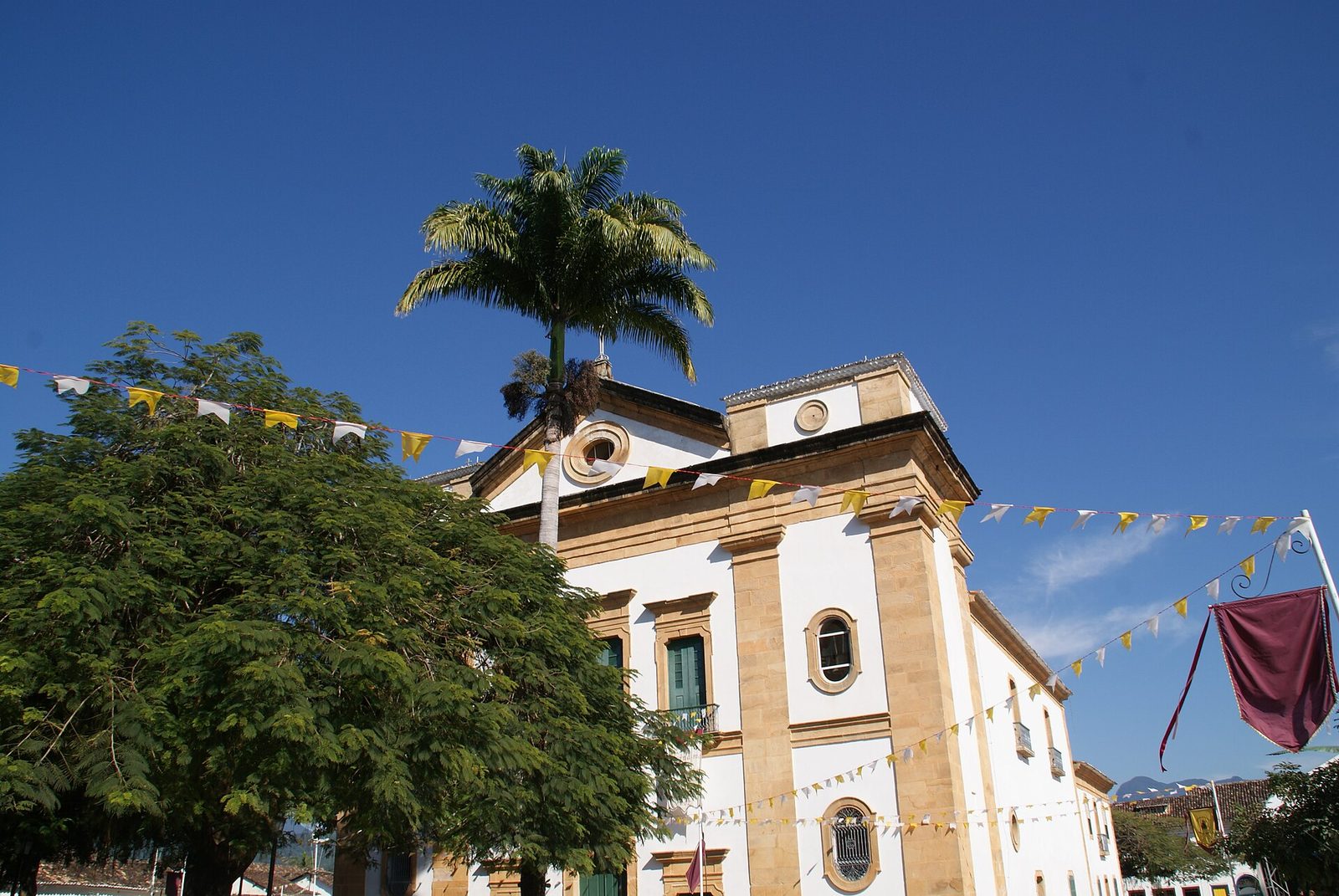
Around the folias and the bandeira, the town fills the days with the full apparatus of an old Brazilian religious feast: the raising of a tall decorated mast, or mastro, near the church; Masses and novena services; a solemn procession through the cobbled streets; the coronation of the Emperor; music, fireworks, and the ringing of bells. And there is food. Communal meals are central to the Divino, cooked in quantity and shared out, in the older spirit of feeding everyone who comes, the poor included — the festival's charity made literal on a plate. It is a good moment to taste the region's traditional cooking at its most heartfelt, and our guide to Paraty's food and cuisine explains the dishes you are likely to meet. Watch all of it quietly and respectfully; this is worship and heritage, not a show, and it is all the more powerful for that.
The red banner of the Divine passes from door to door, and a town that can seem all cobbles and postcards remembers exactly what it is.
Carnival and the Bloco da Lama
At the other end of the spirit from the Divino sits Carnival — loud, playful, and gloriously unruly. It is movable, falling in the run-up to Lent, which usually lands it in February or early March, in the heat of the Brazilian summer. Paraty does not do a Rio-style parade of samba schools; its Carnival is a street festival, and all the better for it, built around blocos — roving bands and their crowds — that fill the car-free lanes with drums, brass, glitter, and dancing.
Carnival in the streets
For a few days the historic center becomes one big open party. Drum blocos wind through the streets pulling crowds behind them, marchinhas and old Carnival songs echo off the whitewashed walls, and families, locals, and visitors of every age spill across the squares. By day much of it is cheerful and child-friendly; by night it turns livelier and later. It is crowded, it is sweaty, and it is a great deal of fun if that is the trip you have come for. If it is not, this is precisely the week to be somewhere quieter — and there is nowhere quieter and closer than the forest above the town.
The mud people of Jabaquara
Paraty's singular contribution to Brazilian Carnival is the Bloco da Lama — the mud bloc. The story goes that it began in the 1980s, when a handful of local youngsters larking about in the tidal mud flats near Jabaquara beach, just north of the historic center, decided to march into town caked head to toe in the stuff. It caught on, and it has grown into one of the most photographed and least explicable spectacles on the coast. Revelers gather at the mangrove mud, coat themselves in the dark, glossy, sulfurous ooze until they are barely recognizable as people, and then parade through the streets grunting and roaring like some tribe of prehistoric swamp creatures, brandishing sticks and vines, chanting as they go. Costumes are minimal; the mud is the costume.
Joining the mud, in the right spirit
It is anarchic, communal, and entirely of Paraty — a homegrown joke that turned into a tradition, and a reminder that the town's festival life is not all incense and processions. Anyone can join; you simply mud up with everyone else. The mud is said, locally, to be good for the skin, and it rinses off in the sea afterward, which is part of the ritual. Go in the right spirit, which is the whole point: this is a shared bit of collective silliness, not a photo safari, so if you are going to watch, be ready to be part of it rather than standing clean at the edge with a lens.
Before you join the mud
If the Bloco da Lama is on your list, wear nothing you would mind ruining and leave everything else behind — the mud gets into every seam, and it stains. Put sunscreen on before you mud up, keep your phone in a sealed bag or back at the room, and plan to walk straight into the sea at Jabaquara to rinse off afterward. Go to take part, not to photograph other people; that is the difference between a guest and a gawker.
FLIP: the Festa Literária Internacional de Paraty
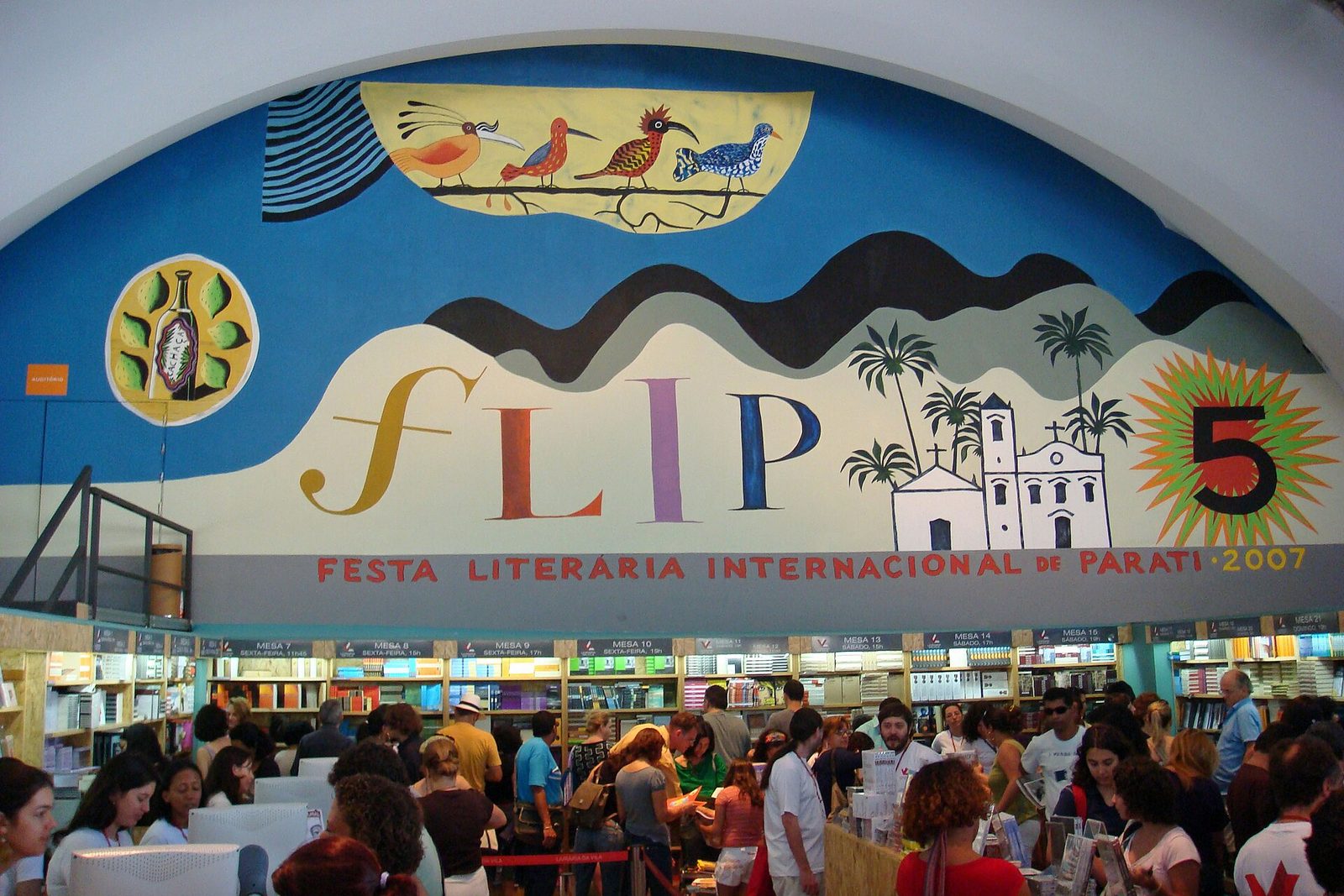
The festival that carried Paraty's name around the world is a literary one. FLIP, the Festa Literária Internacional de Paraty, is an international festival of books and writers, and since it began in the early 2000s it has grown into one of the most important literary gatherings in the Portuguese-speaking world. For its run — a handful of days, usually in the cooler winter months, most often around the middle of the year — the small colonial town becomes a giant, humming book club, its streets full of writers, publishers, journalists, and thousands of readers. The dates have moved around over the years, and each edition's program is different, so treat any timing you carry in your head as approximate and confirm the current year's dates and lineup before you plan.
What FLIP is
At its core, FLIP is a program of on-stage conversations: authors from Brazil and abroad in dialogue about their work and the world, over several intense days. Each edition is built around a writer it honors — usually a major figure from Brazilian letters — whose life and work thread through the talks. The tone is serious but not stuffy, and the appeal is broad; you do not need to be a literary specialist to be swept up in it. It is worth saying plainly that the guests and themes change completely from one year to the next, so there is no fixed roster to promise you — part of the pleasure is seeing who and what a given edition brings.
The main tent and the fringe
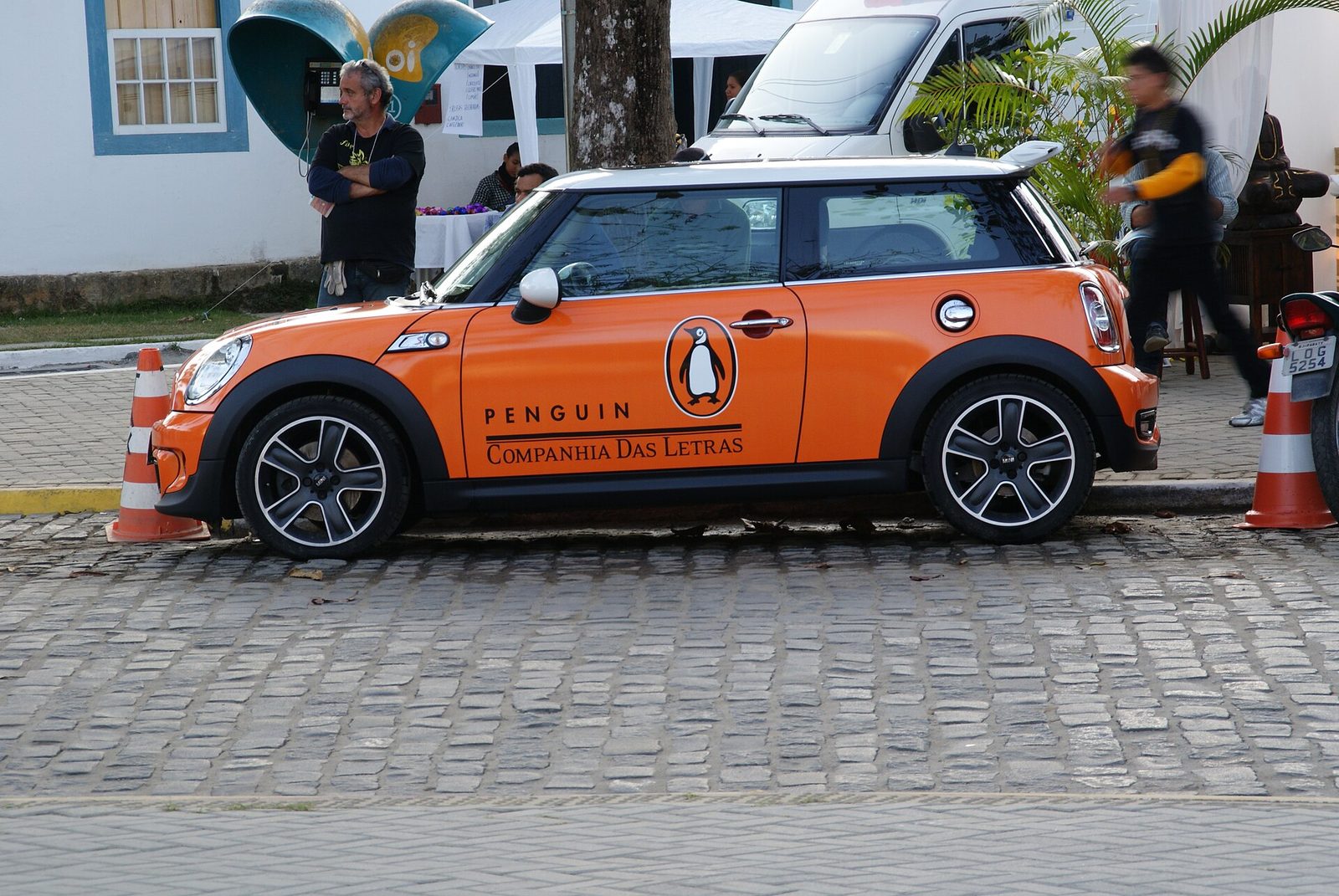
The festival has two halves. There is the official program, staged in a large tent by the waterfront where the headline conversations happen and tickets are prized, and there is the sprawling fringe that takes over the rest of the town: book stalls and pop-up shops, signings, debates in the Casa da Cultura, children's programming, readings, parties, and music that runs late into the night. During FLIP the whole of Paraty is dressed for it, its branding and banners everywhere, and even without a ticket to the tent you can spend days happily inside the festival's free and public life on the streets.
Going to FLIP
FLIP is the single hardest week of the year to get a bed in Paraty, and it is not close. Accommodation across the town and the coast around it books out far in advance and at a premium, tickets to the main-tent sessions sell out, and the historic center is packed shoulder to shoulder. If FLIP is your reason to come, plan and book many months ahead and be ready for crowds and high prices; if you would rather have the town to yourself, this is a week to check the calendar and deliberately avoid. Either way, a calm room up in the forest, a short drive above the throng, is the difference between diving into the festival on your own terms and being swallowed by it.
The Festival da Cachaça, Cultura e Sabores
Paraty and cachaça are old companions. When the gold trade faded, the town and the valleys around it turned to sugarcane and to the spirit distilled from it, and Paraty's cachaça became so well regarded that for a time the town's name was used as a byword for the drink. That heritage gets its own celebration each year in the Festival da Cachaça, Cultura e Sabores — the festival of cachaça, culture, and flavors — held in August, in the heart of the dry winter season.
For its run, the small distilleries of the region, the alambiques that make cachaça by hand in copper pot stills up in the hills and river valleys, bring their bottles down into town. There are tastings and sales, stalls of regional food, live music, and a general air of celebration around the sugarcane spirit and the coastal cooking that goes with it. It is a genuinely good way to learn the difference between the harsh industrial spirit sold cheaply for cocktails and the fine, aged, artisanal cachaça that the best local makers produce — the kind meant to be sipped slowly and neat, like a good rum or whisky. If the festival whets your appetite, the natural next step is to visit a distillery in the valleys and see the process for yourself; our guide to the region's cachaça and alambiques covers how to do that.
A sensible word, since this is a festival built around a strong spirit: pace yourself, especially if you have the winding mountain road back up to the reserve ahead of you. The wiser move is to taste a little, buy a bottle of something you loved, and enjoy it properly and unhurried back at the chalet, rather than to overdo it in town with a drive still to come. Drink slowly, eat as you go, and treat the good cachaça with the respect it has earned.
FICA and the film, photography, and music weeks
Beyond the big set-piece festivals, Paraty carries a rolling program of smaller cultural weeks through the year, and several of them are worth building a trip around if their timing lines up with yours. Because these events shift their dates, change their names, and occasionally pause and return, the honest advice is the same as everywhere on this page: check what is actually on during your window rather than assuming, and take the descriptions below as the shape of the thing, not a promise of a fixed date.
The one that suits this reserve's spirit best is the environmental film festival, FICA, which brings documentary and feature films about nature, conservation, and our relationship with the living world to the town's screens and squares. For a place inscribed by UNESCO for both its culture and its biodiversity, a festival that puts the environment on screen is a natural fit, and it draws an audience that cares about exactly the things the forest above Paraty exists to protect. Alongside it, Paraty has become a gathering point for photographers, with a well-established photography festival that turns the colonial streets into an open-air gallery of exhibitions and talks. And in some years a respected music festival has filled the historic churches and public spaces with concerts, using those centuries-old interiors as concert halls — classical and instrumental music under painted ceilings, often free to the public.
None of these fills the town the way Carnival or FLIP does, which is part of their charm. They tend to draw a smaller, more particular crowd, and they leave room to breathe. If you are the kind of traveler who would rather spend an evening at a film about the Atlantic Forest, an exhibition of coastal photography, or a concert in a colonial church than in a Carnival crush, these are the weeks to watch for. They are also a reminder that Paraty's cultural life is not confined to a few famous dates; it simmers along all year, and you can easily wander into something quietly wonderful without having planned for it at all.
Semana Santa and the religious processions
Paraty's religious calendar reaches its most solemn in Semana Santa, Holy Week, the week before Easter. Easter is movable, so Holy Week usually falls in March or April, in the gentle Brazilian autumn, and the exact dates shift every year with the Church's reckoning. Where Carnival is release and noise, Semana Santa is hush and devotion — the two poles of the same deeply Catholic town, only weeks apart on the calendar.
Through the week the churches hold their services, and the streets carry processions that trace the events of the Passion. Good Friday, in particular, brings a solemn procession through the cobbled center, candlelit and slow, with sacred images carried through streets that have seen the same rite for generations. It is quiet, serious, and often very beautiful, and for many local families it is the most important week of the religious year. Visitors are welcome to watch, but this is the moment above all to fold into the crowd respectfully — to keep your voice down, to stay out of the way of the procession, and to remember that the people around you are at prayer.
Holy Week is not the only occasion for a procession. Some weeks after Easter comes Corpus Christi, another movable feast, usually falling around late May or June, when in the Brazilian tradition the streets are sometimes carpeted with elaborate designs made from dyed sawdust and other materials for a procession to pass over. Scattered through the rest of the year are the feast days of particular saints, each with its own Mass and often its own small procession or blessing. Taken together, these religious observances are the older, steadier rhythm beneath the flashier festivals — the calendar the town has kept longest, and the one that reveals most about who Paraty has always been.
Saints' days, the fishermen, and the caiçara calendar
Some of the most rewarding festivals in Paraty are the ones no tour operator will sell you — the local saints' days and community feasts that belong to the town and the fishing villages of the bay. You are as likely to stumble into one as to plan for it, and that is part of the pleasure. They are smaller, more intimate, and more genuinely local than the marquee events, and they open a window onto the caiçara culture of this coast that the big festivals rarely do.
A few worth knowing about:
- The feast of Nossa Senhora dos Remédios, the town's patron saint, whose name the main parish church carries, is marked with religious and community celebrations in her honor.
- The feast of São Pedro, patron of fishermen, falls around the end of June, in midwinter, and on this coast it is often celebrated with a blessing of the boats and a procession of decorated fishing vessels out on the water — a moving sight in a town whose life has always come from the sea.
- The feast of São Benedito, long tied to the Black brotherhood that built the church of Nossa Senhora do Rosário e São Benedito, carries the memory of that community and its devotion.
- Fandango caiçara — the traditional music and dance of the coastal communities, played on handmade stringed instruments — turns up at community gatherings and cultural events, and is worth seeking out if you want to hear the real folk music of this shore.
What ties these together is that they are living traditions carried by families and villages, not attractions arranged for visitors. Their dates are not always widely advertised, and their scale is human rather than grand. If you are around when one is happening, go gently, watch how the locals behave and follow their lead, and count yourself lucky to have caught the town being itself. Ask at your lodging or in the historic center what small feasts might fall during your stay; these are often the memories that outlast the famous festivals entirely.
How a festival transforms the town
It is worth being clear-eyed about what a big festival does to Paraty, because the difference between the town on an ordinary Tuesday and the town during FLIP or Carnival is night and day. On a quiet week the historic center is calm enough to hear your own footsteps on the cobbles; during a major festival it can be shoulder to shoulder, the squares full, the restaurants turning tables as fast as they can, the boats booked, and the roads in and out noticeably busier. Both versions of Paraty are wonderful. They are simply very different trips, and it pays to know which one you are signing up for.
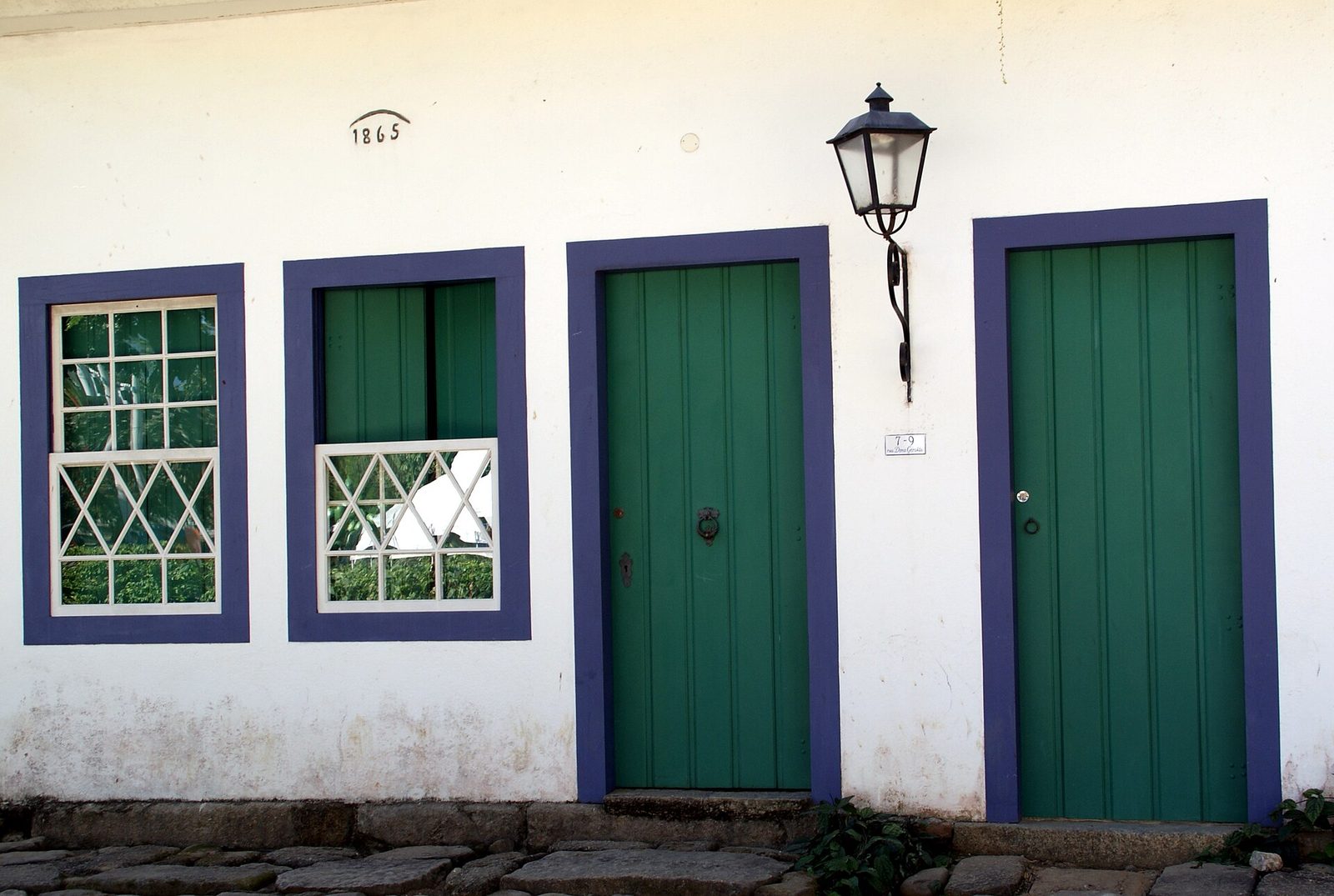
The most practical consequence is accommodation. During the peak festivals — FLIP above all, but also Carnival, the New Year holiday, and the busy long weekends — rooms across Paraty and the surrounding coast fill up far in advance and at prices well above the quiet-season norm. Book late for a festival week and you may find nothing at all, or nothing you would want. Restaurants are fuller and slower, the popular beaches and boat trips are busier, and the drive in from Rio or São Paulo, along with the winding climb up the mountain, carries more traffic than usual. None of this is a reason to stay away; for many people the crowds and the energy are exactly the point. It is only a reason to plan deliberately.
There is a real upside to the transformation, too. A festival is when you see the town at its most alive — the squares in use as they were meant to be, the churches and streets doing the job they have done for centuries, the whole community out and engaged. If you love that kind of energy, timing a visit to catch one of the big festivals gives you a Paraty that a quiet week simply cannot. The trick is to match the trip to your temperament, which is the next question worth asking.
Which festival suits which traveler
Because the festivals differ so completely in mood, the smartest way to use this calendar is to work out which one, if any, fits the trip you actually want, and then aim your dates accordingly. A rough guide:
- If you love books, ideas, and a town buzzing with talk, come for FLIP — but book far ahead, and be ready for crowds and prices to match the occasion.
- If you are drawn to tradition, faith, and centuries-old ritual, plan around the Festa do Divino or Semana Santa, and come as a respectful witness rather than a sightseer.
- If you want release, music, and playful chaos, Carnival and the Bloco da Lama are your festival — loud, crowded, and enormous fun if that is your idea of a good time.
- If food and drink are the way you like to know a place, aim for the Festival da Cachaça in August, and pair it with a distillery visit in the valleys.
- If you would rather have your culture in a quieter key, watch for the environmental film festival, the photography festival, and the music weeks, which draw smaller and gentler crowds.
- If you have come above all for peace — the forest, the waterfalls, the birdsong — then the move is to check the calendar and deliberately avoid the biggest festival weeks, or to enjoy the town on a day trip and retreat to the quiet each night.
None of these is a wrong answer; they are just different trips. The one genuine mistake is to arrive without knowing what is on, and to find either that you have walked into a crush you did not want, or that you have narrowly missed a festival you would have loved. A little planning, and an honest question about what you are really coming for, sorts it out. Our page on the best time to visit lines the festivals up against the weather, the waterfalls, and the crowds, so you can weigh the whole picture at once.
Going respectfully: living traditions, not spectacles
This is the part of the guide that matters most, so it gets said plainly. Many of Paraty's festivals are living community traditions, and some are acts of religious devotion, held by and for the people who live here. They are not performances arranged for tourists, and the town is not a theme park. The gift of being able to witness them comes with a simple responsibility: to behave as a considerate guest in someone else's home and heritage.
At the religious festivals — the Divino, Semana Santa, the saints' days — that means watching quietly, staying out of the path of a procession, keeping your voice down, dressing modestly if you step into a church, and putting the camera away when a moment calls for reverence rather than a photograph. If a service or a rite is underway, follow the lead of the people around you; when in doubt, hang back and observe rather than inserting yourself. These are not props for your pictures. They are prayers, and the courtesy costs you nothing.
At the boisterous festivals, respect looks a little different but the principle holds. The Bloco da Lama and Carnival are communal fun, so the respectful move is to join in the shared spirit rather than to stand apart photographing strangers as if they were exhibits. Support the local economy that makes all of this possible — eat at the family kitchens, buy from the makers, tip the musicians — and clean up after yourself, because a festival crowd can leave a heavy mark on a small, protected town. Leave the streets, the beaches, and the mangrove at Jabaquara as you found them. The reward for going gently is real: locals are far warmer to a visitor who treats their traditions with care, and you come away having been part of something rather than merely having gawked at it.
These are prayers and homegrown joys, not props for your pictures — go as a guest, and the town meets you halfway.
Planning your dates around the calendar
Once you know which festivals appeal to you and which you would rather sidestep, the planning is straightforward, with one non-negotiable step: confirm the current year's dates before you commit to anything. Because so many of these festivals are movable, and because even the fixed ones occasionally shift, the single most common planning mistake is to assume last year's dates hold this year. They often do not. Pin down the real dates first, then build the trip around them.
If a festival is your reason to come, book as early as you possibly can — months ahead for the big ones — because rooms, tables, and tickets all vanish first for the peak weeks, and prices rise to meet the demand. If, instead, you are coming for quiet and want no part of the crowds, do the same research for the opposite reason: find out when the big festivals fall and steer clear of those weeks, favoring the shoulder seasons and midweek stays when the town is at its gentlest. Either way, knowing the calendar is what lets you get the trip you actually wanted rather than the one the dates handed you.
One happy fact makes all of this easier here: you do not have to choose between the festival and the calm. A base up in the forest, a short drive above Paraty, lets you dip into the town for a procession, a book talk, a Carnival bloco, or a day at the cachaça stalls, and then climb back out of the crowd to sleep in the quiet. That is the best of both, and it is exactly how a stay above the town is meant to work.
Book far ahead, and confirm the year's dates
Every festival on this page can move, and the biggest ones sell out the whole town. Before you plan, confirm the current year's dates directly — do not trust last year's. Then book early: for FLIP, Carnival, and the peak holidays, that means months in advance, because rooms and tickets go first and prices climb. If you would rather avoid the crowds, use the same dates in reverse and steer clear of the busy weeks. We are always glad to tell you exactly what is on during the window you are weighing up.
A calm base above the festival town
The nicest way to experience Paraty's festivals is not to stay in the thick of them, but to come down to the town when you want the color, the music, and the life, and then climb back up into the forest when the day is done. Reserva Sete Quedas sits above the seven waterfalls in the Serra do Mar, a working banana farm and eco-reserve wrapped in the Atlantic Forest, and by design it never crowds: the low-impact rules that govern the land cap the whole property at a handful of chalets, widely spaced under the canopy, so that even on the busiest festival weekend down in Paraty, the mountain stays quiet. You get the festival on your own terms, and then you get the silence back.
That pairing suits almost any kind of festival-goer. Book lovers can spend their days at FLIP and their nights with nothing louder than frog-song and falling water. The tradition-minded can follow the Divino's folias through the streets and return to a forest that keeps its own older calendar of seasons and rains. Carnival revelers can mud up at Jabaquara, dance through the town, and rinse it all off before retreating to a cool, dark chalet far from the last of the drums. And anyone who finds they have arrived in a busier week than they bargained for has, in the reserve, the perfect escape hatch: the town is there when you want it, and gone the moment you drive back up the hill.
If you are building a trip around Paraty's calendar — or around avoiding it — the rest of our writing on the region will help you fit the pieces together, from the town and its cachaça to the beaches, the forest, and the best months to come. You will find all of it gathered in our local guides, and when you have a window in mind and want to hold your dates, the stays and booking page is the place to begin. Time it well, come as a respectful guest, and let Paraty's festivals show you the town at its most alive — then let the mountain give you back the quiet at the end of every day.